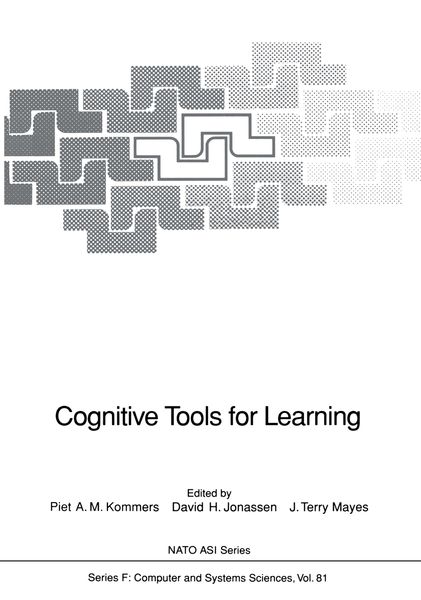
Cognitive Tools for Learning
-
- Taschenbuch ausgewählt
- eBook
-
Sprache:Englisch
97,99 €
inkl. gesetzl. MwSt.,
Lieferung nach Hause
Beschreibung
Produktdetails
Einband
Taschenbuch
Erscheinungsdatum
08.12.2011
Herausgeber
Piet A.M. Kommers + weitereVerlag
Springer BerlinSeitenzahl
282
Maße (L/B/H)
24,2/17/1,7 cm
Gewicht
511 g
Auflage
Softcover reprint of the original 1st ed. 1992
Sprache
Englisch
ISBN
978-3-642-77224-5
outset in the design of software to facilitate human
thinking and learning. This book opens a discussion of the
potential of hypermedia and related approaches to provide
open exploratory learning environments. The papers in the
book are based on contributions to a NATO Advanced Research
Workshop held in July1990 and are grouped into six
sections:
- Semantic networking as cognitive tools,
- Expert systems as cognitive tools,
- Hypertext as cognitive tools,
- Collaborative communication tools,
- Microworlds: context-dependent cognitive tools,
- Implementing cognitive tools.
The book will be valuable for those who design, implement
and evaluate learning programs and who seek to escape from
rigid tactics like programmed instruction and behavioristic
approaches. The book presents principles for exploratory
systems that go beyond existing metaphors of instruction and
provokes the reader to think in a new way about the
cognitive level of human-computer interaction.
Noch keine Bewertungen vorhanden
Verfassen Sie die erste Bewertung zu diesem Artikel
Helfen Sie anderen Kundinnen und Kunden durch Ihre Meinung.
Kurze Frage zu unserer Seite
Vielen Dank für dein Feedback
Wir nutzen dein Feedback, um unsere Produktseiten zu verbessern. Bitte habe Verständnis, dass wir dir keine Rückmeldung geben können. Falls du Kontakt mit uns aufnehmen möchtest, kannst du dich aber gerne an unseren Kund*innenservice wenden.
zum Kundenservice