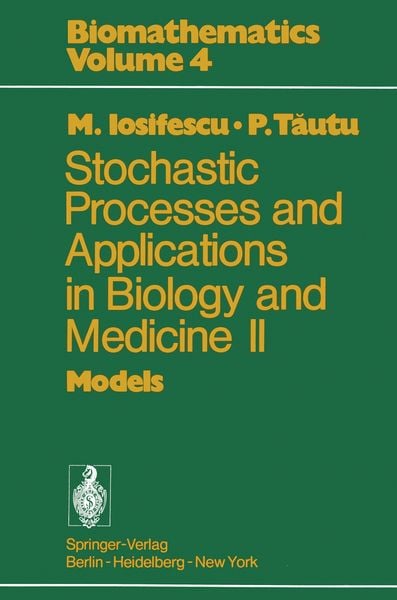
Produktbild: Stochastic processes and applications in biology and medicine II
Band 4

Stochastic processes and applications in biology and medicine II Models

Aus der Reihe Biomathematics

49,99 €

inkl. gesetzl. MwSt., Versandkostenfrei

Lieferung nach Hause

Beschreibung

Produktdetails

Einband

Taschenbuch

Erscheinungsdatum

15.12.2011

Verlag

Springer Berlin

Seitenzahl

338

Maße (L/B/H)

23,5/15,5/1,9 cm

Gewicht

517 g

Auflage

Softcover reprint of the original 1st ed. 1973

Sprache

Englisch

ISBN

978-3-642-80755-8

Beschreibung

Produktdetails

Einband

Taschenbuch

Erscheinungsdatum

15.12.2011

Verlag

Springer Berlin

Seitenzahl

338

Maße (L/B/H)

23,5/15,5/1,9 cm

Gewicht

517 g

Auflage

Softcover reprint of the original 1st ed. 1973

Sprache

Englisch

ISBN

978-3-642-80755-8

Herstelleradresse

Springer-Verlag KG
Sachsenplatz 4-6
1201 Wien
AT

Email: GPSR Kontakt

Noch keine Bewertungen vorhanden

Verfassen Sie die erste Bewertung zu diesem Artikel

Helfen Sie anderen Kundinnen und Kunden durch Ihre Meinung.

Kundinnen und Kunden meinen

Bewertungen (0)

  • Produktbild: Stochastic processes and applications in biology and medicine II
  • 0. Prolegomenon.- 1. Preliminary considerations.- 1.1. Stochastic and deterministic models in biology.- 1.1.1. Comparisons with deterministic models.- 1.1.2. Equipollent and conjunct models.- 1.2. The structure of biological populations.- 1.2.1. Elements of bio-logic.- 1.2.2. Distinguishability and indistinguishability.- 1.2.3. Equivalence relations and graphs.- 1.2.4. Descendants, generations and families.- 1.2.5. The temporal structure of populations and biological objects.- 1.2.6. Characteristic distributions for some biological populations.- 2. Population growth models.- 2.1. Stochastic population processes.- 2.1.1. Point processes as models of stochastic populations.- 2.1.2. Homogeneous birth-and-death processes.- 2.1.3. A random walk example.- 2.1.4. Birth, death and diffusion processes.- 2.2. Population processes in Euclidean space.- 2.2.1. Homogeneous spatial models.- 2.2.2. Birth, death and migration processes in R2 [and R3.- 2.3. Intrinsic processes.- 2.3.1. Multiple-phase processes.- 2.3.2. The life cycle process.- 2.3.3. The birth, death and marks transmission process.- 2.3.4. Interdependent (self)-replicating process.- 2.3.5. Point mutation processes.- 2.4. Stochastic demographic models.- 2.4.1. The discrete time model.- 2.4.2. A model related to human populations.- 2.4.3. Population growth of the sexes.- 2.4.4. The reproductive process.- 2.5. Other growth models and derived processes.- 2.5.1. The cumulative process.- 2.5.2. The Prendiville (logistic) process.- 2.5.3. Some problems of survival and extinction.- 3. Population dynamics processes.- 3.1. Some multi-dimensional Markov jump processes.- 3.1.1. Consael processes.- 3.1.2. A generalized w-dimensional (n ? 2) linear growth process.- 3.2. Immigration-emigration processes.- 3.2.1. The Kendall process.- 3.2.2. Immigration and emigration processes.- 3.2.3. Intermigration and colonization.- 3.2.4. Taxis and kinesis as dispersion processes.- 3.3. Competition processes.- 3.3.1. Some introductory remarks.- 3.3.2. Stochastic competition processes.- 3.3.3. Quasi-competition processes.- 3.3.4. Population excess and cannibalism.- 3.4. Poikilopoiesis models.- 3.4.1. A stochastic approach to embryogenesis.- 3.4.2. Hematopoiesis models.- 4. Evolutionary processes.- 4.1. Basic problems, models and methods.- 4.1.1. Paradigm for the stochastic evolutionary processes.- 4.1.2. Classical genetic stochastic models.- 4.1.3. Tendency to homozygosity.- 4.1.4. Diffusion approximations.- 4.1.5. Non-Mendelian situations.- 4.1.6. Direct product Galton-Watson chains.- 4.2. Random drift and systematic evolutionary processes.- 4.2.1. Random drift.- 4.2.2. Selection.- 4.2.3. Mutation.- 4.3. Problems of molecular genetics.- 4.3.1. Growing point of donor DNA attachment model.- 4.3.2. An example of a random system with complete connections.- 5. Models in physiology and pathology.- 5.1. Stochastic models in physiology.- 5.1.1. Models of the appearance and the transmission of the neural flux.- 5.1.2. Chemical mediation processes.- 5.1.3. Some problems of stochastic networks.- 5.1.4. A model of muscle contraction.- 5.1.5. Renewal processes in pharmacology.- 5.1.6. Multicompartment systems.- 5.2. Models in pathology.- 5.2.1. The process of infection.- 5.2.2. The clinical process.- 5.2.3. Stochastic models for tumour growth.- 5.2.4. Some stochastic aspects of chemotherapy.- 5.2.5. Competing risks of illness.- 5.2.6. Control of biological processes.- 5.3. Epidemic processes.- 5.3.1. The classical models.- 5.3.2. A general approach to epidemics.- 5.3.3. Epidemic Markov chains.- References.- Notation index.- Author index.