
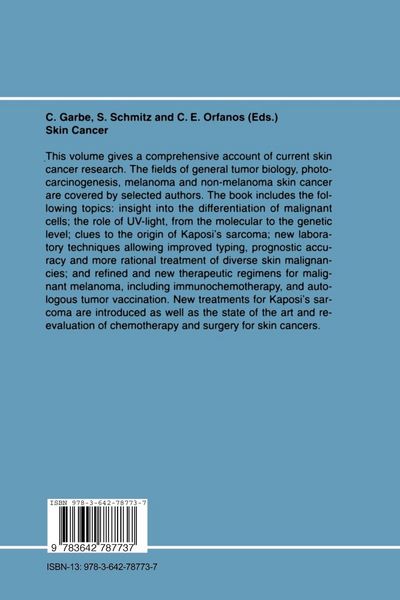
• Produktbild: Skin Cancer: Basic Science, Clinical Research and Treatment
  • Produktbild: Skin Cancer: Basic Science, Clinical Research and Treatment
Band 139

Skin Cancer: Basic Science, Clinical Research and Treatment

97,99 €

inkl. gesetzl. MwSt., Versandkostenfrei

Lieferung nach Hause

Beschreibung

Produktdetails

Einband

Taschenbuch

Erscheinungsdatum

27.12.2011

Herausgeber

Claus Garbe + weitere

Verlag

Springer Berlin

Seitenzahl

440

Maße (L/B/H)

23,5/15,5/2,5 cm

Gewicht

692 g

Auflage

Softcover reprint of the original 1st ed. 1995

Sprache

Englisch

ISBN

978-3-642-78773-7

Beschreibung

Produktdetails

Einband

Taschenbuch

Erscheinungsdatum

27.12.2011

Herausgeber

Verlag

Springer Berlin

Seitenzahl

440

Maße (L/B/H)

23,5/15,5/2,5 cm

Gewicht

692 g

Auflage

Softcover reprint of the original 1st ed. 1995

Sprache

Englisch

ISBN

978-3-642-78773-7

Herstelleradresse

Springer-Verlag KG
Sachsenplatz 4-6
1201 Wien
AT

Email: GPSR Kontakt

Noch keine Bewertungen vorhanden

Verfassen Sie die erste Bewertung zu diesem Artikel

Helfen Sie anderen Kundinnen und Kunden durch Ihre Meinung.

Kundinnen und Kunden meinen

Bewertungen (0)

  • Produktbild: Skin Cancer: Basic Science, Clinical Research and Treatment
  • Produktbild: Skin Cancer: Basic Science, Clinical Research and Treatment
  • I. Carcinogenesis.- Differentiation and Tumor Progression.- Action Spectrum for Photocarcinogenesis.- Processing of Directly and Indirectly Ultraviolet-Induced DNA Damage in Human Cells.- Photodynamic Action of Ultraviolet A: Induction of Cellular Hydroperoxides.- Analysis of N-ras Mutations in Human Cutaneous Melanoma: Tumor Heterogeneity Detected by Polymerase Chain Reaction/Single-Stranded Conformation Polymorphism Analysis.- Skin Cancer and Warts in Immunosuppressed Renal Transplant Recipients.- Risk of Developing Cutaneous Malignant Melanoma in Atypical-Mole Syndrome: New York University Experience and Literature Review.- II. Malignant Melanoma.- Properties of Metastasizing and Nonmetastasizing Human Melanoma Cells.- Protein Patterns of Benign and Malignant Human Melanocytes Show Consistent Changes in Gene Expression.- Mutation and Expression of TP53 in Malignant Melanomas.- Production of Cytokines by Human Melanoma Cells and Melanocytes.- Growth Control of Melanoma Cells and Melanocytes by Cytokines.- Effects of Various Synthetic Retinoids on Proliferation and Immunophenotype of Human Melanoma Cells In Vitro.- Prognostic Significance of DNA Cytometry in Comparison with Histologic Measurements in Malignant Melanomas.- Lymphocyte-Melanoma Interaction: Role of Surface Molecules.- Melanoma Control in the United States: Current Status.- III. Cutaneous Lymphoma.- New Perspectives in Experimental and Clinical Research for Cutaneous T Cell Lymphomas.- Use of Polymerase Chain Reaction in the Detection of Clones in Lymphoproliferative Diseases of the Skin.- bcl-1, bcl-2, p53, c-myc, and lyt-10 Analysis in Cutaneous Lymphomas.- IV. Other Skin Cancers.- Trends in Nonmelanoma Skin Cancer in Japan.- Kaposi’s Sarcoma: A Reevaluation.- Human Leukocyte Antigens and Multiple Basal Cell Carcinomas.- Immunohistochemistry of Eccrine Poroma and Porocarcinoma — More Than Acrosyringeal Tumors?.- V. Treatment and Management.- Excision of Primary Melanoma Should Allow Primary Closure of the Wound.- Role of Elective Lymph Node Dissection in Stage I Malignant Melanoma: Evaluation by Matched Pair Analysis.- Clinical Activity of a Polyvalent Melanoma Antigen Vaccine.- Perspectives of Cytokine Treatment in Malignant Skin Tumors.- Biochemical Modulation of Cytotoxic Drugs by Cytokines: Molecular Mechanisms in Experimental Oncology.- Interleukin-2-Based Immunotherapy and Chemoimmunotherapy in Metastatic Melanoma.- Combination Therapy of Cutaneous T Cell Lymphoma with Interferon Alpha-2a and Photochemotherapy.- Systemic Treatment for Cutaneous Lymphomas.- Extracorporeal Photopheresis — A New Approach for the Treatment of Cutaneous T Cell Lymphomas.- Laser Therapy of Skin Tumors.- Management of Human Immunodeficiency Virus-Associated Malignancies.