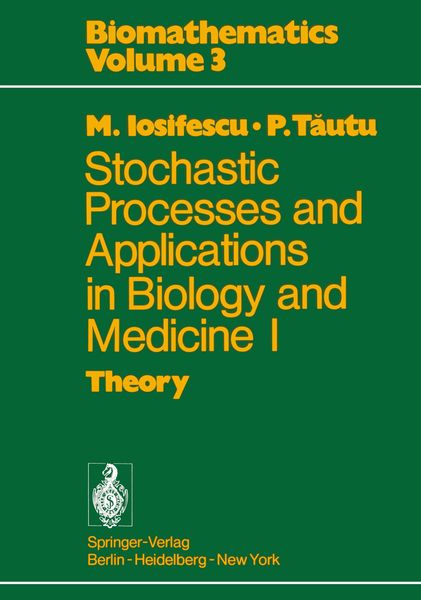

• Produktbild: Stochastic processes and applications in biology and medicine I
  • Produktbild: Stochastic processes and applications in biology and medicine I
Band 3

Stochastic processes and applications in biology and medicine I Theory

Aus der Reihe Biomathematics

49,99 €

inkl. gesetzl. MwSt., Versandkostenfrei

Lieferung nach Hause

Beschreibung

Produktdetails

Einband

Taschenbuch

Erscheinungsdatum

28.01.2012

Verlag

Springer Berlin

Seitenzahl

332

Maße (L/B/H)

23,5/15,5/1,9 cm

Gewicht

505 g

Auflage

Softcover reprint of the original 1st ed. 1973

Sprache

Englisch

ISBN

978-3-642-80752-7

Beschreibung

Produktdetails

Einband

Taschenbuch

Erscheinungsdatum

28.01.2012

Verlag

Springer Berlin

Seitenzahl

332

Maße (L/B/H)

23,5/15,5/1,9 cm

Gewicht

505 g

Auflage

Softcover reprint of the original 1st ed. 1973

Sprache

Englisch

ISBN

978-3-642-80752-7

Herstelleradresse

Springer-Verlag KG
Sachsenplatz 4-6
1201 Wien
AT

Email: GPSR Kontakt

Kundinnen und Kunden meinen

0 Bewertungen

Informationen zu Bewertungen

Zur Abgabe einer Bewertung ist eine Anmeldung im Konto notwendig. Die Authentizität der Bewertungen wird von uns nicht überprüft. Wir behalten uns vor, Bewertungstexte, die unseren Richtlinien widersprechen, entsprechend zu kürzen oder zu löschen.

Die Bewertungen sind nach Format, Anzahl Sterne und Datum sortiert.

Verfassen Sie die erste Bewertung zu diesem Artikel

Helfen Sie anderen Kund*innen durch Ihre Meinung

Kundinnen und Kunden meinen

0 Bewertungen filtern

  • Produktbild: Stochastic processes and applications in biology and medicine I
  • Produktbild: Stochastic processes and applications in biology and medicine I
  • 1 Discrete parameter stochastic processes.- 1.1. Denumerable Markov chains.- 1.1.1. Preliminaries.- 1.1.1.1. Definition of a Markov chain.- 1.1.1.2. The existence theorem.- 1.1.1.3. The n-step transition probabilities.- 1.1.1.4. Strong Markov property.- 1.1.2. Classification of states.- 1.1.2.1. Return states and recurrent states.- 1.1.2.2. Regenerative phenomena.- 1.1.2.3. Positive states and limit theorems.- 1.1.2.4. Geometric ergodicity.- 1.1.2.5. Essential states and classes of states.- 1.1.2.6. Conditional motion.- 1.1.3. Taboo and stationarity.- 1.1.3.1. Taboo transition probabilities.- 1.1.3.2. Ratio limit theorems.- 1.1.3.3. Stationary distributions.- 1.1.3.4. Stationary measures.- 1.1.3.5. Integral representations.- 1.1.4. Finite state Markov chains.- 1.1.4.1. Specific properties.- 1.1.4.2. The matrix method.- 1.1.4.3. The Ehrenfest model.- 1.2. Noteworthy classes of denumerable Markov chains.- 1.2.1. Random walk.- 1.2.1.1. Homogeneous random walk.- 1.2.1.2. Some important special cases.- 1.2.1.3. Barriers.- 1.2.1.4. Generalizations.- 1.2.1.5. Integral representations for certain nonhomogeneous random walks.- 1.2.2. Galton-Watson chains.- 1.2.2.1. Basic properties.- 1.2.2.2. Extinction probability.- 1.2.2.3. Time to extinction.- 1.2.2.4. Stationary distributions and stationary measures.- 1.2.2.5. Spectral theory of Galton-Watson chains.- 1.2.2.6. Asymptotic properties.- 1.2.2.7. Multitype Galton-Watson chains.- 1.2.3. Markov chains occurring in queueing theory.- 1.2.3.1. Preliminaries.- 1.2.3.2. Queueing systems.- 1.2.3.3. An imbedded Markov chain in the M/G/1 queue.- 1.2.3.4. An imbedded Markov chain in the GI/M/1 queue.- 1.3. Markov chains with arbitrary state space.- 1.3.1. Preliminaries.- 1.3.1.1. Definition and existence theorem.- 1.3.1.2. Generalized n-step transition functions.- 1.3.2. Uniform ergodicity.- 1.3.2.1. Uniform strong ergodicity.- 1.3.2.2. Uniform weak ergodicity.- 1.3.3. The coefficient of ergodicity.- 1.3.3.1. Definition and properties.- 1.3.3.2. Application to uniform ergodicity.- 1.3.3.3. Some limit theorems.- 1.3.4. Compact Markov chains.- 1.3.4.1. Definition and properties.- 1.3.4.2. Random systems with complete connections.- References.- 2 Continuous parameter stochastic processes.- 2.1. Some general problems.- 2.1.1. Preliminaries.- 2.1.1.1. Definition of a stochastic process.- 2.1.1.2. Finite dimensional distributions.- 2.1.2. Basic concepts.- 2.1.2.1. Separability.- 2.1.2.2. Stochastic continuity and measurability.- 2.1.3. Trajectories.- 2.1.3.1. Generalities.- 2.1.3.2. Continuous trajectories.- 2.1.3.3. Trajectories without discontinuities of the second kind.- 2.1.4. Convergence of stochastic processes.- 2.1.4.1. Weak convergence of processes.- 2.1.4.2. The Prohorov theorem.- 2.2. Processes with independent increments.- 2.2.1. Preliminaries.- 2.2.1.1. Definition and existence theorem.- 2.2.1.2. Stochastic continuity.- 2.2.2. Basic processes with independent increments.- 2.2.2.1. The Poisson process.- 2.2.2.2. The Wiener process.- 2.2.2.3. Brownian motion.- 2.2.3. General properties.- 2.2.3.1. Integral decomposition.- 2.2.3.2. The three parts decomposition.- 2.3. Markov processes.- 2.3.1. Preliminaries.- 2.3.1.1. Transition functions.- 2.3.1.2. Definition and existence theorem.- 2.3.1.3. The strong Markov property.- 2.3.1.4. The semi-group approach to homogeneous Markov processes.- 2.3.2. Markov jump processes. I. General theory.- 2.3.2.1. Transition intensity functions.- 2.3.2.2. The Kolmogorov-Feller equations.- 2.3.2.3. Determining a transition function from its intensity.- 2.3.2.4. The minimal process.- 2.3.3. Markov jump processes. II. Discrete state space.- 2.3.3.1. The case of a finite state space.- 2.3.3.2. The case of a denumerable state space.- 2.3.3.3. Poisson processes as Markov jump processes.- 2.3.3.4. Markov branching processes.- 2.3.4. Homogeneous Markov jump processes with discrete state space.- 2.3.4.1. Preliminaries.- 2.3.4.2. Continuity and differentiability properties.- 2.3.4.3. The Kolmogorov differential equations.- 2.3.4.4. Continuous parameter regenerative phenomena.- 2.3.4.5. Properties of trajectories.- 2.3.4.6. Discrete skeletons and classification of states.- 2.3.4.7. Birth-and-death processes.- 2.3.5. Markov diffusion processes.- 2.3.5.1. Classical diffusion processes.- 2.3.5.2. The Kolmogorov equations.- 2.3.5.3. Approximations.- 2.3.5.4. Boundaries.- 2.3.5.5. Brownian motion as diffusion process.- 2.3.6. Extensions of Markov processes.- 2.3.6.1. Semi-Markov processes.- 2.3.6.2. Renewal processes.- References.- Notation index.- Author index.