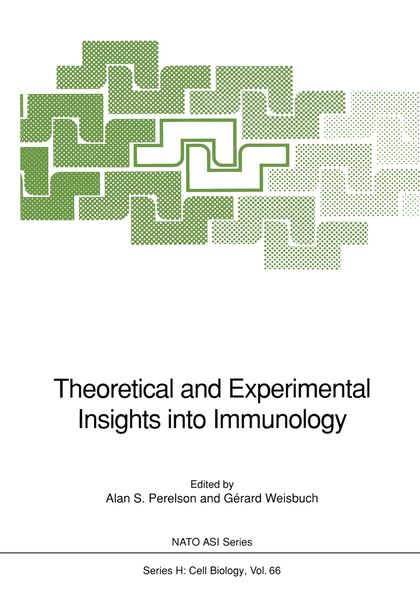
• Produktbild: Theoretical and Experimental Insights into Immunology
  • Produktbild: Theoretical and Experimental Insights into Immunology
Band 66

Theoretical and Experimental Insights into Immunology

Aus der Reihe Nato ASI Subseries H:

175,99 €

inkl. gesetzl. MwSt., Versandkostenfrei


Beschreibung

Produktdetails

Einband

Taschenbuch

Erscheinungsdatum

16.12.2011

Abbildungen

XVIII, 480 p.

Herausgeber

Alan S. Perelson + weitere

Verlag

Springer Berlin

Seitenzahl

480

Maße (L/B/H)

24,2/17/2,8 cm

Gewicht

860 g

Auflage

Softcover reprint of the original 1st ed. 1992

Sprache

Englisch

ISBN

978-3-642-76979-5

Beschreibung

Produktdetails

Einband

Taschenbuch

Erscheinungsdatum

16.12.2011

Abbildungen

XVIII, 480 p.

Herausgeber

Verlag

Springer Berlin

Seitenzahl

480

Maße (L/B/H)

24,2/17/2,8 cm

Gewicht

860 g

Auflage

Softcover reprint of the original 1st ed. 1992

Sprache

Englisch

ISBN

978-3-642-76979-5

Herstelleradresse

Springer-Verlag KG
Sachsenplatz 4-6
1201 Wien
AT

Email: ProductSafety@springernature.com

Noch keine Bewertungen vorhanden

Verfassen Sie die erste Bewertung zu diesem Artikel

Helfen Sie anderen Kundinnen und Kunden durch Ihre Meinung.

Kundinnen und Kunden meinen

Bewertungen (0)

  • Produktbild: Theoretical and Experimental Insights into Immunology
  • Produktbild: Theoretical and Experimental Insights into Immunology
  • I. General Perspectives.- 1. Computer modeling of the immune system: Who are the “fruitori”?.- 2. Is the function of the immune system only to protect?.- 3. The immune system in an evolutionary perspective.- 4. A simulation of the humoral immune system.- 5. Probability of self-nonself discrimination.- 6. Contextual discrimination of antigens by the immune system: Towards a unifying hypothesis.- II. T-Cell Models.- 7. Theoretical insight into antigen-induced T-cell unresponsiveness.- 8. Interaction of interleukin-2 with its cell surface receptors: Interpretation of equilibrium binding experiments via Scatchard plots.- 9. T memory cells in a model of T-cell memory.- 10. A “minimal” basic T-cell model.- 11. Mathematical modeling of Th1-Th2 dynamics.- 12. Complex outcomes in mouse Leishmaniasis: A model for the dynamics of the Th1 response.- III. Networks and Attractors.- 13. Generic modeling of the immune network.- 14. Growth and recruitment in the immune network.- 15. Memory B-cells stabilize cycles in a repressive network.- IV. From Molecular to Cellular Immunology.- 16. Implications of cooperativity and dimensional complexity for immunological recognition.- 17. Shannon information as a measure of amino acid diversity.- 18. Experimental strategies, antigenicity and interpretation of intermolecular interactions.- 19. Receptor-ligand interactions and diffusion effects.- V. Theories and Applications to Clinical Immunology.- 20. Mathematical modeling of the immune response during acute viral infections.- 21. Mimicking the strategy of the immune system: Insight gained from mathematics.- 22. Rash theory.- 23. On second symmetry and AIDS.- 24. Superantigens, alloreactivity, immunological tolerance and AIDS: A unified hypothesis.- 25. Paradoxical effects of suppressorT-cells in adjuvant arthritis: Neural network analysis.- 26. Idiotypic regulation in experimental autoimmune thyroiditis (EAT).- VI. Repertoire Selection.- 27. The secrets of crypticity and its relationship to medical problems: Autoimmune disease, transplantation and cancer.- 28. Role of cryptic self germline encoded Ig epitopes in the selection of the T-cell repertoire.- 29. T-cell repertoire in autoreactive immunoglobulin-transgenic mice.- 30. Experimental and theoretical investigations on idiotypic mimicry.