• Produktbild: Computational Nuclear Physics 2
  • Produktbild: Computational Nuclear Physics 2
- 10%

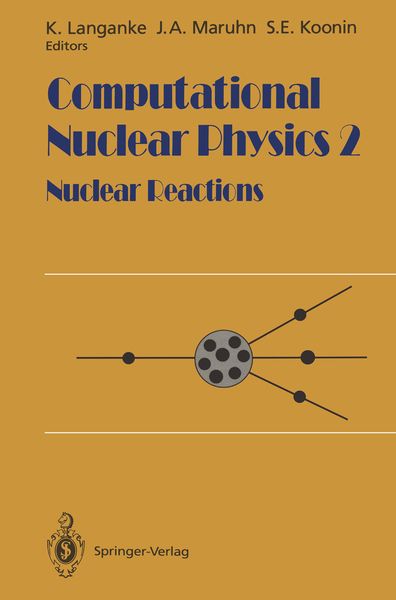
Computational Nuclear Physics 2 Nuclear Reactions

10% sparen

114,99 € UVP 128,39 €

inkl. gesetzl. MwSt., Versandkostenfrei

Lieferung nach Hause

Beschreibung

Produktdetails

Einband

Taschenbuch

Erscheinungsdatum

18.10.2011

Herausgeber

K. Langanke + weitere

Verlag

Springer Us

Seitenzahl

203

Maße (L/B/H)

23,5/15,5/1,3 cm

Gewicht

341 g

Auflage

Softcover reprint of the original 1st ed. 1993

Sprache

Englisch

ISBN

978-1-4613-9337-5

Beschreibung

Produktdetails

Einband

Taschenbuch

Erscheinungsdatum

18.10.2011

Herausgeber

Verlag

Springer Us

Seitenzahl

203

Maße (L/B/H)

23,5/15,5/1,3 cm

Gewicht

341 g

Auflage

Softcover reprint of the original 1st ed. 1993

Sprache

Englisch

ISBN

978-1-4613-9337-5

Herstelleradresse

Springer-Verlag KG
Sachsenplatz 4-6
1201 Wien
AT

Email: ProductSafety@springernature.com

Kundinnen und Kunden meinen

0 Bewertungen

Informationen zu Bewertungen

Zur Abgabe einer Bewertung ist eine Anmeldung im Konto notwendig. Die Authentizität der Bewertungen wird von uns nicht überprüft. Wir behalten uns vor, Bewertungstexte, die unseren Richtlinien widersprechen, entsprechend zu kürzen oder zu löschen.

Die Bewertungen sind nach Format, Anzahl Sterne und Datum sortiert.

Verfassen Sie die erste Bewertung zu diesem Artikel

Helfen Sie anderen Kund*innen durch Ihre Meinung

Kundinnen und Kunden meinen

0 Bewertungen filtern

  • Produktbild: Computational Nuclear Physics 2
  • Produktbild: Computational Nuclear Physics 2
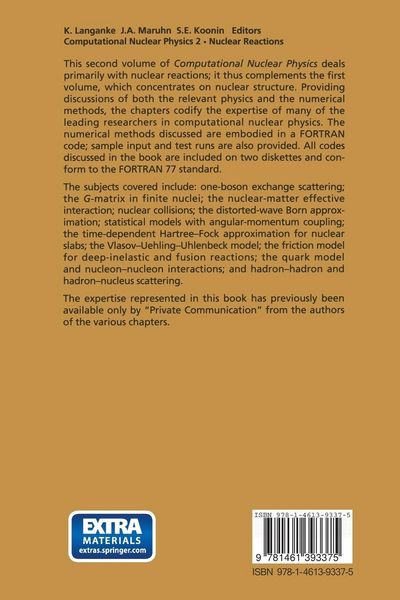
  • 1. One-Boson-Exchange Potentials and Nucleon-Nucleon Scattering.- 1.1 The Meson Theory of Nuclear Forces.- 1.2 Relativistic Two-Nucleon Scattering.- 1.2.1 Covariant Equations.- 1.2.2 The R-Matrix Equation and Helicity State Basis.- 1.2.3 The On-Shell R-Matrix and Phase Shifts.- 1.2.4 Effective Range Parameters.- 1.2.5 Using Thompson’s Equation.- 1.3 One-Boson-Exchange Potentials.- 1.3.1 Interaction Lagrangians and OBE Amplitudes.- 1.3.2 Partial-Wave Decomposition.- 1.3.3 Meson Parameters and Two-Nucleon Predictions.- 1.4 Numerics and Codes.- 1.4.1 Momentum-Space OBEP.- 1.4.2 $$\hat R$$-Matrix and Phase Shifts.- 1.5 Using the Codes.- 1.5.1 OBEP Code BONN.- 1.5.2 Code PHASES.- 1.6 What Else?.- Acknowledgments.- References.- 2. The G-Matrix in Finite Nuclei.- 2.1 Introduction.- 2.2 The G-Matrix, a First Step Towards an Effective NN Interaction.- 2.3 The Solution of the Bethe-Goldstone Equation.- 2.4 Details of the Numerical Calculation.- 2.5 Some Examples for Tests and Studies.- 2.6 Technical Note.- References.- 3. The Nuclear-Matter Effective Interaction.- 3.1 Background.- 3.2 The Bethe-Goldstone Equation in Uniform Matter.- 3.3 The Reference Spectrum Method.- 3.4 The Legindgaard Representation.- 3.5 Numerical Methods.- 3.5.1 The Off-Shell Reference Effective Interaction for a Local Potential.- 3.5.2 The Nuclear Matter Reaction Matrix.- 3.6 Remarks on the Code.- 3.6.1 Input to TREF.- 3.6.2 Output from TREF.- 3.6.3 Input to TNM.- 3.6.4 Output from TNM.- 3.7 Performance.- 3.8 Things to Do.- References.- 4. Microscopic Description of Nuclear Collisions.- 4.1 Introduction.- 4.2 Theoretical Background to the Resonating Group Method.- 4.3 A Short Description of the Numerical Methods Used and the Program Structure.- 4.4 Installation and Use of the Codes.- 4.5 Physical Applications.- 4.6 Technical Note.- References.- 5. The Distorted-Wave Born Approximation.- 5.1 General Description of DWUCK4.- 5.2 Specific Cases of Reactions.- 5.2.1 Inelastic Excitation Using a Collective Nuclear Model.- 5.2.2 The (d,p) Stripping Reaction.- 5.2.3 The (p,d) Pickup Reaction.- 5.2.4 The Microscopic Interaction Model for Inelastic Scattering.- 5.3 Description of the Input for DWUCK4.- 5.4 Sample Cases-Input and Output.- 5.5 Things to Do.- 5.6 Technical Note.- References.- 6. Statistical-Model Calculations with Angular-Momentum Coupling.- 6.1 Background.- 6.2 Basic Features of the Code.- 6.3 Level-Density Tables.- 6.4 Transmission Coefficients.- 6.5 Fission Barrier and Probability.- 6.6 Angular Distribution.- 6.7 Special Programming Features.- 6.8 Input and Output Files.- 6.9 Summary.- 6.10 Technical Note.- References.- 7. The Time-Dependent Hartree-Fock Approximation for Nuclear Slabs.- 7.1 Background.- 7.2 Interaction.- 7.3 Reduction to One Dimension.- 7.4 Numerical Methods.- 7.4.1 The Static Problem.- 7.4.2 The Dynamic Problem.- 7.5 Remarks on the Code.- 7.5.1 Input.- 7.5.2 Output.- 7.6 Running the Code.- 7.7 Things to Do.- References.- 8. The Vlasov-Uehling-Uhlenbeck Model.- 8.1 Introduction.- 8.2 Theoretical Description of Heavy-Ion Collisions.- 8.3 The VUU Equation.- 8.4 The Nuclear Equation of State.- 8.5 Numerical Realization.- 8.6 The Basic Structure of the Program.- 8.7 Running the Program.- 8.7.1 Compilation and Linking.- 8.7.2 Input.- 8.8 Input Examples.- 8.9 Interpretation of the Output.- 8.10 Output Analysis with VUUANL.- 8.11 Final Comments on Using the Program.- 8.12 Test Output.- References.- 9. The Friction Model for Deep-Inelastic and Fusion Reactions.- 9.1 Introduction.- 9.2 Description of the Program.- 9.2.1 FOLDING.- 9.2.2 FIT.- 9.2.3 FRICTION.- 9.3 The Structure of the Final Printout File.- 9.4 Running the Code with the Sample Input.- References.- 10. The Quark Model and the Nucleon-Nucleon Interaction.- 10.1 Introduction.- 10.2 The Resonating Group Method.- 10.3 The Hamiltonian of the Six-Quark System.- 10.4 Remarks on the Code.- 10.4.1 General Structure of the Program.- 10.4.2 Input Parameters.- 10.4.3 Output of the Code.- 10.4.4 Library Routines.- 10.4.5 Performance.- 10.4.6 Sample Parameters and Exercises.- 10.5 Technical Note.- References.- 11. Hadron-Hadron and Hadron-Nucleus Scattering.- 11.1 Introduction.- 11.2 Multiple Scattering Off Nuclei.- 11.2.1 General Formalism.- 11.2.2 Numerical Methods.- 11.2.3 Program Description MUSH (Multiple Scattering of Hadrons) and Performance.- 11.2.4 Discussion of the Results.- 11.3 Hadronic Interactions in the Quark Model.- 11.3.1 Definition of the Model.- 11.3.2 Solution of the 4-Quark Problem.- 11.3.3 Calculational Methods.- 11.3.4 Numerical Methods.- 11.3.5 Program Description QUASH (Quarks and Hadron Scattering) and Performance.- 11.3.6 Discussion of the Results.- 11.4 Conclusion.- 11.5 Technical Note.- References.