KI-Beratung Beta

  • Produktbild: Radar Absorbing Materials
  • Produktbild: Radar Absorbing Materials

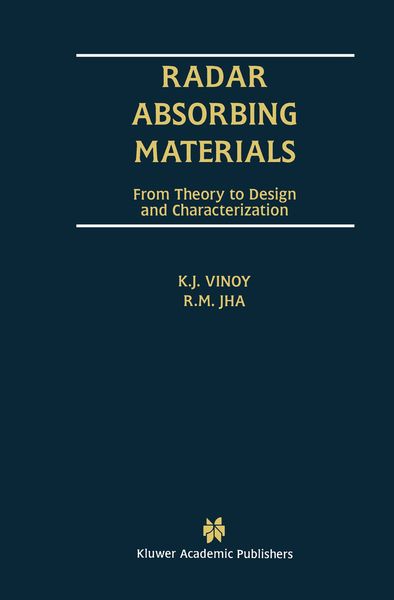
Radar Absorbing Materials From Theory to Design and Characterization

175,99 €

inkl. gesetzl. MwSt., Versandkostenfrei


Beschreibung

Due to its extensive applications in stealth technology, much of the research effort in radar absorbing materials (RAM) has remained classified. As is the wont with classified topics, it has resulted in much awe and unfounded speculation. The aim of this book is to demystify this topic. The book in hand...

Beschreibung

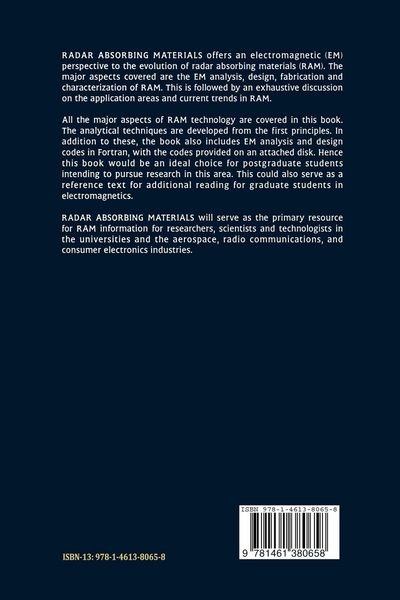
Due to its extensive applications in stealth technology, much of the research effort in radar absorbing materials (RAM) has remained classified. As is the wont with classified topics, it has resulted in much awe and unfounded speculation. The aim of this book is to demystify this topic. The book in hand is concise but complete in itself. The attention of the readers is first drawn towards the historical evolution of RAM to emphasize that the elementary principles of electromagnetics lead to the fundamental concepts of RAM. These also form the basis for further mathematical analysis and design of RAM. The performance plots for the various RAM designs, to the extent possible, are taken with respect to power reflection; this should facilitate comparison of their relative performances. In order to further induce the reader to take the first step towards RAM design, we have included the relevant computer codes in a companion diskette. This would enable the reader to try out elementary designs on his own. * .EXE files should facilitate ready execution of codes on most DOS based computing platforms. The corresponding source codes with comments are also included as * .FOR files. The reader may wish to modify some of these codes for examining RAM design algorithms further. We welcome comments from the reader on these codes.

Produktdetails

Einband

Taschenbuch

Erscheinungsdatum

21.09.2011

Abbildungen

208 p.

Verlag Springer Us

Produktdetails

Einband

Taschenbuch

Erscheinungsdatum

21.09.2011

Abbildungen

208 p.

Verlag Springer Us
Seitenzahl

208

Maße (L/B/H)

23,5/15,5/1,2 cm

Gewicht

324 g

Auflage

Softcover reprint of the original 1st ed. 1996

Sprache

Englisch

ISBN

978-1-4613-8065-8

Herstelleradresse

Springer-Verlag KG
Sachsenplatz 4-6
1201 Wien
AT

Email: ProductSafety@springernature.com

Noch keine Bewertungen vorhanden

Verfassen Sie die erste Bewertung zu diesem Artikel

Helfen Sie anderen Kundinnen und Kunden durch Ihre Meinung.

Kundinnen und Kunden meinen

Bewertungen (0)

  • Produktbild: Radar Absorbing Materials
  • Produktbild: Radar Absorbing Materials
  • 1 Introduction.- 1.1 Concepts in Radar Cross Section.- 1.2 RCS and Radar Range Equation.- 1.3 Stealth Techniques.- 1.4 RAM and its Ideal Requirements.- 1.5 A Historical Perspective to the Evolution of RAM.- 1.6 Organization of the Book.- 1.7 Summary.- References.- 2 Fundamental Electromagnetic Concepts for RAM.- 2.1 Maxwell’s Equations.- 2.2 Surface Boundary Conditions.- 2.3 Constitutive Relations and Features of the Medium.- 2.4 EM Wave Propagation.- 2.5 EM Parameters for Radar Absorbing Materials.- 2.6 Summary.- References.- 3 Mathematical Analysis for RAM on Surfaces.- 3.1 Electromagnetic Reflections at Planar Boundary.- 3.2 Analysis of RAM on Curved Surfaces.- 3.3 Grid Based Methods.- 3.4 High Frequency Methods.- 3.5 Summary.- References.- 4 Electromagnetic Design of RAM.- 4.1 Narrowband Absorbers.- 4.2 Broadband Absorbers.- 4.3 Realization of RAM in Practice.- 4.4 Summary.- References.- 5 Absorber Characterization Techniques.- 5.1 Measurement of Material Properties.- 5.2 Free Space Techniques.- 5.3 Summary.- References.- 6 Identification and Applications of RAM.- 6.1 Classification of RAM.- 6.2 Applications in Defense.- 6.3 Applications in Antenna Engineering.- 6.4 Applications in Microwave Components.- 6.5 Applications in Consumer Electronics.- 6.6 Summary.- References.- 7 Trends in RAM.- 7.1 Operational Bandwidth.- 7.2 Analytical Techniques.- 7.3 Design Algorithms.- 7.4 Broadband Characterization Methods.- 7.5 Novel Constructions.- 7.6 Summary.- References.- List of Symbols.- Suggestions for Further Reading.- Author Index.