Gutscheinbedingungen

**Gültig bis 10.06.2026 / Gültig für gebrauchte Bücher / Mindestbestellwert 20,00 € / Einzelne Artikel können ausgeschlossen sein / Online auf www.bücher.de.de / Nicht kombinierbar mit anderen Gutscheinen oder Preisaktionen / Nur einmal pro Einkauf einlösbar / Gutschein wird auf max. 500€ Bestellwert angerechnet / Keine Barauszahlung / Nicht gültig für Versandkosten und Services

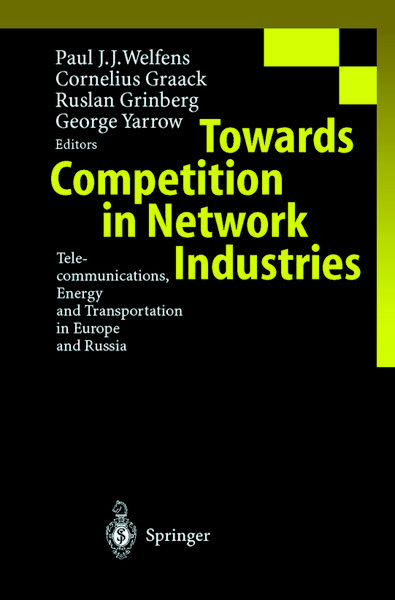
  • Produktbild: Towards Competition in Network Industries
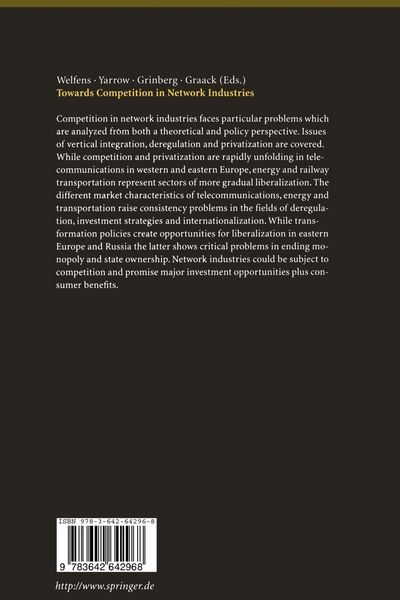
  • Produktbild: Towards Competition in Network Industries

Towards Competition in Network Industries Telecommunications, Energy and Transportation in Europe and Russia

97,99 €

inkl. gesetzl. MwSt., Versandkostenfrei

Lieferung nach Hause

Beschreibung

Produktdetails

Einband

Taschenbuch

Erscheinungsdatum

25.01.2012

Herausgeber

Paul J.J. Welfens + weitere

Verlag

Springer Berlin

Seitenzahl

570

Maße (L/B/H)

23,5/15,5/3,2 cm

Gewicht

889 g

Auflage

Softcover reprint of the original 1st ed. 1999

Sprache

Englisch

ISBN

978-3-642-64296-8

Beschreibung

Portrait

Paul J. J. Welfens, geb. 1957 in Düren, Studium der Volkswirtschaftslehre in Wuppertal, Duisburg und Paris, Promotion 1985, Habilitation1989. Inhaber des Lehrstuhls für Volkswirtschaftslehre - Schwerpunkt Makroökonomische Theorie und Politik an der Bergischen Universität Wuppertal; Präsident des Europäischen Instituts für Internationale Wirtschaftsbeziehungen (EIIW); Jean-Monnet-Professor für Europäische Wirtschaftsintegration; zuvor Distinguished Research Fellow am AICGS/The Johns Hopkins University, Professor an der Universität Münster bzw. Potsdam, Visiting Alfred Grosser Professor Sciences Po, Paris.

Produktdetails

Einband

Taschenbuch

Erscheinungsdatum

25.01.2012

Herausgeber

Verlag

Springer Berlin

Seitenzahl

570

Maße (L/B/H)

23,5/15,5/3,2 cm

Gewicht

889 g

Auflage

Softcover reprint of the original 1st ed. 1999

Sprache

Englisch

ISBN

978-3-642-64296-8

Herstelleradresse

Springer-Verlag GmbH
Tiergartenstr. 17
69121 Heidelberg
DE

Email: ProductSafety@springernature.com

Kundinnen und Kunden meinen

0 Bewertungen

Informationen zu Bewertungen

Zur Abgabe einer Bewertung ist eine Anmeldung im Konto notwendig. Die Authentizität der Bewertungen wird von uns nicht überprüft. Wir behalten uns vor, Bewertungstexte, die unseren Richtlinien widersprechen, entsprechend zu kürzen oder zu löschen.

Die Bewertungen sind nach Format, Anzahl Sterne und Datum sortiert.

Verfassen Sie die erste Bewertung zu diesem Artikel

Helfen Sie anderen Kund*innen durch Ihre Meinung

Kundinnen und Kunden meinen

0 Bewertungen filtern

  • Produktbild: Towards Competition in Network Industries
  • Produktbild: Towards Competition in Network Industries
  • Introduction.- Deregulation and Market Dynamics in Telecommunications: P.J.J. Welfens: Competition, Privatization and Foreign Direct Investment.- Introduction.- Network Theory, Technological Progress and Competition.- Competition and Privatization.- Foreign Direct Investment in Network Industries.- Conclusions.- P. Ruys: Comments.- P. Jasinski: Privatizsation, Competition and Regulation in Transforming Economies: The Cases of the Electricity Supply Industry and Telecommunications.- Introduction.- Competition and Regulation in STEs.- Systemic Transformation.- Regulation Sensu Largo.- Regulation Sensu Stricto.- The ESI and Telecommunications.- H. Brezinski: Comments.- C. Graack: Deregulation, Privatization and Internationalization of European Telecoms Markets.- Introduction.- Developments on the National Level of EU Member States.- Impacts of the Liberalization and Privatization Process on EU Telecoms Market Structures.- Conclusions.- D. Elixmann: Comments.- M. Andersson: Full Competition in Telecommunications: The Experience of Finland.- J. Spindler: Full Competition in Telecommunications: The US Perspective.- Introduction.- The Telecom Act - Key Principles.- Rollout of the Trilogy.- How the Trilogy Principles Apply to Other Countries.- 'Best Practices' for Other Countries.- G. Knieps: Market Entry in the Presence of a 'Dominant' Network Operator in Telecommunications.- Introduction.- Excessive Regulation Due to an Oversized Regulatory Basis.- The Necessity for a Symmentric Regulatory Approach.- The Dangers of an Inadequate Application of Regulatory Rules Bases on the Concept of Dominant Network Carriers.- J. Müller: Comments.- Is Market Power Regulation Enough?.- Wil Contestable Markets be Competitive?.- Implementing Regulation.- Is Structural RegulationNecessary?.- M. Falch: Electricity Companies and Railway Networks as Newcomers in Telecommunications.- Introduction.- Current Competition from the Network Facilities of Railway and Electricity Companies.- The Cost Structure of a Telecoms Network.- The Role of Investment Costs.- Changing Demand Conditions.- Conditions for Effective Competition.- Conclusion.- O. Lorz: Comments.- J. Kubasik: Liberalization of Telecommunications in Central Europe.- Introduction.- The Need for Changes.- Objectives in Restructuring the Telecommunications Sector.- Networks Developments.- Regulation: Opening Up Competition.- Liberalization in Practice: The Example of Poland.- Privatization of the National Network Operator: Different Methods.- Conclusions.- S. Petuhova, A. Vronez: Regulation of the Telecommunication Sector in Russia: Direct Foreign Investments and Options for Competition.- Introduction.- System of Control and Regulation in the Telecommunication Complex.- Economic Indicators of Business Activity within the Telecom Sector.- Direct Foreign Investments in Development of the Communications Branch.- Prospects for Telecommunications Development in Russia.- Conclusion.- W. Pfaffenberger: Comments.- R. Grinberg: Systemic Transformation and Direct Foreign Investment in Russia: Problems and Solutions.- Market Reforms and Macroeconomic Stabilization in the Central and Eastern European Countries and Russia: Comparing Intermediate Results.- The Climate of Investment in Russia: Analysis and Conclusions.- Foreign Direct Investment in Russia.- Regulation and Management of Foreign Investment in Russia.- Perfection and Development of Interaction with Foreign Capital.- H. Brücker: Comments.- Introduction.- Why has Stabilisation Failed in Russia?.- Was Privatisation and Institutional Reform a Failure?.- FDI: Is the Glass Half Full or Half Empty?.- Are