• Produktbild: Macroeconomics and New Macroeconomics
  • Produktbild: Macroeconomics and New Macroeconomics
- 12%

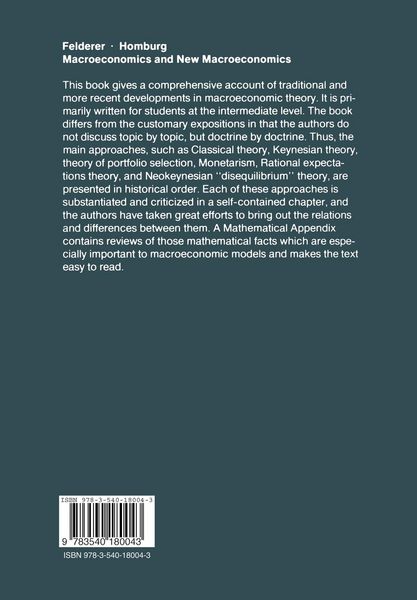
Macroeconomics and New Macroeconomics

12% sparen

74,99 € UVP 85,55 €

inkl. gesetzl. MwSt., Versandkostenfrei

Lieferung nach Hause

Beschreibung

Produktdetails

Einband

Taschenbuch

Erscheinungsdatum

20.07.1987

Verlag

Springer Berlin

Seitenzahl

332

Maße (L/B/H)

24,4/17/1,9 cm

Gewicht

601 g

Auflage

1

Sprache

Englisch

ISBN

978-3-540-18004-3

Beschreibung

Produktdetails

Einband

Taschenbuch

Erscheinungsdatum

20.07.1987

Verlag

Springer Berlin

Seitenzahl

332

Maße (L/B/H)

24,4/17/1,9 cm

Gewicht

601 g

Auflage

1

Sprache

Englisch

ISBN

978-3-540-18004-3

Herstelleradresse

Springer-Verlag GmbH
Tiergartenstr. 17
69121 Heidelberg
DE

Email: GPSR Kontakt

Noch keine Bewertungen vorhanden

Verfassen Sie die erste Bewertung zu diesem Artikel

Helfen Sie anderen Kundinnen und Kunden durch Ihre Meinung.

Kundinnen und Kunden meinen

Bewertungen (0)

  • Produktbild: Macroeconomics and New Macroeconomics
  • Produktbild: Macroeconomics and New Macroeconomics
  • Definitions of Variables.- One. Fundamentals.- I. Some Methodological Considerations.-
    1 Economic Theories.-
    2 Economic Models.-
    3 Methods.-
    4 Equilibrium and Disequilibrium. Stability.-
    5 Statics, Comparative Statics, and Dynamics.-
    6 Ex Post versus Ex Ante Analysis.-
    7 Partial versus Total Analysis. The Ceteris Paribus Clause.-
    8 Microeconomics versus Macroeconomics.- II. A Historical Survey.-
    9 The Predecessors.-
    10 The Classical Economists.-
    11 The Neoclassical Economists.-
    12 From Keynes to the Present.- Further Reading.- III. National Income Accounting.-
    13 The Economy as a Circular Flow.-
    14 The Circular Flow-Model of François Quesnay.-
    15 The System of Income Accounts.-
    16 Notions of Income in the System of Income Accounts.- Two. Macroeconomics.-
    17 Introduction to Part Two.- IV. The Classical Theory.-
    18 The Classical Vision. Plan of the Chapter.-
    19 Production Functions.-
    20 The Firms.-
    21 The Households.-
    22 The Labor Market.-
    23 The Capital Market.-
    24 The Commodity Market.-
    25 The Quantity Theory of Money.-
    26 Say’s Law.-
    27 The Classical Model.-
    28 Digression: Walras’ Model.-
    29 Conclusion.- Further Reading.- V. The Keynesian Theory.-
    30 The Crisis.-
    31 The “General Theory” and Its Interpreters.-
    32 The Effective Demand.-
    33 Consumption Demand.-
    34 Investment Demand.-
    35 The Income-Expenditure Model.-
    36 The Simple Multiplier.-
    37 The Markets for Money and Bonds. The LM Curve.-
    38 The Capital Market. The IS Curve.-
    39 The IS/LM Model.-
    40 The Complete Keynesian Model.-
    41 First Scenario: The Investment Trap.-
    42 Second Scenario: The Liquidity Trap.-
    43 An Under-employment Equilibrium with a Flexible Real Wage?.-
    44 Third Scenario: Sticky Wages.-
    45 Conclusion.- Further Reading.- VI. Political Implications: A Comparison.-
    46 The Role of Government. Goals and Means of Economic Policy.-
    47 Fiscal Policy.-
    48 Fiscal Policy in the Classical Case.-
    49 Fiscal Policy in the Complete Keynesian Case.-
    50 Fiscal Policy with an Investment or Liquidity Trap.-
    51 Fiscal Policy with Sticky Wages.-
    52 The Concept of Counter-cyclical Fiscal Policy.-
    53 Monetary Policy.-
    54 Monetary Policy in the Classical Case.-
    55 Monetary Policy in the Complete Keynesian Case.-
    56 Monetary Policy with an Investment or Liquidity Trap.-
    57 Monetary Policy with Sticky Wages.-
    58 Conclusion.- Further Reading.- Three. New Macroeconomics.-
    59 Introduction to Part Three.- VII. The Real-Balance Effect.-
    60 A Criticism of Classical Monetary Theory.-
    61 A Criticism of Keynesian Monetary Thoery.-
    62 Conclusion.- Further Reading.- VIII. The Theory of Portfolio Selection.-
    63 Microeconomic Foundations.-
    64 Macroeconomic Applications.-
    65 Conclusion.- Further Reading.- IX. Monetarism.-
    66 The Theoretical Foundations, or: Monetarism versus Keynesianism.-
    67 The Empirical Investigations, or: Monetarism versus Fiscalism.-
    68 The Political Inferences, or: Monetarism versus Activism.-
    69 Conclusion.- Further Reading.- X. New Classical Economics.-
    70 Expectations and Rational Expectations.-
    71 The Phillips-Curve. Stagflation.-
    72 The New Classical Vision.-
    73 The New Classical Model.-
    74 Political Inferences.-
    75 Conclusion.- Further Reading.- XI. Neokeynesian Theory.-
    76 The Evolution of Neokeynesian Economics.-
    77 The Dual Decision Hypothesis.-
    78 The Logic of the Fix Price-Method.-
    79 A Reconsideration of the Consumption Function.-
    80 The Neokeynesian Model.-
    81 Political Inferences.-
    82 Walras’ Law with Quantity Constraints.-
    83 Conclusion.- Further Reading.- Mathematical Appendix.- 1. Calculus of Functious of a Single Variable.- 1.1 Functions of a Single Variable.- 1.2 Derivatives.- 1.3 Taylor’s Theorem.- 1.4 Differentials.- 1.5 Concavity and Convexity.- 1.6 Maxima and Minima.- * 1.7 Profit Maximization.- 2. Linear Algebra.- 2.1 Vectors.- 2.2 Matrices and Determinants.- 2.3 Simultaneous Linear Equations.- 2.4 Characteristic Value Problems.- 2.5 Quadratic Forms.- 3. Calculus of Functious of Several Variables.- 3.1 Functions of Several Variables.- 3.2 Partial Derivatives. Gradients.- 3.3 Chain Rule.- 3.4 Taylor’s Theorem.- 3.5 Partial and Total Differentials.- 3.6 Concavity and Convexity.- 3.7 Maxima and Minima.- 3.8 Maxima and Minima under Constraints.- * 3.9 Profit Maximization.- 4. Implicit Functious.- 4.1 Explicit and Implicit Functions.- 4.2 Implicit Differentiation with Two Variables.- 4.3 Implicit Function Theorem.- * 4.4 The Slope of Equilibrium Loci.- * 4.5 Properties of Demand Functions.- * 4.6 Fiscal Policy in the Keynesian Model.- 5. Ordinary Differential Equatious.- 5.1 Function Equations and Functional Equations.- 5.2 Solution of a Linear Differential Equation.- * 5.3 Stability of a Market.- 5.4 Solution of Simultaneous Differential Equations.- * 5.5 Stability of the IS/LM Model.- * 5.6 Stability of the Neokeynesian Model.- Further Reading.- Author Index.