• Produktbild: Lectures on Photomorphogenesis
  • Produktbild: Lectures on Photomorphogenesis

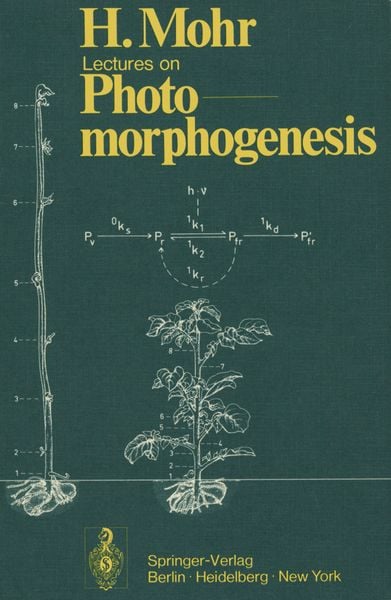
Lectures on Photomorphogenesis

49,99 €

inkl. gesetzl. MwSt., Versandkostenfrei

Lieferung nach Hause

Beschreibung

Produktdetails

Einband

Taschenbuch

Erscheinungsdatum

03.11.1972

Verlag

Springer Berlin

Seitenzahl

240

Maße (L/B/H)

24,4/17/1,5 cm

Gewicht

448 g

Sprache

Englisch

ISBN

978-3-540-05879-3

Beschreibung

Produktdetails

Einband

Taschenbuch

Erscheinungsdatum

03.11.1972

Verlag

Springer Berlin

Seitenzahl

240

Maße (L/B/H)

24,4/17/1,5 cm

Gewicht

448 g

Sprache

Englisch

ISBN

978-3-540-05879-3

Herstelleradresse

Springer-Verlag KG
Sachsenplatz 4-6
1201 Wien
AT

Email: GPSR Kontakt

Noch keine Bewertungen vorhanden

Verfassen Sie die erste Bewertung zu diesem Artikel

Helfen Sie anderen Kundinnen und Kunden durch Ihre Meinung.

Kundinnen und Kunden meinen

Bewertungen (0)

  • Produktbild: Lectures on Photomorphogenesis
  • Produktbild: Lectures on Photomorphogenesis
  • 1st Lecture: Phenomenology of Photomorphogenesis; the Goals of Photomorphogenic Research; the Operational Criteria for the Involvement of Phytochrome.- Selected Further Reading.- 2nd Lecture: Some Properties of Phytochrome.- Selected Further Reading.- 3rd Lecture: Intracellular Localization of Phytochrome.- Selected Further Reading.- 4th Lecture: Induction Experiments Versus Steady State Experiments; the Problem of the “High Irradiance Response” (HIR).- 1. Some Phenomena.- 2. Some Conclusions.- 3. Control of Hypocotyl Lengthening in Lettuce (Lactuca sauva L., cv. Grand Rapids) as a Prototype of a “High Irradiance Response”.- 4. Further Applications of Hartmann’s Technique.- 5. The Action of Blue Light in “Long-term” Experiments.- 6. Sequential Action of “High Irradiance Reaction” and Pfr (in the Ground State)?.- 7. HIR and Photosynthesis.- 8. Operational Definitions (Criteria) for the Involvement of Phytochrome in a Response.- Selected Further Reading.- 5th Lecture: Phytochrome and the Diversity of Photoresponses; “Positive” and “Negative” Photoresponses; a Unifying Hypothesis.- Selected Further Reading.- 6th Lecture: Phytochrome-mediated Enzyme Induction.- Suggested Further Reading.- 7th Lecture: Enzyme Repression, Mediated by Phytochrome through a Threshold Mechanism.- Selected Further Reading.- 8th Lecture: Phytochrome-mediated Modulation of Metabolic Steady States and of Photonastic Movements.- 1. Ascorbic Acid Synthesis.- 2. Carotenoid Synthesis.- 3. The Problem of the “Lag-phases”.- 4. Modulations of Specialized Cells.- Selected Further Reading.- 9th Lecture: Control of Longitudinal Growth by Phytochrome.- 1. General Remarks.- 2. Interaction or no Interaction between Phytochrome and Gibberellic Acid (GA3) in Control of Hypocotyl Elongation in Mustard Seedlings.- 3. Is RNA and Protein Synthesis Related to Phytochrome-mediated Control of Longitudinal Cell Growth?.- 4. Is Carbohydrate Metabolism Related to Control of Longitudinal Cell Growth?.- 5. Control by Far-red Light of Hypocotyl Lengthening in Diploid Tetraploid Seedlings.- 6. Conclusion.- Selected Further Reading.- 10th Lecture: Modulation of Hypocotyl Longitudinal Growth by Pfr (ground state) through a Threshold Mechanism.- 1. Experimental Data.- 2. Theoretical Treatment.- 3. Growth-limiting Proteins.- 4. A Final Comment.- Appendix: On the Use of Excised Segments in Phytochrome Research.- Selected Further Reading.- 11th Lecture: The Problem of the Primary Reaction of Phytochrome.- 1. Different Pfr Populations.- 2. Polarotropism of Fern Sporelings.- 3. Threshold Regulation of Lipoxygenase Synthesis vs. Phytochrome-mediated Anthocyanin Synthesis as a Graded Response.- 4. Control by Pfr (ground state) of Extension Growth and Anthocyanin Synthesis in One and the Same Cell.- 5. Control by Pfr of Ascorbic Acid and Anthocyanin Accumulation in the Mustard Seedling.- 6. Control of PAL (Phenylalanine Ammonia-lyase) and AO (Ascorbate Oxidase) Synthesis in the Mustard Seedling.- 7. General Conclusions.- 8. Tentative Models.- 9. The Significance of Acetylcholine.- 10. NAD Kinase and Phytochrome.- Appendix: On the Mechanism of the “High Irradiance Response”.- Suggested Further Reading.- 12th Lecture: Interaction between Phytochrome and Hormones.- 1. Induction of Amylase by Pfr.- 2. Induction of Peroxidase by Pfr.- Suggested Further Reading.- 13th Lecture: The Double Function of Phytochrome in Mediating Anthocyanin and Enzyme Synthesis.- 1. Anthocyanin Synthesis.- 2. Enzyme Synthesis.- Appendix 1 : Function of Pfr in Ascorbic Acid Synthesis.- Appendix 2: Induction of Nitrate-reductase in Corn Leaves.- Suggested Further Reading.- 14th Lecture: Repression of Lipoxygenase Synthesis by Pfr: The Problem of Primary and Secondary Differentiation.- 1. Threshold Regulation of Lipoxygenase Synthesis : A Recapitulation.- 2. Some Experiments to Validate the Concept of the Double-action Control Mechanism in Development.- 3. Some Related Phenomena in Animal Physiology.- 4. Primary and Secondary Differentiation in Anthocyanin Synthesis.- 5. Further Approaches to the Problem.- Suggested Further Reading.- 15th Lecture: Light-mediated Flavonoid Synthesis: A Biochemical Model System of Differentiation.- 1. The Starting Point.- 2. Phytochrome-mediated Anthocyanin Synthesis in the Mustard Seedling as a Model System for Secondary Differentiation.- 3. Flavone Glycoside Synthesis in Cell Suspension Cultures of Parsley as a Model System for Primary and Secondary Differentiation.- 4. Some General Remarks.- Appendix: Phytochrome-mediated Anthocyanin Synthesis as a Model System for Two-factor Analysis (Multiplicative Calculation).- Suggested Further Reading.- 16th Lecture: Control of Distinct Enzymes (PAL, AO) in Different Organs of a Plant (Mustard Seedling).- 1. The Problem.- 2. The Advantages of the Experimental System Used for these Investigations.- 3. PAL: Results and Conclusions.- 4. Ascorbate Oxidase (AO): Results and Conclusions.- Suggested Further Reading.- 17th Lecture: Energetics of Morphogenesis.- 1. The Background.- 2. The Hypothesis.- 3. General Conclusions.- 4. Etiolation as an Adaptive Trait.- 5. The Rapidity of Regressive (or Degenerative) Evolution.- 6. A Final Speculation.- Suggested Further Reading.- 18th Lecture: Control of Plastogenesis by Phytochrome.- 1. The System: Cotyledons of the Mustard Seedling.- 2. The Aim of the Present Investigations.- 3. Some Histological Data.- 4. Control of Plastid Development by Phytochrome.- 5. Control of Carotenoid Synthesis by Phytochrome.- 6. Control of Galactolipid Biosynthesis by Phytochrome.- 7. Control of Galactosyltransferase by Phytochrome.- 8. Control of Glyceraldehyde-3-phosphate Dehydrogenase (GPD) by Phytochrome.- 9. Control of Chlorophyll Synthesis by Phytochrome.- a) Basic Phenomena and the Leading Model at Present.- b) Feeding ?-ALA to Mustard Seedlings.- c) Control of Protochlorophyll (PChl) and Chlorophyll a (Chla) Accumulation by Phytochrome.- Suggested Further Reading.- Appendix: Phytochrome-mediated Control of Peroxisome Enzymes.- Suggested Further Reading.- 19th Lecture: Phytochrome and Flower Initiation.- 1. Definitions.- 2. Involvement of Phytochrome.- 3. Interaction between Phytochrome and Endogenous Rhythms.- 4. The “Primary Action of Pfr” in Connection with Flower Initiation.- 5. Photoperiodic Effects on Vegetative Characteristics.- Suggested Further Reading.- 20th Lecture: Phytochrome and Seed Germination.- 1. Operational Criteria for the Involvement of Pfr(ground state) in Seed Germination.- 2. The Inhibitory Effect of Long-term Far-red Light on Seed Germination.- 3. Direct Phytochrome Measurements in Seed.- 4. The “Mechanism” of Germination.- Suggested Further Reading.- 21st Lecture: Examples of Blue-light-mediated Photomorphogenesis.- 1. Blue Light and the Phytochrome System.- 2. Light-dependent Carotenoid Synthesis in Fusarium aquaeductuum.- 3. Polarotropism in Filamentous Germlings of the Liverwort Sphaerocarpus donnellii.- 4. The Light Growth Response in the Sporangiophore of the Fungus Phycornyces.- 5. General Conclusions.- 6. Photomorphogenesis in Fern Gametophytes.- a) Basic Phenomena.- b) The Problem of the Photoreceptor.- c) A Hypothesis.- d) Test to Validate this Hypothesis.- e) Microscopic Data on Plastids.- f) Data on RNA.- g) Microscopic Data on Nuclei and Nucleoli.- h) Summary.- Suggested Further Reading.- 22nd Lecture: The Problem of Phototropism.- 1. The Traditional View.- 2. Phototropic Responses in a Unicellular System.- 3. Phototropic Responses of the Hypocotyl.- 4. Homeostasis and Integration.- Suggested Further Reading.- 23rd Lecture: Genes and Environment.- 1. The Problem.- 2. The Principal Results of the Foregoing Lectures.- 3. Environmental Variability of Different Characteristics (or Traits).- 4. A Hypothesis to Explain the Phenomena Described in the Previous Section.- 5. Phenotypization of Genetic Information as a Two-step Process.- 6. Future Topics for Research.- Selected Further Reading.- 24th Lecture: Epilogue: Science and Responsibility.- Suggested Further Reading.- Literature Cited.