
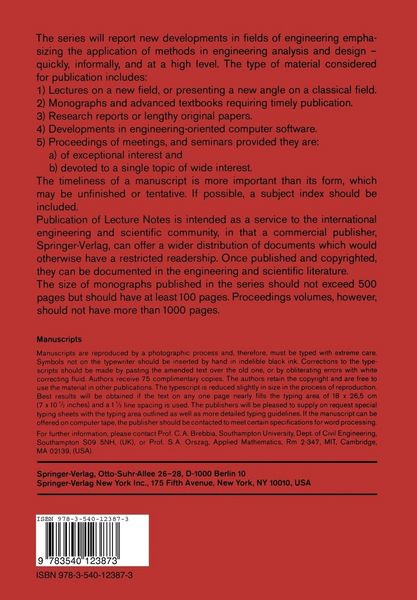
• Produktbild: The Boundary Element Method Applied to Inelastic Problems
  • Produktbild: The Boundary Element Method Applied to Inelastic Problems
Band 1

The Boundary Element Method Applied to Inelastic Problems

97,99 €

inkl. gesetzl. MwSt., Versandkostenfrei

Lieferung nach Hause

Produktdetails

Einband

Taschenbuch

Erscheinungsdatum

01.05.1983

Verlag

Springer Berlin

Seitenzahl

247

Maße (L/B/H)

24,4/17/1,5 cm

Gewicht

415 g

Sprache

Englisch

ISBN

978-3-540-12387-3

Produktdetails

Einband

Taschenbuch

Erscheinungsdatum

01.05.1983

Verlag

Springer Berlin

Seitenzahl

247

Maße (L/B/H)

24,4/17/1,5 cm

Gewicht

415 g

Sprache

Englisch

ISBN

978-3-540-12387-3

Herstelleradresse

Springer-Verlag GmbH
Tiergartenstr. 17
69121 Heidelberg
DE

Email: ProductSafety@springernature.com

Kundinnen und Kunden meinen

0 Bewertungen

Informationen zu Bewertungen

Zur Abgabe einer Bewertung ist eine Anmeldung im Konto notwendig. Die Authentizität der Bewertungen wird von uns nicht überprüft. Wir behalten uns vor, Bewertungstexte, die unseren Richtlinien widersprechen, entsprechend zu kürzen oder zu löschen.

Die Bewertungen sind nach Format, Anzahl Sterne und Datum sortiert.

Verfassen Sie die erste Bewertung zu diesem Artikel

Helfen Sie anderen Kund*innen durch Ihre Meinung

Kundinnen und Kunden meinen

0 Bewertungen filtern

  • Produktbild: The Boundary Element Method Applied to Inelastic Problems
  • Produktbild: The Boundary Element Method Applied to Inelastic Problems
  • 1 Introduction and Motivation.- 1.1 Introduction.- 1.2 Literature Survey-Nonlinear Applications.- 1.3 Layout of Notes.- 2 Basic Theory.- 2.1 Introduction.- 2.2 Theory of Elasticity.- 2.3 Inelastic Behaviour of Materials.- 2.4 Governing Equations.- 3 Boundary Element Formulation for Elastic Problems.- 3.1 Introduction.- 3.2 Somigliana’s Identity.- 3.3 Fundamental Solutions.- 3.4 Stresses at Internal Points.- 3.5 Boundary Integral Equation.- 3.6 Infinite and Semi-Infinite Regions.- 3.7 Numerical Implementation.- 3.8 Examples — Half-Plane Formulation.- 4 Boundary Element Equations for Inelastic Problems.- 4.1 Introduction.- 4.2 Somigliana’s Identity for Inelastic Problems.- 4.3 Internal Stresses.- 4.4 Alternative Boundary Element Formulations.- 4.4.1 Initial Strain.- 4.4.2 Initial Stress.- 4.4.3 Fictitious Tractions and Body Forces.- 4.5 Half-Plane Formulations.- 4.6 Spatial Discretization.- 4.7 Internal Cells.- 5 Elastoplastic Boundary Element Analysis.- 5.1 Introduction.- 5.2 Some Simple Elastoplastic Relations.- 5.3 Initial Strain — Numerical Solution Technique.- 5.4 Examples — Initial Strain Formulation.- 5.4.1 Perforated Aluminium Strip.- 5.4.2 Polystyrene Crazing Problem.- 5.4.3 Plane Strain Punch.- 5.4.4 Thick Cylinder.- 5.5 General Elastoplastic Stress-Strain Relations.- 5.6 Initial Stress-Outline of Solution Techniques.- 5.7 Examples — Kelvin Implementation.- 5.7.1 Notched Tensile Specimen.- 5.7.2 Deep Circular Tunnel.- 5.7.3 Rough Punch.- 5.8 Examples — Half-Plane Implementation.- 5.8.1 Strip Footing.- 5.8.2 Shallow Tunnel.- 6 Viscoplasticity and Creep Using Boundary Elements.- 6.1 Introduction.- 6.2 Rate Dependent Constitutive Equations.- 6.3 Solution Technique.- 6.4 Examples.- 6.4.1 Deep Beam.- 6.4.2 Thin Disc.- 6.4.3 Plate Under Thermal Shrinkage.- 7 General Discussion and Conclusions.- References.- Appendix A Indirect Computation of Principal Values.- Appendix B Stress Rates at Boundary Nodes.- Appendix C Displacements Due to Constant Inelastic Strain Fields.- Appendix D Some Particular Expressions for 2-D Inelastic Problems.