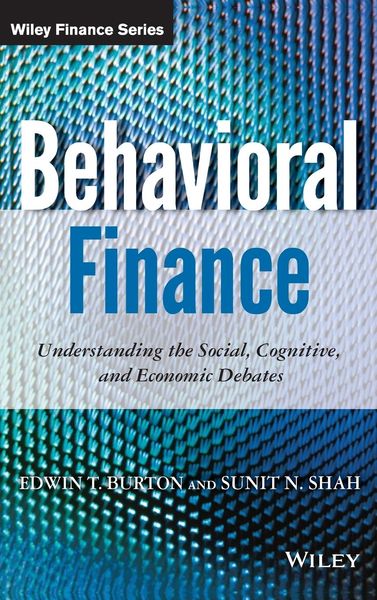
Produktbild: Behavioral Finance

Behavioral Finance Understanding the Social, Cognitive, and Economic Debates

Aus der Reihe Wiley Finance Editions

88,99 €

inkl. gesetzl. MwSt., Versandkostenfrei


Beschreibung

Produktdetails

Einband

Gebundene Ausgabe

Erscheinungsdatum

08.03.2013

Verlag

John Wiley & Sons

Seitenzahl

256

Maße (L/B/H)

23,5/15,7/1,8 cm

Gewicht

528 g

Auflage

1. Auflage

Sprache

Englisch

ISBN

978-1-118-30019-0

Beschreibung

Produktdetails

Einband

Gebundene Ausgabe

Erscheinungsdatum

08.03.2013

Verlag

John Wiley & Sons

Seitenzahl

256

Maße (L/B/H)

23,5/15,7/1,8 cm

Gewicht

528 g

Auflage

1. Auflage

Sprache

Englisch

ISBN

978-1-118-30019-0

Herstelleradresse

Libri GmbH
Europaallee 1
36244 Bad Hersfeld
DE

Email: gpsr@libri.de

Noch keine Bewertungen vorhanden

Verfassen Sie die erste Bewertung zu diesem Artikel

Helfen Sie anderen Kundinnen und Kunden durch Ihre Meinung.

Kundinnen und Kunden meinen

Bewertungen (0)

Die Leseprobe wird geladen.
  • Produktbild: Behavioral Finance
  • Preface xi
     
    Introduction 1
     
    Part I Introduction to Behavioral Finance
     
    Chapter 1 What is the Efficient Market Hypothesis? 5
     
    Information and the Efficient Market Hypothesis 6
     
    Random Walk, the Martingale Hypothesis, and the EMH 8
     
    False Evidence against the EMH 11
     
    What Does It Mean to Disagree with EMH? 13
     
    Chapter 2 The EMH and the "Market Model" 15
     
    Risk and Return--the Simplest View 15
     
    The Capital Asset Pricing Model (CAPM) 18
     
    So, What is the Market Model? 23
     
    Chapter 3 The Forerunners to Behavioral Finance 25
     
    The Folklore of Wall Street Traders 26
     
    The Birth of Value Investing: Graham and Dodd 28
     
    Financial News in a World of Ubiquitous Television and Internet 29
     
    Part II Noise Traders
     
    Chapter 4 Noise Traders and the Law of One Price 33
     
    The Law of One Price and the Case of Fungibility 33
     
    Noise 38
     
    Chapter 5 The Shleifer Model of Noise Trading 43
     
    The Key Components of the Shleifer Model 44
     
    Results 49
     
    Why the Shleifer Model is Important 50
     
    Resolving the Limits to Arbitrage Dispute 51
     
    Chapter 6 Noise Trading Feedback Models 53
     
    The Hirshleifer Model 53
     
    The Subrahmanyam-Titman Model 58
     
    Conclusion 62
     
    Chapter 7 Noise Traders as Technical Traders 65
     
    Technical Traders as Noise Traders 67

    Herd Instinct Models 72
     
    Conclusion 76
     
    Part III: Anomalies
     
    Chapter 8 The Rational Man 81
     
    Consumer Choice with Certainty 81
     
    Consumer Choice with Uncertainty 84
     
    The Allais Paradox 90
     
    Conclusion 92
     
    Chapter 9 Prospect Theory 93
     
    The Reference Point 93
     
    The S-Curve 94
     
    Loss Aversion 96
     
    Prospect Theory in Practice 98
     
    Drawbacks of Prospect Theory 98
     
    Conclusion 100
     
    Chapter 10 Perception Biases 101
     
    Saliency 101
     
    Framing 103
     
    Anchoring 106
     
    Sunk Cost Bias 108
     
    Conclusion 109
     
    Chapter 11 Inertial Effects 111
     
    Endowment Effect 111
     
    Status Quo Effect 116
     
    Disposition Effect 119
     
    Conclusion 120
     
    Chapter 12 Causality and Statistics 123
     
    Representativeness 123
     
    Conjunction Fallacy 127
     
    Reading into Randomness 129
     
    Small Sample Bias 131
     
    Probability Neglect 133
     
    Conclusion 134
     
    Chapter 13 Illusions 135
     
    Illusion of Talent 135
     
    Illusion of Skill 138
     
    Illusion of Superiority 139
     
    Illusion of Validity 141
     
    Conclusion 142
     
    Part IV Serial Correlation
     
    Chapter 14 Predictability of Stock Prices: Fama-French Leads the Way 147
     
    Testing the Capital Asset Pricing Model 147
     
    A Plug for Value Investing 149
     
    Mean Reversion - The DeBondt-Thaler Research 151
     
    Why Fama-French is a Milestone for Behavioral Finance 152
     
    Chapter 15 Fama French and Mean Reversion: Which Is It? 155
     
    The Month of January 155
     
    Is This Just About Price? 157
     
    The Over-reaction Theme 157
     
    Lakonishok, Shleifer and Vishny (1994) on Value Versus Growth 158
     
    Is Over-reaction Nothing More Than a 'Small Stock' Effect? 159
     
    Daniel and Titman on Unpriced Risk in Fama and French 164
     
    Summing Up the Contrarian Debate 165
     
    Chapter 16 Short Term Momentum 167
     
    Price and Earnings Momentum 167
     
    Earnings Momentum - Ball and Brown 168
     
    Measuring Earnings Surprises 170