KI-Beratung Beta

  • Produktbild: Aerospace Propulsion
  • Produktbild: Aerospace Propulsion

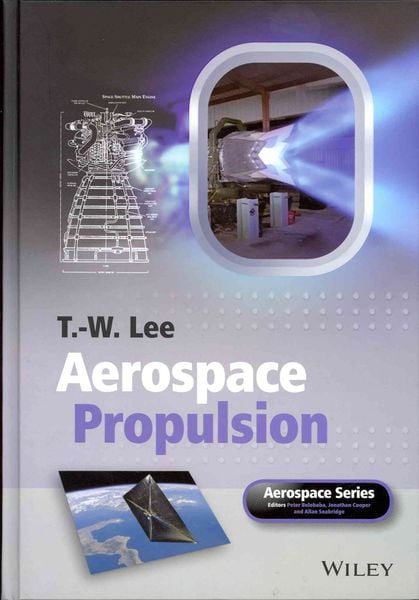
Aerospace Propulsion

Aus der Reihe Aerospace Series (PEP)

128,99 €

inkl. gesetzl. MwSt., Versandkostenfrei


Beschreibung

Aerospace propulsion devices embody some of the most advanced technologies, ranging from materials, fluid control, and heat transfer and combustion. In order to maximize the performance, sophisticated testing and computer simulation tools are developed and used.   Aerospace Propulsion comprehensively covers...

Beschreibung

Aerospace propulsion devices embody some of the most advanced technologies, ranging from materials, fluid control, and heat transfer and combustion. In order to maximize the performance, sophisticated testing and computer simulation tools are developed and used.
 
Aerospace Propulsion comprehensively covers the mechanics and thermal-fluid aspects of aerospace propulsion, starting from the fundamental principles, and covering applications to gas-turbine and space propulsion (rocket) systems. It presents modern analytical methods using MATLAB and other advanced software and includes essential elements of both gas-turbine and rocket propulsion systems. Gas turbine coverage includes thermodynamic analysis, turbine components, diffusers, compressors, turbines, nozzles, compressor-turbine matching, combustors and afterburners. Rocket coverage includes chemical rockets, electrical rockets, nuclear and solar sail.
 
Key features:
* Both gas-turbine and rocket propulsion covered in a single volume
* Presents modern analytical methods and examples
* Combines fundamentals and applications, including space applications
* Accompanied by a website containing MATLAB examples, problem sets and solutions
 
Aerospace Propulsion is a comprehensive textbook for senior undergraduate graduate and aerospace propulsion courses, and is also an excellent reference for researchers and practicing engineers working in this area.

Rezension

"Nevertheless this book covers the basics in a clear and easily accessible manner and would serve as a valuable study aid and as a companion text to the number of excellent, more specialised textbooks in this area such as Gas Turbine Theoryby Savaranamutto, Rogers, Cohen and Straznicky (Prentice Hall. 2008 - Sixth edition) and Space Propulsion Analysis and Designedited by R. W. Humble et al . (McGraw-Hill Publishing Company. 1995)." ( The Aeronautical Journal , 1 June 2014)

Produktdetails

Einband

Gebundene Ausgabe

Erscheinungsdatum

08.01.2014

Herausgeber Peter Belobaba + weitere
Verlag John Wiley & Sons Inc

Produktdetails

Einband

Gebundene Ausgabe

Erscheinungsdatum

08.01.2014

Herausgeber
Verlag John Wiley & Sons Inc
Seitenzahl

320

Maße (L/B/H)

25/17,5/2,2 cm

Gewicht

732 g

Auflage

1. Auflage

Sprache

Englisch

ISBN

978-1-118-30798-4

Herstelleradresse

Libri GmbH
Europaallee 1
36244 Bad Hersfeld
DE

Email: gpsr@libri.de

Noch keine Bewertungen vorhanden

Verfassen Sie die erste Bewertung zu diesem Artikel

Helfen Sie anderen Kundinnen und Kunden durch Ihre Meinung.

Kundinnen und Kunden meinen

Bewertungen (0)

Die Leseprobe wird geladen.
  • Produktbild: Aerospace Propulsion
  • Produktbild: Aerospace Propulsion
  • Series Preface ix
    Preface xi

    1 Introduction to Propulsion Systems 1
    1.1 Conservation of Momentum 7
    1.2 Conservation of Energy (the First Law of Thermodynamics) and Other Thermodynamic Relationships 10
    1.3 One-Dimensional Gas Dynamics 13
    1.4 Heat Transfer 14
    1.5 Standard Atmospheric Air Properties 15
    1.6 Unit Conversion 17
    1.7 Problems 20

    2 Principle of Thrust 21
    2.1 Thrust Configurations 21
    2.2 Thrust Equation 23
    2.3 Basic Engine Performance Parameters 28
    2.4 Propulsion and Aircraft Performance 34
    2.5 Propeller Propulsion 38
    2.6 MATLAB1 Program 39
    2.7 Problems 40

    3 Basic Analyses of Gas-Turbine Engines 43
    3.1 Introduction 43
    3.2 Gas-Turbine Engine as a Power Cycle (Brayton Cycle) 43
    3.3 Ideal-Cycle Analysis for Turbofan Engines 49
    3.4 Turbojets, Afterburners and Ramjets 61
    3.5 Further Uses of Basic Engine Analysis 73
    3.6 MATLAB1 Program 76
    3.7 Problems 77

    4 Gas-Turbine Components: Inlets and Nozzles 81
    4.1 Gas-Turbine Inlets 81
    4.2 Subsonic Diffuser Operation 82
    4.3 Supersonic Inlet Operation 91
    4.4 Gas-Turbine Nozzles 95
    4.5 Problems 98

    5 Compressors and Turbines 101
    5.1 Introduction 101
    5.2 Basic Compressor Aero-Thermodynamics 103
    5.3 Radial Variations in Compressors 115
    5.4 Preliminary Compressor Analysis/Design 119
    5.5 Centrifugal Compressors 120
    5.6 Turbine 123
    5.7 MATLAB1 Programs 129
    5.8 Problems 131

    6 Combustors and Afterburners 135
    6.1 Combustion Chambers 135
    6.2 Jet Fuels and Heating Values 137
    6.3 Fluid Mixing in the Combustor 141
    6.4 Afterburners 149
    6.5 Combustor Heat Transfer 152
    6.6 Stagnation Pressure Loss in Combustors 153
    6.7 Problems 155

    7 Gas-Turbine Analysis with Efficiency Terms 159
    7.1 Introduction 159
    7.2 Turbofan Engine Analysis with Efficiency Terms 160
    7.3 MATLAB1 Program 172
    7.4 Problems 174

    8 Basics of Rocket Propulsion 177
    8.1 Introduction 177
    8.2 Basic Rocketry 182
    8.3 MATLAB1 Programs 189
    8.4 Problems 190

    9 Rocket Propulsion and Mission Analysis 193
    9.1 Introduction 193
    9.2 Trajectory Calculations 195
    9.3 Rocket Maneuvers 203
    9.4 Missile Pursuit Algorithms and Thrust Requirements 209
    9.5 Problems 213

    10 Chemical Rockets 217
    10.1 Rocket Thrust 217
    10.2 Liquid Propellant Rocket Engines 220
    10.3 Solid Propellant Combustion 244
    10.4 Rocket Nozzles 252
    10.5 MATLAB1 Program 256
    10.6 Problems 256

    11 Non-Chemical Rockets 259
    11.1 Electrothermal Devices 261
    11.2 Ion Thrusters 265
    11.3 Problems 280
    Bibliography 282

    Appendices 283
    Appendix A: Standard Atmospheric Air Properties 283
    Appendix B: Specific Heats for Air as a Function of Temperature 286
    Appendix C: Normal Shock Properties 287
    Appendix D: Oblique Shock Angle Chart 291
    Appendix E: Polynomial Coefficients for Specific Heat of Selected Gases 292
    Appendix F: Standard state Gibbs free energy 293

    Index 295