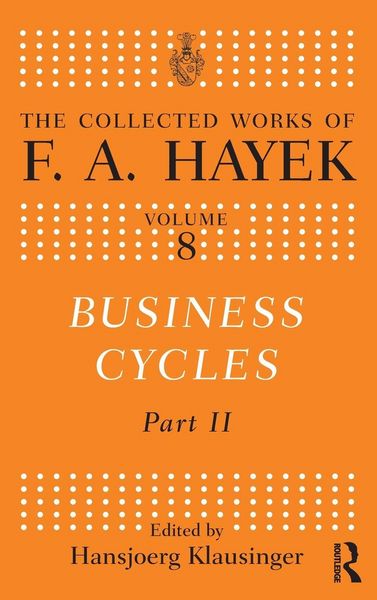

Business Cycles Part II
-
- Hardcover ausgewählt
- Taschenbuch
- eBook
-
Sprache:Englisch
-
Verlag:Taylor and Francis
259,99 €
inkl. gesetzl. MwSt.,
Lieferung nach Hause
Beschreibung
Produktdetails
Einband
Gebundene Ausgabe
Erscheinungsdatum
10.10.2012
Herausgeber
Klausinger HansjoergVerlag
Taylor and FrancisSeitenzahl
360
Maße (L/B/H)
23,5/15,7/2,4 cm
Gewicht
640 g
Sprache
Englisch
ISBN
978-0-415-64117-3
In the years following its publication, F. A. Hayek's pioneering work on business cycles was regarded as an important challenge to what was later known as Keynesian macroeconomics. Today, as debates rage on over the monetary origins of the current economic and financial crisis, economists are once again paying heed to Hayek's thoughts on the repercussions of excessive central bank interventions. The latest editions in Routledge's ongoing series The Collected Works of F. A. Hayek, these volumes bring together Hayek's work on what causes periods of boom and bust in the economy. Moving away from the classical emphasis on equilibrium, Hayek demonstrates that business cycles are generated by the adaptation of the structure of production to changes in relative demand. Thus, when central banks artificially lower interest rates, the result is a misallocation of capital and the creation of asset bubbles and additional instability. Business Cycles, Part I contains Hayek's two major monographs on the topic: Monetary Theory and the Trade Cycle and Prices and Production. Reproducing the text of the original 1933 translation of the former, this edition also draws on the original German, as well as more recent translations. For Prices and Production, a variorum edition is presented, incorporating the 1931 first edition and its 1935 revision. Business Cycles, Part II assembles a series of Hayek's shorter papers on the topic, ranging from the 1920s to 1981. In addition to bringing together Hayek's work on the evolution of business cycles, the two volumes of Business Cycles also include extensive introductions by Hansjoerg Klausinger, placing the writings in intellectual context, including their reception and the theoretical debates to which they contributed, and providing background on the evolution of Hayek's thought.
Kundinnen und Kunden meinen
Verfassen Sie die erste Bewertung zu diesem Artikel
Helfen Sie anderen Kund*innen durch Ihre Meinung
Kurze Frage zu unserer Seite
Vielen Dank für dein Feedback
Wir nutzen dein Feedback, um unsere Produktseiten zu verbessern. Bitte habe Verständnis, dass wir dir keine Rückmeldung geben können. Falls du Kontakt mit uns aufnehmen möchtest, kannst du dich aber gerne an unseren Kund*innenservice wenden.
zum Kundenservice