KI-Beratung Beta

Gutscheinbedingungen

**Gültig vom 05.10.2026 bis 07.10.2026 | Gültig für nicht preisgebundene fremdsprachige Bücher | Einzelne Artikel können ausgeschlossen sein | Online auf www.bücher.de einlösbar | Click & Collect nur mit Online-Zahlung (Paypal/Kreditkarte) vorab | Nicht kombinierbar mit anderen Gutscheinen oder Preisaktionen | Nur einmal pro Einkauf einlösbar | Gutschein wird auf max. 500€ Bestellwert angerechnet | Keine Barauszahlung | Nicht gültig für Versandkosten und Services

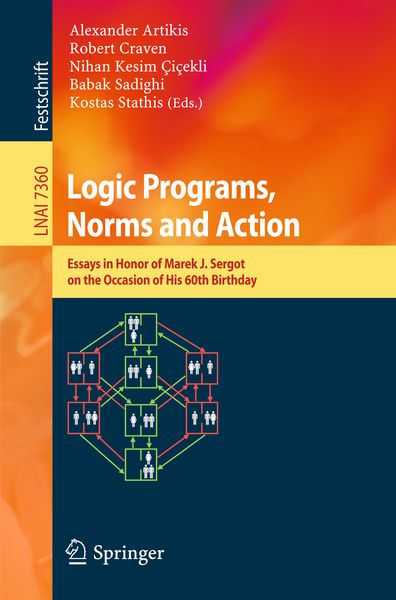
Produktbild: Logic Programs, Norms and Action
Band 7360

Logic Programs, Norms and Action Essays in Honor of Marek J. Sergot on the Occasion of His 60th Birthday

49,99 €

inkl. gesetzl. MwSt., Versandkostenfrei


Beschreibung

Produktdetails

Einband

Taschenbuch

Erscheinungsdatum

02.05.2012

Abbildungen

XX, 425 p. 36 illus.

Herausgeber

Alexander Artikis + weitere

Verlag

Springer Berlin

Seitenzahl

425

Maße (B/H)

15,5/23,5 cm

Gewicht

701 g

Sprache

Englisch

ISBN

978-3-642-29413-6

Beschreibung

Produktdetails

Einband

Taschenbuch

Erscheinungsdatum

02.05.2012

Abbildungen

XX, 425 p. 36 illus.

Herausgeber

Verlag

Springer Berlin

Seitenzahl

425

Maße (B/H)

15,5/23,5 cm

Gewicht

701 g

Sprache

Englisch

ISBN

978-3-642-29413-6

Herstelleradresse

Springer-Verlag GmbH
Heidelberger Platz 3
14197 Berlin
Deutschland
Email: sdc-bookservice@springer.com
Url: www.springer.com
Telephone: +49 30 827870
Fax: +49 30 8214091

Noch keine Bewertungen vorhanden

Verfassen Sie die erste Bewertung zu diesem Artikel

Helfen Sie anderen Kundinnen und Kunden durch Ihre Meinung.

Kundinnen und Kunden meinen

Bewertungen (0)

  • Produktbild: Logic Programs, Norms and Action
  • Marek Sergot: A Memoir.- The Scientific Contribution of Marek Sergot.- Teleo-Reactive Abductive Logic Programs.- Semi-negative Abductive Logic Programs with Implicative Integrity Constraints: Semantics and Properties.- What Is Negation as Failure?.- The Importance of the Past in Interval Temporal Logics: The Case of Propositional Neighborhood Logic.- Argumentation and the Event Calculus.- Reactive Event Calculus for Monitoring Global Computing Applications.- Reasoning about the Intentions of Agents.- Symbolic Model Checking for Temporal-Epistemic Logic.- GOAL Agents Instantiate Intention Logic.- Open Texture and Argumentation: What Makes an Argument Persuasive?.- Irrationality in Persuasive Argumentation.- Some Reflections on Two Current Trends in Formal Argumentation.- On the Representation of Normative Sentences in FOL.- Why Be Afraid of Identity? Comments on Sergot and Prakken’s Views.- Deon +: Abduction and Constraints for Normative Reasoning.- Contrary-To-Duties in Games.- Logical Approaches to Authorization Policies.- Decentralized Governance of Distributed Systems via Interaction Control.- Managing User-Generated Content as a Knowledge Commons.

    The Scientific Contribution of Marek Sergot.- Teleo-Reactive Abductive Logic Programs.- Semi-negative Abductive Logic Programs with Implicative Integrity Constraints: Semantics and Properties.- What Is Negation as Failure?.- The Importance of the Past in Interval Temporal Logics: The Case of Propositional Neighborhood Logic.- Argumentation and the Event Calculus.- Reactive Event Calculus for Monitoring Global Computing Applications.- Reasoning about the Intentions of Agents.- Symbolic Model Checking for Temporal-Epistemic Logic.- GOAL Agents Instantiate Intention Logic.- Open Texture and Argumentation: What Makes an Argument Persuasive?.- Irrationality in Persuasive Argumentation.- Some Reflections on Two Current Trends in Formal Argumentation.- On the Representation of Normative Sentences inFOL.- Why Be Afraid of Identity? Comments on Sergot and Prakken’s Views.- Deon +: Abduction and Constraints for Normative Reasoning.- Contrary-To-Duties in Games.- Logical Approaches to Authorization Policies.- Decentralized Governance of Distributed Systems via Interaction Control.- Managing User-Generated Content as a Knowledge Commons.