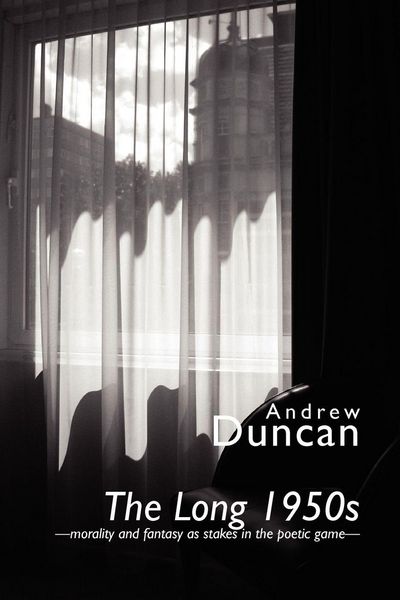
Where poetry is dominated by amateurs, its key ideas are the ones that nobody owns. Underneath the glittering cavalcade of conscious and innovative art is another world of poetry without technique, protected from change. Can we find a history of what seems to be most inaccessible to time? Can we write a history of the unheard voices, articulate the unconscious and write a stylistics of the conventional? Most people who write poetry are untouched by theory and have no expectations of winning prizes. Is there a much deeper, inarticulate, pulse of style history, almost detached from reflexivity and concealed from view by an elite who write directly from theory? The 1950s now seem like a mystery, only remembered as the factory which produced all the rebels of the succeeding two decades. But its rejection of rhetoric opened the gates to the amateur poet, its existential preoccupation with authenticity gave the unknown poet a chit to justify writing for and about themselves alone. It seems as if the 1950s have never stopped. The return to them is an attempt to crystallise the unchanged, the underlying stock of linguistic practices which was damaged by all the changes that washed over it but was finally intact, indifferent, unlearning. A kind of safe world where dissidents didn't rush in to subvert the text at every minute and where there was a comforting shared feeling among literary people. An era of naivety, virtue-and Close Reading. Did Pop and protest poetry come out of the Church's inner crisis on discovering that urban youth had given up church-going and that its noble oratory seemed irrelevant to social issues? Existentialism looks at the concrete and close at hand and turns out to be looking at white goods, pass marks for the bourgeoisie. Inhibitions seemed to be part of the kitchen equipment. How would we recover such a history? Surely, by discarding names and isolating styles, entities recovered by emphasis from a vast amorphous mass of data. So we address the domestic anecdote, the Pop poem, the academic poem, the communalist poem, the Oxford Line, the late Christian poem. These foci allow us to define and reflect on what seemed to be transparent and anti-technical. They reach highlights, where we look at supremely gifted exponents of the styles. The mass of material is far greater than any classification can round up and frame. Looking for tensions within the material, we recover a break within the gatekeepers' rules. A trail through a static landscape leads to a legend about a crisis and the fall of a wall: an unmarked point during the 1980s where the restrictions failed to turn up for work and so the 1950s ended, giving way to a new regime of the 'post-modern' or 'deregulated'.
Kundinnen und Kunden meinen
0.0/5.0
0 Bewertungen
Verfassen Sie die erste Bewertung zu diesem Artikel
Helfen Sie anderen Kund*innen durch Ihre Meinung
Kurze Frage zu unserer Seite
Vielen Dank für dein Feedback
Wir nutzen dein Feedback, um unsere Produktseiten zu verbessern. Bitte habe Verständnis, dass wir dir keine Rückmeldung geben können. Falls du Kontakt mit uns aufnehmen möchtest, kannst du dich aber gerne an unseren Kund*innenservice wenden.