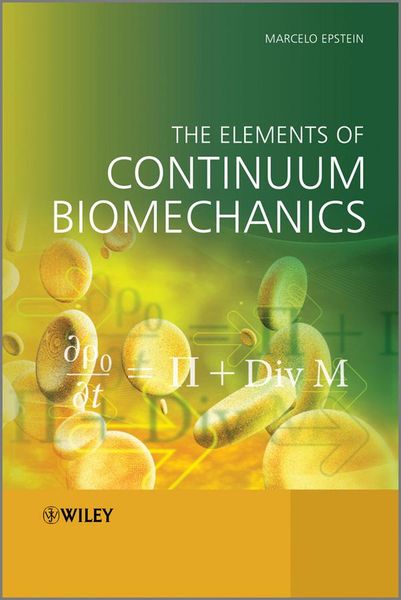
The Elements of Continuum Biomechanics
137,99 €
inkl. gesetzl. MwSt.,
Beschreibung
Produktdetails
Einband
Gebundene Ausgabe
Erscheinungsdatum
20.08.2012
Verlag
John Wiley & SonsSeitenzahl
392
Maße (L/B/H)
25,4/17,5/2,4 cm
Gewicht
744 g
Auflage
1. Auflage
Sprache
Englisch
ISBN
978-1-119-99923-2
This book presents the elements of Continuum Mechanics to people interested in applications to biological systems. It is divided into two parts, the first of which introduces the basic concepts within a strictly one-dimensional spatial context. This policy has been adopted so as to allow the newcomer to Continuum Mechanics to appreciate how the theory can be applied to important issues in Biomechanics from the very beginning. These include mechanical and thermodynamical balance, materials with fading memory and chemically reacting mixtures.
In the second part of the book, the fully fledged three-dimensional theory is presented and applied to hyperelasticity of soft tissue, and to theories of remodeling, aging and growth. The book closes with a chapter devoted to Finite Element analysis. These and other topics are illustrated with case studies motivated by biomedical applications, such as vibration of air in the air canal, hyperthermia treatment of tumours, striated muscle memory, biphasic model of cartilage and adaptive elasticity of bone. The book offers a challenging and appealing introduction to Continuum Mechanics for students and researchers of biomechanics, and other engineering and scientific disciplines.
Key features:
* Explains continuum mechanics using examples from biomechanics for a uniquely accessible introduction to the topic
* Moves from foundation topics, such as kinematics and balance laws, to more advanced areas such as theories of growth and the finite element method..
* Transition from a one-dimensional approach to the general theory gives the book broad coverage, providing a clear introduction for beginners new to the topic, as well as an excellent foundation for those considering moving to more advanced application
Noch keine Bewertungen vorhanden
Verfassen Sie die erste Bewertung zu diesem Artikel
Helfen Sie anderen Kundinnen und Kunden durch Ihre Meinung.
Kurze Frage zu unserer Seite
Vielen Dank für dein Feedback
Wir nutzen dein Feedback, um unsere Produktseiten zu verbessern. Bitte habe Verständnis, dass wir dir keine Rückmeldung geben können. Falls du Kontakt mit uns aufnehmen möchtest, kannst du dich aber gerne an unseren Kund*innenservice wenden.
zum Kundenservice