KI-Beratung Beta

Gutscheinbedingungen

**Gültig vom 23.11. bis 30.11.2026 | Gültig für nicht preisgebundene fremdsprachige Bücher | Einzelne Artikel können ausgeschlossen sein | Online auf www.bücher.de einlösbar | Click & Collect nur mit Online-Zahlung (Paypal/Kreditkarte) vorab | Nicht kombinierbar mit anderen Gutscheinen oder Preisaktionen | Nur einmal pro Einkauf einlösbar | Gutschein wird auf max. 500€ Bestellwert angerechnet | Keine Barauszahlung | Nicht gültig für Versandkosten und Services

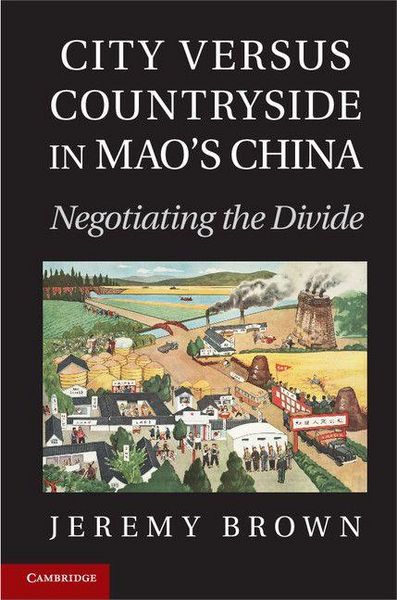
  • Produktbild: City versus Countryside in Mao's China
  • Produktbild: City versus Countryside in Mao's China

City versus Countryside in Mao's China

145,99 €

inkl. gesetzl. MwSt., Versandkostenfrei


Beschreibung

The gap between those living in the city and those in the countryside remains one of China's most intractable problems. This powerful work of grassroots history traces the origins of China's rural-urban divide back to the Mao Zedong era. Harrowing accounts reveal how Chinese people fought back against...

Beschreibung

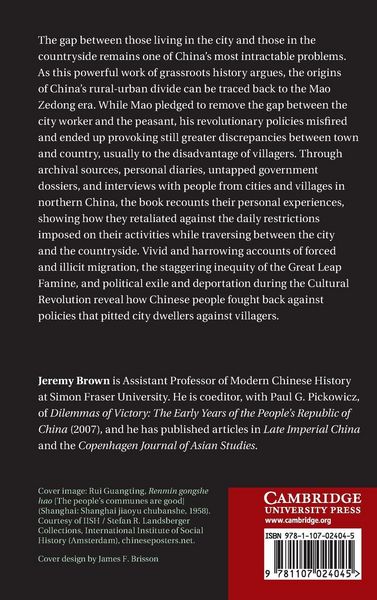
The gap between those living in the city and those in the countryside remains one of China's most intractable problems. This powerful work of grassroots history traces the origins of China's rural-urban divide back to the Mao Zedong era. Harrowing accounts reveal how Chinese people fought back against policies that pitted city dwellers against villagers. The gap between those living in the city and those in the countryside remains one of China's most intractable problems. As this powerful work of grassroots history argues, the origins of China's rural-urban divide can be traced back to the Mao Zedong era. While Mao pledged to remove the gap between the city worker and the peasant, his revolutionary policies misfired and ended up provoking still greater discrepancies between town and country, usually to the disadvantage of villagers. Through archival sources, personal diaries, untapped government dossiers and interviews with people from cities and villages in northern China, the book recounts their personal experiences, showing how they retaliated against the daily restrictions imposed on them while traversing between the city and the countryside. Vivid and harrowing accounts of forced and illicit migration, the staggering inequity of the Great Leap Famine and political exile during the Cultural Revolution reveal how Chinese people fought back against policies that pitted city dwellers against villagers.

Rezension

'This is a well-written, often bitterly ironic, account of an extraordinary period in the development of modern China, but one which, in many ways, built the booming economy that we are confronted with in the second decade of the twenty-first century. As Brown concludes, the shadow of the Maoist era still casts itself across events even today, and this book does an excellent job of reminding us of this.' Kerry Brown, Asian Affairs

Produktdetails

Einband

Gebundene Ausgabe

Erscheinungsdatum

06.09.2012

Abbildungen

2 maps 5 tables

Verlag Cambridge University Press

Produktdetails

Einband

Gebundene Ausgabe

Erscheinungsdatum

06.09.2012

Abbildungen

2 maps 5 tables

Verlag Cambridge University Press
Seitenzahl

270

Maße (L/B/H)

23,5/15,7/1,9 cm

Gewicht

498 g

Sprache

Englisch

ISBN

978-1-107-02404-5

Herstelleradresse

Libri GmbH
Europaallee 1
36244 Bad Hersfeld
DE

Email: gpsr@libri.de

Noch keine Bewertungen vorhanden

Verfassen Sie die erste Bewertung zu diesem Artikel

Helfen Sie anderen Kundinnen und Kunden durch Ihre Meinung.

Kundinnen und Kunden meinen

Bewertungen (0)

Die Leseprobe wird geladen.
  • Produktbild: City versus Countryside in Mao's China
  • Produktbild: City versus Countryside in Mao's China
  • Introduction; 1. The city leads the village: governing Tianjin in the early 1950s; 2. Eating, moving, and working; 3. Tianjin's great leap: urban survival, rural starvation; 4. The great downsizing of 1961-3; 5. The four cleanups and urban youth in Tianjin's hinterland; 6. Purifying the city: the deportation of political outcasts during the Cultural Revolution; 7. Neither urban nor rural: in-between spaces in the 1960s and 1970s; 8. Staging Xiaojinzhuang: the urban occupation of a model village, 1974-8; Epilogue.