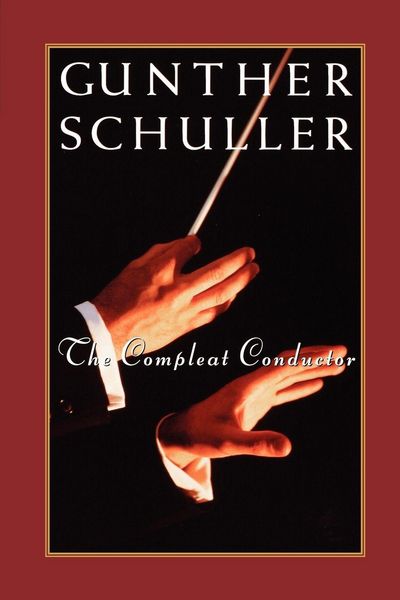
The Compleat Conductor
-
- Taschenbuch ausgewählt
- eBook
-
Sprache:Englisch
-
Verlag:Oxford University Press
39,99 €
inkl. gesetzl. MwSt.,
Lieferung nach Hause
Beschreibung
Produktdetails
Einband
Taschenbuch
Erscheinungsdatum
01.10.1998
Verlag
Oxford University PressSeitenzahl
584
Maße (L/B/H)
23,4/15,6/3,1 cm
Gewicht
830 g
Sprache
Englisch
ISBN
978-0-19-512661-7
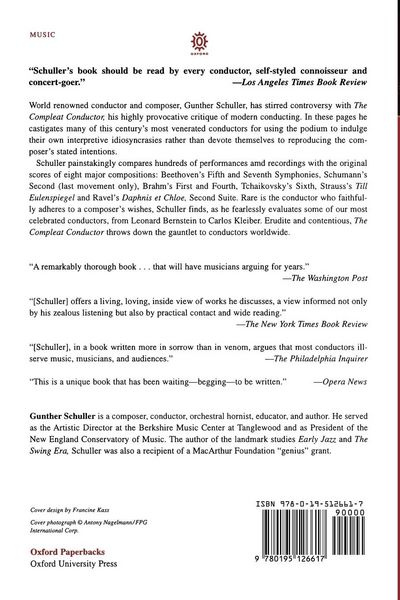
Contrary to the average concert-goer's notion (all too often shared by the musicians as well) that conducting is an easily learned skill, Schuller argues here that conducting is "the most demanding, musically all embracing, and complex" task in the field of music performance. Conducting demands profound musical sense, agonizing hours of study, and unbending integrity. Most important, a conductor's overriding concern must be to present a composer's work faithfully and accurately, scrupulously following the score including especially dynamics and tempo markings with utmost respect and care. Alas, Schuller finds, rare is the conductor who faithfully adheres to a composer's wishes. To document this, Schuller painstakingly compares hundreds of performances and recordings with the original scores of eight major compositions: Beethoven's fifth and seventh symphonies, Schumann's second (last movement only), Brahms's first and fourth, Tchaikovsky's sixth, Strauss's "Till Eulenspiegel" and Ravel's "Daphnis et Chloe, Second Suite." Illustrating his points with numerous musical examples, Schuller reveals exactly where conductors have done well and where they have mangled the composer's work. As he does so, he also illuminates the interpretive styles of many of our most celebrated conductors, offering pithy observations that range from blistering criticism of Leonard Bernstein ("one of the world's most histrionic and exhibitionist conductors") to effusive praise of Carlos Kleiber (who "is so unique, so remarkable, so outstanding that one can only describe him as a phenomenon"). Along the way, he debunks many of the music world's most enduring myths (such as the notion that most of Beethoven's metronome markings were "wrong" or "unplayable," or that Schumann was a poor orchestrator) and takes on the "cultish clan" of period instrument performers, observing that many of their claims are "totally spurious and chimeric." In his epilogue, Schuller sets forth clear guidelines for conductors that he believes will help steer them away from self indulgence towards the correct realization of great art.
Courageous, eloquent, and brilliantly insightful, The Compleat Conductor throws down the gauntlet to conductors worldwide. It is a controversial book that the music world will be debating for many years to come.
Noch keine Bewertungen vorhanden
Verfassen Sie die erste Bewertung zu diesem Artikel
Helfen Sie anderen Kundinnen und Kunden durch Ihre Meinung.
Kurze Frage zu unserer Seite
Vielen Dank für dein Feedback
Wir nutzen dein Feedback, um unsere Produktseiten zu verbessern. Bitte habe Verständnis, dass wir dir keine Rückmeldung geben können. Falls du Kontakt mit uns aufnehmen möchtest, kannst du dich aber gerne an unseren Kund*innenservice wenden.
zum Kundenservice