• Produktbild: Organic, Inorganic and Hybrid Solar Cells
  • Produktbild: Organic, Inorganic and Hybrid Solar Cells

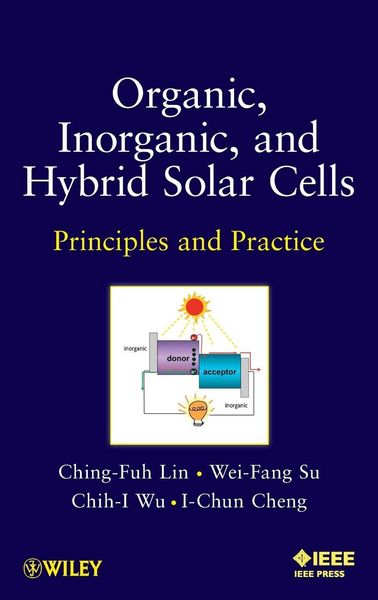
Organic, Inorganic and Hybrid Solar Cells Principles and Practice

139,99 €

inkl. gesetzl. MwSt., Versandkostenfrei


Beschreibung

Produktdetails

Einband

Gebundene Ausgabe

Erscheinungsdatum

04.09.2012

Verlag

John Wiley & Sons Inc

Seitenzahl

288

Maße (L/B/H)

24,1/15,6/2,2 cm

Gewicht

521 g

Auflage

1. Auflage

Sprache

Englisch

ISBN

978-1-118-16853-0

Beschreibung

Produktdetails

Einband

Gebundene Ausgabe

Erscheinungsdatum

04.09.2012

Verlag

John Wiley & Sons Inc

Seitenzahl

288

Maße (L/B/H)

24,1/15,6/2,2 cm

Gewicht

521 g

Auflage

1. Auflage

Sprache

Englisch

ISBN

978-1-118-16853-0

Herstelleradresse

Libri GmbH
Europaallee 1
36244 Bad Hersfeld
DE

Email: GPSR Kontakt

Noch keine Bewertungen vorhanden

Verfassen Sie die erste Bewertung zu diesem Artikel

Helfen Sie anderen Kundinnen und Kunden durch Ihre Meinung.

Kundinnen und Kunden meinen

Bewertungen (0)

  • Produktbild: Organic, Inorganic and Hybrid Solar Cells
  • Produktbild: Organic, Inorganic and Hybrid Solar Cells
  • Foreword
     
    Preface
     
    About the Authors
     
    Chapter 1 Introduction - Why Solar Energy?
    Ching-Fuh Lin
     
    1.1 The Era of Fossil Energy
     
    1.1.1 Possible Depletion of Fossil Fuels
     
    1.1.2 Global Warming
     
    1.1.3 Dramatic Change of Weather
     
    1.2 Renewable Energies
     
    1.3 Solar Energy and Economy
     
    1.3.1 Production Issue
     
    1.3.2 Types of Solar Cells
     
    1.3.3 Cost Analysis--Grid Parity
     
    1.3.4 Cost Analysis--Break Down the System Cost
     
    1.3.5 The Forecast and Practical Trends
     
    1.4 Move toward Thin-Film Solar Cells
     
    1.4.1 Inorganic vs. Organic
     
    1.4.2 More Possible Applications
     
    1.5 Outline of the Book
     
    Chapter 2 Light and Its Interaction with Matters
    Ching-Fuh Lin
     
    2.1 What is Light?
     
    2.1.1 Light Ray
     
    2.1.2 Light as a Wave
     
    2.1.3 Plane-wave Solution of Wave Equation
     
    2.1.4 Wave as a Particle
     
    2.1.5 Black-body Radiation and Solar Spectrum
     
    2.1.6 The Brightness and Intensity of Sunlight
     
    2.2 Fundamentals of Interaction between Light and Matters
     
    2.2.1 Interaction of Electric Field with Dielectrics
     
    2.2.2 Interaction of Light with Magnetic Materials
     
    2.2.3 Summary of Light-Matter Interaction without Energy Exchange
     
    2.3 Basic Properties of Transparent Materials
     
    2.3.1 Reflection and Refraction
     
    2.3.1.1 Boundary Conditions for Electric and Magnetic Fields
     
    2.3.1.2 Reflection and Transmission of Plane Waves
     
    2.3.1.3 Laws of Reflection and Refraction
     
    2.3.1.4 Reflection and Transmission Coefficients
     
    2.3.1.5 Reflectivity and Ratio of Transmitted Intensity
     
    2.3.1.6 Total Reflection
     
    2.3.1.7 Brewster Angle
     
    2.3.2 Polarization
     
    2.3.3 Dispersion
     
    2.3.4 Isotropy and Anisotropy
     
    2.3.5 Scattering
     
    2.3.6 Nonlinear Optics: Energy Up Conversion and Down Conversion
     
    2.4 Interaction of Light and Matters with Energy Exchange
     
    2.4.1 Interaction of Light with Conductors
     
    2.4.2 Quantum Concept of Atomic System
     
    2.4.3 Light-Matter Interactions
     
    Chapter 3 Fundamentals of Inorganic Solar Cells
    Chih-I Wu
     
    3.1. From Atomic Bonds to Energy Bands
     
    3.2 Energy Bands from a Quantum Mechanics Point of View
     
    3.3. The Energy Band in Semiconductors
     
    3.4. PN Junction
     
    3.5 Energy Band Diagram of the PN Junction
     
    3.6 Carrier Transport in a PN Junction
     
    3.6.1 Diffusion
     
    3.6.2 Drift
     
    3.7 PN junction diodes
     
    3.8 Solar Cell Diodes
     
    3.9 Interaction of Light and Materials
     
    3.10 Solar Cell Materials
     
    3.10.1 Crystalline Silicon
     
    3.10.2 GaAs
     
    3.10.3 Thin Film Silicon
     
    3.10.4 Cu-In-Ga-Se (CIGS)
     
    3.10.5 Polymer Solar Cell Materials
     
    Chapter 4 Organic Materials
    Wei-Fang Su
     
    4.1 Bonding and Structure of Organic Molecule
     
    4.2 Properties of Organic Molecules
     
    4.3 Optical Properties of Organic Materials
     
    4.3.1 Absorption
     
    4.3.2 Fluorescence
     
    4.4 Band Gap of Organic Materials
     
    4.5 Electrical Conducting Properties of Organic Materials
     
    4.6 Suitable Organic Materials for Solar Cell Application
     
    Chapter 5 Interface between Organic and Inorganic Materials
    Wei-Fang Su
     
    5.1 Interface between Transparent Electrode and Substrate
     
    5.2 Interface between Transparent Electrode and Active Layer
     
    5.3 Interface between Donor and Acceptor of Active Layer
     
    5.4 Interface