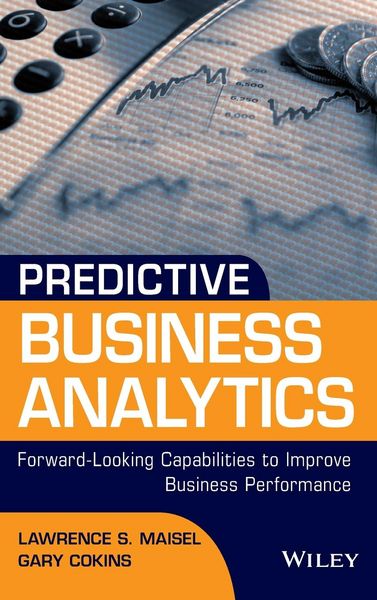
Produktbild: Predictive Business Analytics

Predictive Business Analytics Forward Looking Capabilities to Improve Business Performance

Aus der Reihe SAS Institute Inc

46,99 €

inkl. gesetzl. MwSt., Versandkostenfrei


Beschreibung

Produktdetails

Einband

Gebundene Ausgabe

Erscheinungsdatum

07.10.2013

Verlag

John Wiley & Sons Inc

Seitenzahl

272

Maße (L/B/H)

23,5/15,7/1,9 cm

Gewicht

554 g

Auflage

1. Auflage

Sprache

Englisch

ISBN

978-1-118-17556-9

Beschreibung

Produktdetails

Einband

Gebundene Ausgabe

Erscheinungsdatum

07.10.2013

Verlag

John Wiley & Sons Inc

Seitenzahl

272

Maße (L/B/H)

23,5/15,7/1,9 cm

Gewicht

554 g

Auflage

1. Auflage

Sprache

Englisch

ISBN

978-1-118-17556-9

Herstelleradresse

Libri GmbH
Europaallee 1
36244 Bad Hersfeld
DE

Email: GPSR Kontakt

Noch keine Bewertungen vorhanden

Verfassen Sie die erste Bewertung zu diesem Artikel

Helfen Sie anderen Kundinnen und Kunden durch Ihre Meinung.

Kundinnen und Kunden meinen

Bewertungen (0)

Die Leseprobe wird geladen.
  • Produktbild: Predictive Business Analytics
  • Preface xv
     
    Part One "Why" 1
     
    Chapter 1 Why Analytics Will Be the Next Competitive Edge 3
     
    Analytics: Just a Skill, or a Profession? 4
     
    Business Intelligence versus Analytics versus Decisions 5
     
    How Do Executives and Managers Mature in Applying Accepted Methods? 6
     
    Fill in the Blanks: Which X Is Most Likely to Y? 6
     
    Predictive Business Analytics and Decision Management 7
     
    Predictive Business Analytics: The Next "New" Wave 9
     
    Game-Changer Wave: Automated Decision-Based Management 10
     
    Preconception Bias 11
     
    Analysts' Imagination Sparks Creativity and Produces Confidence 12
     
    Being Wrong versus Being Confused 12
     
    Ambiguity and Uncertainty Are Your Friends 14
     
    Do the Important Stuff First--Predictive Business Analytics 16
     
    What If . . . You Can 17
     
    Notes 19
     
    Chapter 2 The Predictive Business Analytics Model 21
     
    Building the Business Case for Predictive Business Analytics 27
     
    Business Partner Role and Contributions 28
     
    Summary 29
     
    Notes 29
     
    Part Two Principles and Practices 31
     
    Chapter 3 Guiding Principles in Developing Predictive Business Analytics 33
     
    Defining a Relevant Set of Principles 34
     
    PRINCIPLE 1: Demonstrate a Strong Cause-and-Effect Relationship 34
     
    PRINCIPLE 2: Incorporate a Balanced Set of Financial and
     
    Nonfinancial, Internal and External Measures 36
     
    PRINCIPLE 3: Be Relevant, Reliable, and Timely for Decision Makers 37
     
    PRINCIPLE 4: Ensure Data Integrity 38
     
    PRINCIPLE 5: Be Accessible, Understandable, and Well Organized 39
     
    PRINCIPLE 6: Integrate into the Management Process 39
     
    PRINCIPLE 7: Drive Behaviors and Results 40
     
    Summary 41
     
    CHAPTER 4 Developing a Predictive Business Analytics Function 43
     
    Getting Started 44
     
    Selecting a Desired Target State 46
     
    Adopting a PBA Framework 49
     
    Developing the Framework 49
     
    Summary 60
     
    Notes 60
     
    CHAPTER 5 Deploying the Predictive Business Analytics Function 61
     
    Integrating Performance Management with Analytics 63
     
    Performance Management System 64
     
    Implementing a Performance Scorecard 67
     
    Management Review Process 76
     
    Implementation Approaches 78
     
    Change Management 80
     
    Summary 81
     
    Notes 82
     
    Part Three Case Studies 83
     
    CHAPTER 6 MetLife Case Study in Predictive Business Analytics 85
     
    The Performance Management Program 88
     
    Implementing the MOR Program 93
     
    Benefi ts and Lessons Learned 108
     
    Summary 108
     
    Notes 108
     
    CHAPTER 7 Predictive Performance Analytics in the Biopharmaceutical Industry 109
     
    Case Studies 113
     
    Summary 127
     
    Note 127
     
    Part Four Integrating Business Methods and Techniques 129
     
    CHAPTER 8 Why Do Companies Fail (Because of Irrational Decisions)? 131
     
    Irrational Decision Making 131
     
    Why Do Large, Successful Companies Fail? 132
     
    From Data to Insights 134
     
    Increasing the Return on Investment from Information Assets 135
     
    Emerging Need for Analytics 136
     
    Summary 137
     
    Notes 138
     
    CHAPTER 9 Integration of Business Intelligence, Business Analytics, and Enterprise Performance Management 139
     
    Relationship among Business Intelligence, Business Analytics, and Enterprise Performance Management 140
     
    Overcoming Barriers 143
     
    Summary 144
     
    Notes 145
     
    CHAPTER 10 Predictive Accounting and Marginal Expense An