Beschreibung
Produktdetails
Einband
Gebundene Ausgabe
Erscheinungsdatum
05.03.2012
Herausgeber
Josep Guerrero + weitereVerlag
John Wiley & SonsSeitenzahl
328
Maße (L/B/H)
23,4/16/2,3 cm
Gewicht
635 g
Auflage
1. Auflage
Sprache
Englisch
ISBN
978-1-84821-323-4
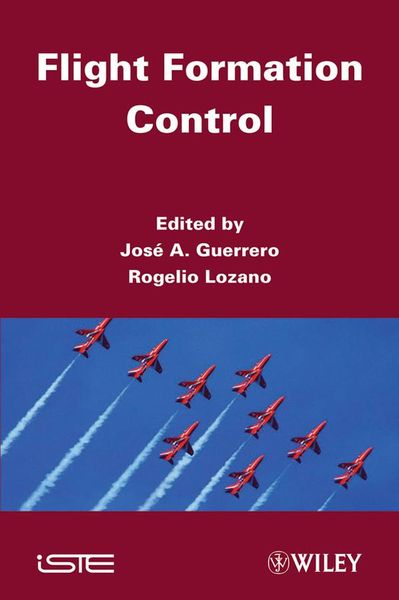
In the last decade the development and control of Unmanned Aerial Vehicles (UAVs) has attracted a lot of interest. Both researchers and companies have a growing interest in improving this type of vehicle given their many civilian and military applications. This book presents the state of the art in the area of UAV Flight Formation. The coordination and robust consensus approaches are presented in detail as well as formation flight control strategies which are validated in experimental platforms. It aims at helping students and academics alike to better understand what coordination and flight formation control can make possible. Several novel methods are presented: - controllability and observability of multi-agent systems; - robust consensus; - flight formation control; - stability of formations over noisy networks; which generate solutions of guaranteed performance for UAV Flight Formation. Contents 1. Introduction, J.A. Guerrero. 2. Theoretical Preliminaries, J.A. Guerrero. 3. Multiagent Coordination Strategies, J.A. Guerrero, R. Lozano, M.W. Spong, N. Chopra. 4. Robust Control Design for Multiagent Systems with Parametric Uncertainty, J.A. Guerrero, G. Romero. 5. On Adaptive and Robust Controlled Synchronization of Networked Robotic Systems on Strongly Connected Graphs, Y.-C. Liu, N. Chopra. 6. Modeling and Control of Mini UAV, G. Flores Colunga, J.A. Guerrero, J. Escareño, R. Lozano. 7. Flight Formation Control Strategies for Mini UAVs, J.A. Guerrero. 8. Formation Based on Potential Functions, L. García, A. Dzul. 9. Quadrotor Vision-Based Control, J.E. Gomez-Balderas, J.A. Guerrero, S. SALAZAR, R. Lozano, P. Castillo. 10. Toward Vision-Based Coordination of Quadrotor Platoons, L.R. García Carrillo, J.A. Guerrero, R. Lozano. 11. Optimal Guidance for Rotorcraft Platoon Formation Flying in Wind Fields, J.A. Guerrero, Y. Bestaoui, R. Lozano. 12. Impact of Wireless Medium Access Protocol on the Quadrotor Formation Control, J.A. Guerrero, Y. Challal, P. Castillo. 13. MAC Protocol for Wireless Communications, A. Mendez, M. Panduro, O. Elizarraras, D. Covarrubias. 14. Optimization of a Scannable Pattern for Bidimensional Antenna Arrays to Provide Maximum Performance, A. Reyna, M.A. Panduro, A. Mendez.
Noch keine Bewertungen vorhanden
Verfassen Sie die erste Bewertung zu diesem Artikel
Helfen Sie anderen Kundinnen und Kunden durch Ihre Meinung.
Kurze Frage zu unserer Seite
Vielen Dank für dein Feedback
Wir nutzen dein Feedback, um unsere Produktseiten zu verbessern. Bitte habe Verständnis, dass wir dir keine Rückmeldung geben können. Falls du Kontakt mit uns aufnehmen möchtest, kannst du dich aber gerne an unseren Kund*innenservice wenden.
zum Kundenservice