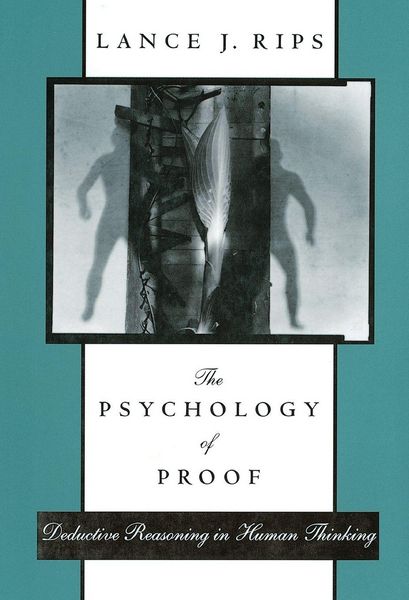
The Psychology of Proof Deductive Reasoning in Human Thinking
-
- Englisch ausgewählt
54,99 €
inkl. gesetzl. MwSt.,
Lieferung nach Hause
Beschreibung
Produktdetails
Einband
Taschenbuch
Erscheinungsdatum
01.01.2003
Verlag
MIT PressSeitenzahl
464
Maße (L/B/H)
23,1/15,7/2,5 cm
Gewicht
695 g
Sprache
Englisch
ISBN
978-0-262-51721-8
Lance Rips describes a unified theory of natural deductive reasoning and fashions a working model of deduction, with strong experimental support, that is capable of playing a central role in mental life.
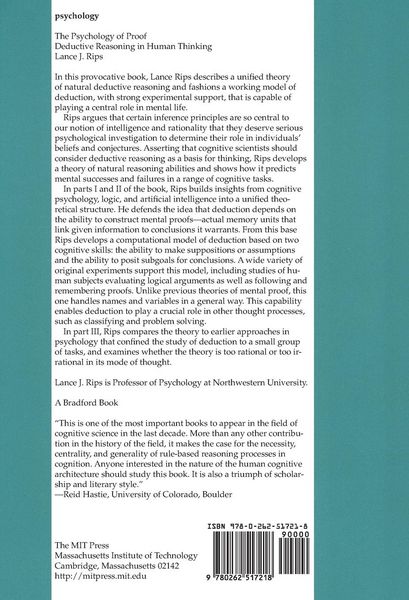
In this provocative book, Lance Rips describes a unified theory of natural deductive reasoning and fashions a working model of deduction, with strong experimental support, that is capable of playing a central role in mental life.
Rips argues that certain inference principles are so central to our notion of intelligence and rationality that they deserve serious psychological investigation to determine their role in individuals' beliefs and conjectures. Asserting that cognitive scientists should consider deductive reasoning as a basis for thinking, Rips develops a theory of natural reasoning abilities and shows how it predicts mental successes and failures in a range of cognitive tasks.
In parts I and II of the book, Rips builds insights from cognitive psychology, logic, and artificial intelligence into a unified theoretical structure. He defends the idea that deduction depends on the ability to construct mental proofs—actual memory units that link given information to conclusions it warrants. From this base Rips develops a computational model of deduction based on two cognitive skills: the ability to make suppositions or assumptions and the ability to posit sub-goals for conclusions. A wide variety of original experiments support this model, including studies of human subjects evaluating logical arguments as well as following and remembering proofs. Unlike previous theories of mental proof, this one handles names and variables in a general way. This capability enables deduction to play a crucial role in other thought processes, such as classifying and problem solving.
In part III, Rips compares the theory to earlier approaches in psychology which confined the study of deduction to a small group of tasks, and examines whether the theory is too rational or too irrational in its mode of thought.
Noch keine Bewertungen vorhanden
Verfassen Sie die erste Bewertung zu diesem Artikel
Helfen Sie anderen Kundinnen und Kunden durch Ihre Meinung.
Kurze Frage zu unserer Seite
Vielen Dank für dein Feedback
Wir nutzen dein Feedback, um unsere Produktseiten zu verbessern. Bitte habe Verständnis, dass wir dir keine Rückmeldung geben können. Falls du Kontakt mit uns aufnehmen möchtest, kannst du dich aber gerne an unseren Kund*innenservice wenden.
zum Kundenservice