• Produktbild: Bacillus thuringiensis Biotechnology
  • Produktbild: Bacillus thuringiensis Biotechnology
- 13%

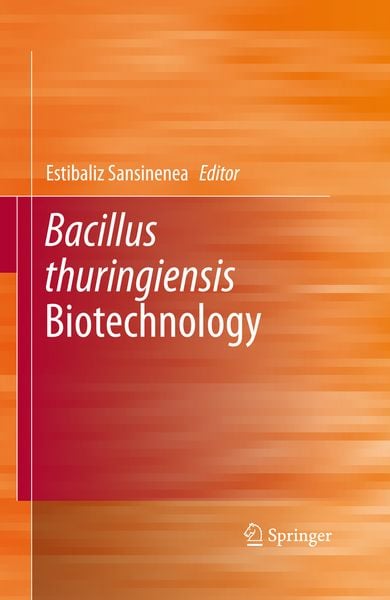
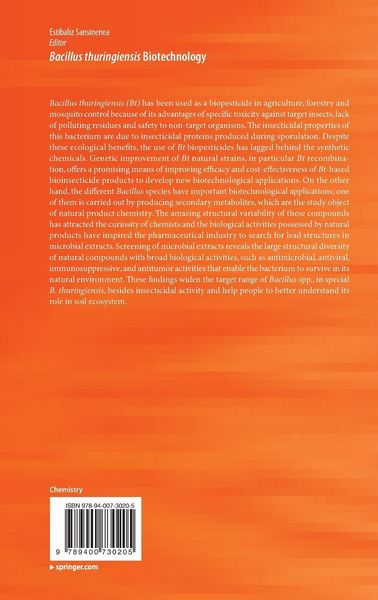
Bacillus thuringiensis Biotechnology

13% sparen

231,99 € UVP 267,49 €

inkl. gesetzl. MwSt., Versandkostenfrei

Lieferung nach Hause

Beschreibung

Produktdetails

Einband

Gebundene Ausgabe

Erscheinungsdatum

14.03.2012

Herausgeber

Estibaliz Sansinenea

Verlag

Springer Netherland

Seitenzahl

392

Maße (L/B/H)

24,1/16/2,7 cm

Gewicht

776 g

Auflage

1. Auflage

Sprache

Englisch

ISBN

978-94-007-3020-5

Beschreibung

Produktdetails

Einband

Gebundene Ausgabe

Erscheinungsdatum

14.03.2012

Herausgeber

Estibaliz Sansinenea

Verlag

Springer Netherland

Seitenzahl

392

Maße (L/B/H)

24,1/16/2,7 cm

Gewicht

776 g

Auflage

1. Auflage

Sprache

Englisch

ISBN

978-94-007-3020-5

Herstelleradresse

Springer-Verlag GmbH
Tiergartenstr. 17
69121 Heidelberg
DE

Email: [email protected]

Kundinnen und Kunden meinen

0 Bewertungen

Informationen zu Bewertungen

Zur Abgabe einer Bewertung ist eine Anmeldung im Konto notwendig. Die Authentizität der Bewertungen wird von uns nicht überprüft. Wir behalten uns vor, Bewertungstexte, die unseren Richtlinien widersprechen, entsprechend zu kürzen oder zu löschen.

Die Bewertungen sind nach Format, Anzahl Sterne und Datum sortiert.

Verfassen Sie die erste Bewertung zu diesem Artikel

Helfen Sie anderen Kund*innen durch Ihre Meinung

Kundinnen und Kunden meinen

0 Bewertungen filtern

  • Produktbild: Bacillus thuringiensis Biotechnology
  • Produktbild: Bacillus thuringiensis Biotechnology
  • Index Of Contributors.- Preface.- PART I BACILLUS THURINGIENSIS: AN ENVIRONMENTALLY SAFETY ALTERNATIVE.- 1 Discovery and description of Bacillus thuringiensis.- 1 .1 Introduction.-  1.2 A brief History and Discovery of Bacillus thuringiensis.- 1.3 A Description of B. thuringiensis.- 1.4 Conclusions.- References.- 2 Bacillus thuringiensis applications in agriculture.- 2.1 Introduction.- 2.2 Methods of application of Bt and its products in agriculture.- 2.3 Advantages of using Bt products over chemical agents in agricultural  practices.- 2.4 Threat to continuous use of Bt as biological control agent.- 2.5 Strategies to ensure continuing use of Bt and its products in agriculture.- References.- 3 Risk Assessment of Bt Transgenic Crops.- 3.1 Introduction.- 3.2 Perceived risks with Bt transgenic crops.- 3.3 Risk analysis of Bt transgenic crops.- 3.4 Oversight of Bt Transgenic crops.- 3.5 Conclusion and Future Prospects.- References.- 4 Use and efficacy of Bt compared to less environmentally safe alternatives .- 4.1 Biopesticide Classification.- 4.2 Biopesticide Market Survey.- 4.3 Use of Bt in IPM.- 4.4 Use and Efficacy of Bt.- References.-  5 Protein Engineering of Bacillus thuringiensis δ-Endotoxins .- 5.1 Introduction.- 5.2 Protein Engineering of Bt δ-endotoxins.- 5.3 Conclusions.- 5.4 Perspectives.- References.- PART II  GENETICS OF BACILLUS THURINGIENSIS.-  6 Evolution of the Bacillus cereus group.- 6.1 The Bacillus cereus group.- 6.2 B. cereus group phylogeny.- 6.3 Bacillus cereus group genome sequencing.- 6.4 Bacillus cereus group bacteria – pathogens and symbionts.- 6.5 What distinguishes the species in the B. cereus group?.- 6.6 Importance of plasmids to B. cereus group biology.- References.- 7 Bacillus thuringiensis genetics and phages - from transduction and sequencing to recombineering .- 7.1 Introduction: a dramatic story of the Bacillus cereus genetics.- 7.2 Phage-mediated gene transduction.- 7.3 Phage-mediated gene transduction in the B. cereus group.- 7.4 Recombineering perspectives for the B. cereus group.- References.-  8 Conjugation in Bacillus thuringiensis: insights into the plasmids exchange process.- 8.1 Introduction.- 8.2  Conjugation as a tool to understand the ecology of B. cereus group.- 8.3 Conclusion and Perspectives.- References.- 9  Shuttle vectors of Bacillus thuringiensis .- 9.1 Introduction.- 9.2 Plasmids in Bacillus thuringiensis.- 9.3 Shuttle vectors of Bacillus thuringiensis.- 9.4 Transformation of Bacillus thuringiensis.- References.-  10 Construction and application in plasmid vectors of Bacillus cereus group .- 10.1 Introduction.- 10.2 Shuttle plasmid vectors in the B. cereus group.- 10.3 Integration vectors in the B. cereus group.- 10.4 Resolution vectors in the B. cereus group.- 10.5 High-effective expression vectors in the B. cereus group.- 10.6 Conclusion.- References.-  11 Recombination in Bacillus thuringiensis.- 11.1 Introduction.- 11.2 Site Specific Recombination in B. thuringiensis.- 11.3 Homologous Recombination in B. thuringiensis.- 11.4 Conclusion.- References.-  12 Genetic improvement of Bt strains and development of novel biopesticides.- 12.1 Introduction.- 12.2 Discovery of new Bt strains harbouring novel cry genes.- 12.3 Engineering of novel Cry proteins.- 12.4 Construction of new Bt strains by conjugation.- 12.5 Expression of Bt cry genes in heterologous microbial hosts.- 12.6 Development of recombinant Bt strains.- 12.7 Development of asporogenic Bt strains.- 12.8 Concluding remarks.- References.- PART III BT AS BIOPESTICIDE: APPLICATIONS IN BIOTECHNOLOGY.-  13 Genetically Modified Bacillus thuringiensis Biopesticides .- 13.1 Introduction.- 13.2 Strategies for constructing genetically modified Bt strains for engineered biopesticide development.- 13.3 Bt engineered strains with high toxicity or broader insecticidal spectrum.- 13.4 Multifunctional Bt engineered strains.- 13.5 Genetically modified Bt strains with delayed pest resistance.- References.- 14 Bacillus thuringiensis Recombinant Insecticidal Protein Production.- 14.1 Introduction.- 14.2 Pesticidal Protein Expression in Gram Negative Hosts.- 14.3 Pesticidal Protein Expression in B. thuringiensis.- 14.4 Bacterial expression applications summary.- 14.5 Expression in Transgenic Plants.- 14.6 Plant Expression Summary.- 14.7 Conclusion.- Bibliography.- 15 Bt crops: past and future .- 15.1 Introduction.- 15.2 Developments conducive to Bt crops.- 15.3 Commercialization and performance of “first generation” Bt crops.- 15.4 Risks associated with the use of Bt crops.- 15.5 “Second” and “third” generation Bt crops.- 15.6 Conclusions and future prospects.- References.- 16 A Review of the Food Safety of Bt Crops.- 16.1 Background.- 16.2 Regulatory guidance for the safety assessment of Cry proteins.- 16.3 The Species-specific acute mode of action of Cry proteins.- 16.4 Potential digestibility of Cry proteins.- 16.5 Toxicology testing of Cry proteins.- 16.6 Assessment of food processing on Cry protein biological activity.- 16.7 Human dietary exposure assessment for Cry proteins in Bt crops.- 16.8 Toxicology feeding studies in rodents fed Bt crops.- 16.9 Food and Feed Safety Benefits of Bt Crops.- 16.10 Conclusions.- References.- PART IV OTHER BACILLUS SPECIES IN BIOTECHNOLOGY.- 17 The most important Bacillus species in biotechnology.- 17.1 Introduction.- 17.2 Most important biotechnological applications of Bacillus species.- 17.3 Conclusions and perspectives.- References.-  18 Secondary metabolites of Bacillus: potentials in biotechnology.- 18.1 Introduction.- 18.2 The most important secondary metabolites of Bacillus species.- 18.3 Other metabolites and activities of Bacillus species.- 18.4 Secondary metabolites from marine Bacilli.- 18.5 Safety evaluation and risk assessment.- 18.6 Conclusion and perspectives.- References.- 19 Future challenges and prospects of Bacillus thuringiensis.- 19.1 Introduction.- 19.2 Chitinases of B. thuringiensis in environment and food industry.- 19.3 Bacteriocins of Bacillus thuringiensis.- References.