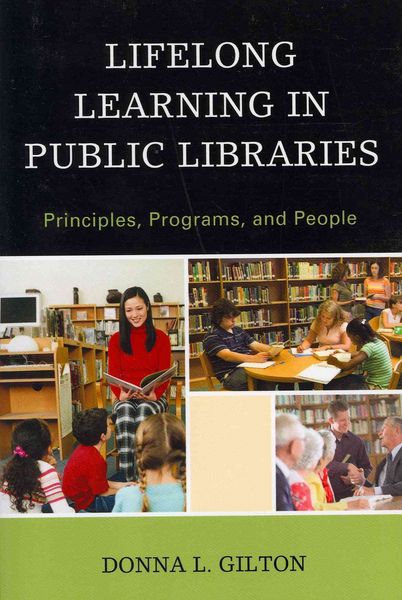
Produktbild: Lifelong Learning in Public Libraries

Lifelong Learning in Public Libraries Principles, Programs, and People

99,99 €

inkl. gesetzl. MwSt., Versandkostenfrei

Lieferung nach Hause

Beschreibung

Produktdetails

Einband

Taschenbuch

Erscheinungsdatum

15.03.2012

Verlag

Scarecrow Press

Seitenzahl

252

Maße (L/B/H)

22,9/15,2/1,5 cm

Gewicht

415 g

Sprache

Englisch

ISBN

978-0-8108-8356-7

Beschreibung

Produktdetails

Einband

Taschenbuch

Erscheinungsdatum

15.03.2012

Verlag

Scarecrow Press

Seitenzahl

252

Maße (L/B/H)

22,9/15,2/1,5 cm

Gewicht

415 g

Sprache

Englisch

ISBN

978-0-8108-8356-7

Herstelleradresse

Libri GmbH
Europaallee 1
36244 Bad Hersfeld
DE

Email: [email protected]

Kundinnen und Kunden meinen

0 Bewertungen

Informationen zu Bewertungen

Zur Abgabe einer Bewertung ist eine Anmeldung im Konto notwendig. Die Authentizität der Bewertungen wird von uns nicht überprüft. Wir behalten uns vor, Bewertungstexte, die unseren Richtlinien widersprechen, entsprechend zu kürzen oder zu löschen.

Die Bewertungen sind nach Format, Anzahl Sterne und Datum sortiert.

Verfassen Sie die erste Bewertung zu diesem Artikel

Helfen Sie anderen Kund*innen durch Ihre Meinung

Kundinnen und Kunden meinen

0 Bewertungen filtern

Die Leseprobe wird geladen.
  • Produktbild: Lifelong Learning in Public Libraries
  • Chapter 1. The World of Information Literacy Instruction (ILI): An Extensive and Intensive Introduction and Overview
    A. What is Information Literacy
    B. Early Instruction in Academic Libraries
    C. From Bibliographic Instruction (BI) to Information Literacy Instruction (ILI)
    D. Current Instruction in Academic Libraries
    E. Instruction in School Media Centers
    F. Instruction in Special Libraries
    G. ILI as a Department Store: Components of Instruction
    H. Information Enfranchisement, Samuel Green and the Three-Legged Stool of Reference Services
    I. Instruction in Public Libraries: Some History and Background
    Chapter 2. Current Developments in Public Library Instruction
    A. Forms of Public Library Instruction
    B. Public Library Instruction Outside the U.S.A.
    C. State of the Literature in Public Library Instruction
    Chapter 3. How People Learn, Grow, Think, Feel, and Develop: Do We Have Theories!
    A. How People Mature: Theories of Erikson, Piaget, Perry, Belenky, Kohlberg, Gilligan, Vygotsky, and Others
    B. How People Act: Behaviorism
    C. How People Think: Cognitive Theories
    D. How People Solve Problems: Constructivism
    E. How People Feel: Educational Humanism
    F. How People Learn: Perceptual Modalities, Field Dependence and Independence, and Multiple Intelligence
    Chapter 4. Instructing Diverse Groups
    A. International Students and Immigrants
    B. U.S. Ethnic Groups, Especially Racial Minorities
    Chapter 5. Teaching People With Disabilities in Ten Steps
    A. Know the Issues
    B. Know the Laws and the History of Services, Family Activism, and Organizations
    C. Know About Developments in Education and LIS
    D. Know Whether Your Library is ADA-Compliant
    E. Know Whether Your Website is Accessible to All
    F. Know How to Find Out About Adaptive or Assistive Technology
    G. Plan Services to People With Disabilities, in General
    H. Teach Your Staff
    I. Plan Your Instruction
    J. Know the Needs of Specific Groups
    Chapter 6. Making a PACE of a Program: Planning, Administration, Coordination, and Evaluation
    A. Models of Instruction, Modes of Planning
    B. Startup Resources For ILI
    C. Planning
    D. Evaluation
    E. Marketing
    F. Staffing For Instruction
    G. What a Good Instruction Program Looks Like
    Chapter 7. Public Libraries as Non-formal Cultural Institutions: Impact on Programming and Instruction
    A. Types of Education
    B. Churches and Other Religious Bodies as Agents of Non-formal Education
    C. Museums and Public Libraries as Agents of Non-formal Education
    D. Traditional Public Libraries and ILI
    Chapter 8. Instructing From the Cradle to the Grave Throughout the Life Cycle
    A. Preschoolers and Their Caretakers
    B. Children, Teens, and Family Outreach
    C. Coming of Age: Roads to Adulthood
    D. All Grown Up and Places to Go: Adult Learners
    E. Coming of Age: Elderhood
    F. Conclusions
    Bibliography