Gutscheinbedingungen

**Gültig bis 10.06.2026 / Gültig für gebrauchte Bücher / Mindestbestellwert 20,00 € / Einzelne Artikel können ausgeschlossen sein / Online auf www.bücher.de.de / Nicht kombinierbar mit anderen Gutscheinen oder Preisaktionen / Nur einmal pro Einkauf einlösbar / Gutschein wird auf max. 500€ Bestellwert angerechnet / Keine Barauszahlung / Nicht gültig für Versandkosten und Services

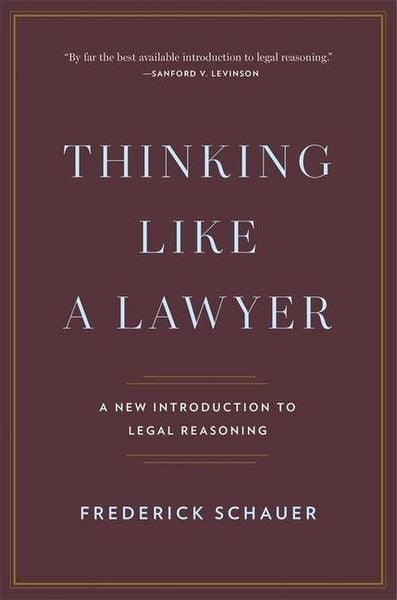
Produktbild: Thinking Like a Lawyer

Thinking Like a Lawyer A New Introduction to Legal Reasoning

27,99 €

inkl. gesetzl. MwSt., Versandkostenfrei

Lieferung nach Hause

Beschreibung

Produktdetails

Einband

Taschenbuch

Erscheinungsdatum

16.04.2012

Verlag

University Presses

Seitenzahl

256

Maße (L/B/H)

24,2/15,9/1,8 cm

Gewicht

302 g

Sprache

Englisch

ISBN

978-0-674-06248-1

Beschreibung

Produktdetails

Einband

Taschenbuch

Erscheinungsdatum

16.04.2012

Verlag

University Presses

Seitenzahl

256

Maße (L/B/H)

24,2/15,9/1,8 cm

Gewicht

302 g

Sprache

Englisch

ISBN

978-0-674-06248-1

Herstelleradresse

Libri GmbH
Europaallee 1
36244 Bad Hersfeld
DE

Email: gpsr@libri.de

Kundinnen und Kunden meinen

0 Bewertungen

Informationen zu Bewertungen

Zur Abgabe einer Bewertung ist eine Anmeldung im Konto notwendig. Die Authentizität der Bewertungen wird von uns nicht überprüft. Wir behalten uns vor, Bewertungstexte, die unseren Richtlinien widersprechen, entsprechend zu kürzen oder zu löschen.

Die Bewertungen sind nach Format, Anzahl Sterne und Datum sortiert.

Verfassen Sie die erste Bewertung zu diesem Artikel

Helfen Sie anderen Kund*innen durch Ihre Meinung

Kundinnen und Kunden meinen

0 Bewertungen filtern

  • Produktbild: Thinking Like a Lawyer
  • * Preface * Is There Legal Reasoning? * Rules--in Law and Elsewhere 2.1 Of Rules in General 2.2 The Core and the Fringe 2.3 The Generality of Rules 2.4 The Formality of Law * The Practice and Problems of Precedent 3.1 Precedent in Two Directions 3.2 Precedent--The Basic Idea 3.3 A Strange Idea 3.4 On Identifying a Precedent 3.5 On the Force of Precedent--Overruling, Distinguishing, and Other Types of Avoidance * Authority and Authorities 4.1 The Idea of Authority 4.2 On Binding and So-Called Persuasive Authority 4.3 Why Real Authority Need Not be "Binding" 4.4 Can There Be Prohibited Authorities? 4.5 How Authorities Become Authoritative * The Use and Abuse of Analogies 5.1 On Distinguishing Precedent from Analogy 5.2 On the Determination of Similarity 5.3 The Skeptical Challenge 5.4 Analogy and the Speed of Legal Change * The Idea of the Common Law 6.1 Some History and a Comparison 6.2 On the Nature of the Common Law 6.3 How Does the Common Law Change? 6.4 Is the Common Law Law? 6.5 A Short Tour of the Realm of Equity * The Challenge of Legal Realism 7.1 Do Rules and Precedents Decide cases? 7.2 Does Doctrine Constrain Even if It Does Not Direct? 7.3 An Empirical Claim 7.4 Realism and the Role of the Lawyer 7.5 Critical Legal Studies and Realism in Modern Dress * The Interpretation of Statutes 8.1 Statutory Interpretation in the Regulatory State 8.2 The Role of the Text 8.3 When the Text Provides No Answer 8.4 When the Text Provides a Bad Answer 8.5 The Canons of Statutory Construction * The Judicial Opinion 9.1 The Causes and Consequences of Judicial Opinions 9.2 Giving Reasons 9.3 On Holding and Dicta 9.4 The Declining Frequency of Opinions * Making Law with Rules and Standards 10.1 The Basic Distinction 10.2 Rules, Standards, and the Question of Discretion 10.3 Stability and Flexibility 10.4 Rules and Standards in Judicial Opinions * Law and Fact 11.1 On the Idea of a Fact 11.2 Determining Facts at Trial--The Law of Evidence and Its Critics 11.3 Facts and the Appellate Process * The Burden of Proof and Its Cousins 12.1 The Burden of Proof 12.2 Presumptions 12.3 Deference and the Allocation of Decision-Making Responsibility * Index