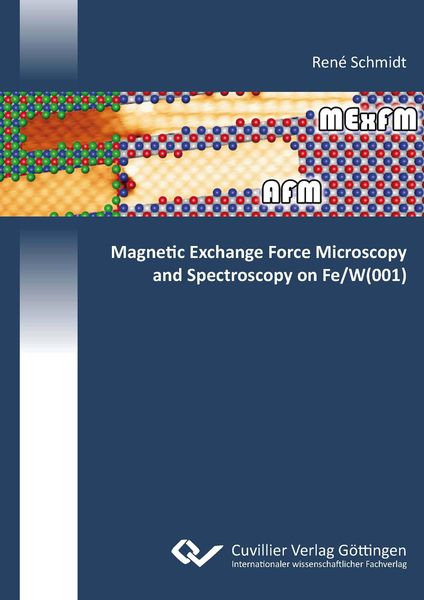
Magnetic Exchange Force Microscopy and Spectroscopy on Fe/W(001)
-
- Taschenbuch ausgewählt
- eBook
-
Sprache:Englisch
27,95 €
inkl. gesetzl. MwSt.,
Lieferung nach Hause
Beschreibung
Produktdetails
Einband
Taschenbuch
Erscheinungsdatum
17.08.2011
Verlag
Cuvillier, ESeitenzahl
144
Maße (L/B/H)
21/14,8/0,8 cm
Gewicht
197 g
Sprache
Englisch
ISBN
978-3-86955-855-4
Iron grows pseudomorphically on W(001) whereby the layers are highly strained. Differences in strain between first and second layer iron and hybridization with the substrate lead to differences in electronic properties and magnetism: both layers exhibit a different work function, mapped with KPFM. Interestingly, even on the same layer, different work functions are observed. Moreover, both layers are magnetically different. The second layer is ferromagnetic (FM) with in-plane anisotropy as verified by MFM, while the first layer is antiferromagnetic (AF) with out-of-plane anisotropy. Using MexFM the AF alignment of the monolayer magnetic moments is resolved by detecting the short-ranged magnetic exchange force between tip and sample. The origin of the magnetic contrast formation is discussed and compared to ab initio calculations. Later, MExFS, which allows to directly measure the distance dependence of the magnetic exchange interaction between an atomically sharp magnetic tip and the antiferromagnetically ordered Fe monolayer on W(001), is employed. The site specific distance dependence of the total tip-sample interaction is recorded above Fe atoms which exhibit parallel as well as antiparallel atomic magnetic moments. The contribution of the magnetic exchange interaction between both sites can be extracted by subtracting the two curves from each other. All other interactions are identical on both sites. The experimental results are compared to ab initio calculations accounting for magnetically different tips composed of either Cr or Fe, or mixtures of both. Depending on symmetry and stability of the experimentally used probe tips, qualitatively different MExFM contrasts and MExFS data with a stronger distance dependence are observed. By analyzing the energy loss per single cantilever oscillation cycle, simultaneously recorded with topography and frequency shift in the experiments, a bottom-up characterization of the structurally and magnetically unknown probe tip apex is given. Considering the tip apex as magnetically and structurally independent cluster allows to explain the observed tip behavior.
Noch keine Bewertungen vorhanden
Verfassen Sie die erste Bewertung zu diesem Artikel
Helfen Sie anderen Kundinnen und Kunden durch Ihre Meinung.
Kurze Frage zu unserer Seite
Vielen Dank für dein Feedback
Wir nutzen dein Feedback, um unsere Produktseiten zu verbessern. Bitte habe Verständnis, dass wir dir keine Rückmeldung geben können. Falls du Kontakt mit uns aufnehmen möchtest, kannst du dich aber gerne an unseren Kund*innenservice wenden.
zum Kundenservice