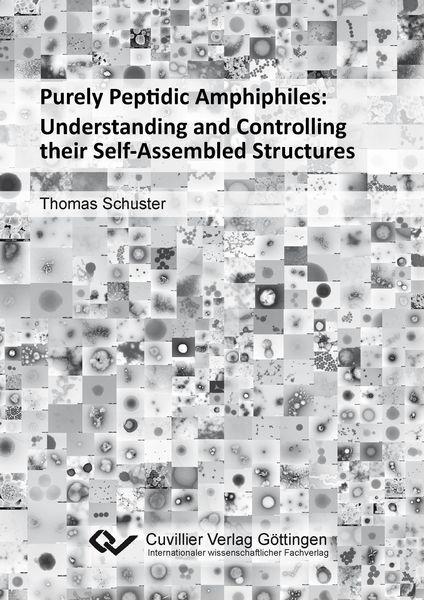
Purely Peptidic Amphiphiles: Understanding and Controlling their Self-Assembled Structures
-
- Taschenbuch ausgewählt
- eBook
-
Sprache:Englisch
22,95 €
inkl. gesetzl. MwSt.,
Beschreibung
Produktdetails
Einband
Taschenbuch
Erscheinungsdatum
05.07.2011
Verlag
Cuvillier, ESeitenzahl
138
Maße (L/B/H)
21/14,8/0,8 cm
Gewicht
189 g
Sprache
Englisch
ISBN
978-3-86955-797-7
Amphiphilic molecules spontaneously self-assemble into a variety of structures in solution. The term amphiphilic indicates that one part of the molecule is attracted to the solvent, while the other is not. Interactions such as between solute-solvent and solute-solute thus determine the organization. Understanding the self-assembly means understanding those interactions and their driving forces. In the first chapter an overview of the self-organization of amphiphilic molecules into supermolecuar aggregates of different morphologies is provided, with a focus on purely peptidic amphiphiles, i.e. amphiphiles which consist solely of a different amino acid sequence. In the second chapter the self-assembly of amphiphilic peptides with a specific amino acid sequence into micelles and spherical peptide nanoparticles is described. The undecamer peptide that was used features a repetitive L-tryptophan and D-leucine [LW-DL] motif, representing the hydrophobic block - which is a truncated version of gramicidin A (gA), named gT. The N-terminally attached hydrophilic section was either lysine (K) or acetylated lysine (X) and was optionally terminated with cysteine for post-functionalization of the thiol-group. The uncharged peptide AcC-X3-gT was demonstrated to assemble into micelles and subsequently into peptide particles, termed 'peptide beads'. We hypothesize that the peptide beads consisted of micelles - a structure described as multicompartment micelles. Peptide beads using AcC-X3-gT and its analogues - including Ac-X3-gT-C, a new peptide with the cysteine residue on the C instead of the N-terminus - are further investigated in Chapter Three. We succeeded in creating highly ordered Ac-X3-gT-C - Au-NP composites, which allowed us to visualize the inner structure of the nanoparticles. The presented composite materials are expected to exhibit exceptional electrical and optical properties.
Noch keine Bewertungen vorhanden
Verfassen Sie die erste Bewertung zu diesem Artikel
Helfen Sie anderen Kundinnen und Kunden durch Ihre Meinung.
Kurze Frage zu unserer Seite
Vielen Dank für dein Feedback
Wir nutzen dein Feedback, um unsere Produktseiten zu verbessern. Bitte habe Verständnis, dass wir dir keine Rückmeldung geben können. Falls du Kontakt mit uns aufnehmen möchtest, kannst du dich aber gerne an unseren Kund*innenservice wenden.
zum Kundenservice