
• Produktbild: Information Literacy as a Student Learning Outcome
  • Produktbild: Information Literacy as a Student Learning Outcome

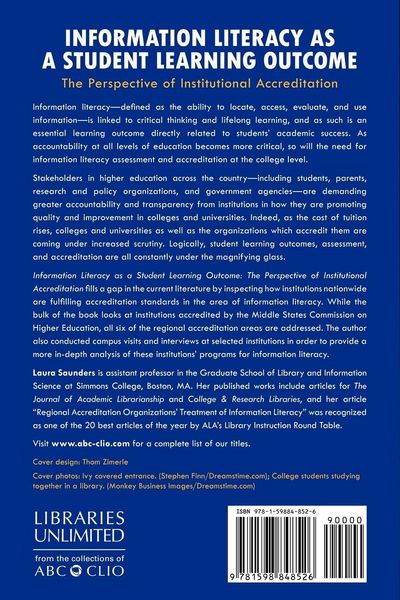
Information Literacy as a Student Learning Outcome The Perspective of Institutional Accreditation

78,99 €

inkl. gesetzl. MwSt., Versandkostenfrei

Lieferung nach Hause

Beschreibung

Produktdetails

Einband

Taschenbuch

Erscheinungsdatum

29.06.2011

Verlag

Libraries Unlimited

Seitenzahl

316

Maße (L/B/H)

23,4/15,6/1,7 cm

Gewicht

483 g

Sprache

Englisch

ISBN

978-1-59884-852-6

Beschreibung

Produktdetails

Einband

Taschenbuch

Erscheinungsdatum

29.06.2011

Verlag

Libraries Unlimited

Seitenzahl

316

Maße (L/B/H)

23,4/15,6/1,7 cm

Gewicht

483 g

Sprache

Englisch

ISBN

978-1-59884-852-6

Herstelleradresse

Libri GmbH
Europaallee 1
36244 Bad Hersfeld
DE

Email: gpsr@libri.de

Kundinnen und Kunden meinen

0 Bewertungen

Informationen zu Bewertungen

Zur Abgabe einer Bewertung ist eine Anmeldung im Konto notwendig. Die Authentizität der Bewertungen wird von uns nicht überprüft. Wir behalten uns vor, Bewertungstexte, die unseren Richtlinien widersprechen, entsprechend zu kürzen oder zu löschen.

Die Bewertungen sind nach Format, Anzahl Sterne und Datum sortiert.

Verfassen Sie die erste Bewertung zu diesem Artikel

Helfen Sie anderen Kund*innen durch Ihre Meinung

Kundinnen und Kunden meinen

0 Bewertungen filtern

  • Produktbild: Information Literacy as a Student Learning Outcome
  • Produktbild: Information Literacy as a Student Learning Outcome
  • Illustrations
    Foreword
    Acknowledgments
    1. Introduction
    A Brief History of Information Literacy
    Development of Information Literacy
    Information Literacy as a Learning Outcome
    Assessment of Information Literacy Learning Outcomes
    Debating Definitions
    Conclusion
    2. Accreditation and Higher Education in the United States
    Overview of Accreditation
    A Brief History of Accreditation in the United States
    Overview
    The Council on Higher Education Accreditation
    Accreditation Process
    Stakeholders Interested in Learning Outcomes
    Direct Stakeholders
    Indirect Stakeholders
    Purposes of Accreditation
    Accountability
    Improving the Quality of the Educational Experience
    Assessment
    Outcomes Assessment
    Assessment for Quality Improvement
    Information Literacy as a Learning Outcome
    Middle States Commission on Higher Education
    Conclusion
    3. The Study's Reflective Inquiry and Procedures
    Problem Statement
    Literature Review
    The Library: Roles and Responses
    Collaboration/Partnerships for Instruction and Assessment
    Accountability and Transparency
    Institutional Culture
    Leadership
    Procedures
    Population
    Methodology
    Limitations
    Conclusion
    4. Quantitative Findings of Institutes Accredited by the Middle States Commission and Case Study Selection
    Response Rates
    Age of Report
    Incidence of Information Literacy
    Information Literacy: Uses and Contexts
    Integration at Various Levels
    Division of Responsibilities and Attention to Competency Areas
    Information Literacy: Themes
    Collaboration
    Assessment
    Accountability and Transparency
    Institutional Culture
    Leadership
    Case Study Selection
    Conclusion
    5. Quantitative Findings for Phase Four: The Remaining Five Regions
    Differences in Regional Accreditation
    Incidence of Information Literacy
    Information Literacy in Context
    Integration at Various Levels
    Division of Responsibility and Attention to Competency Areas
    Information Literacy: Themes
    Collaboration
    Assessment
    Accountability and Transparency
    Institutional Culture
    Leadership
    Regional Differences Revisited
    Quality Enhancement Plans for Information Literacy
    Conclusion
    6. Updates to the Middle States Commission Region
    Updated Findings
    Collaboration
    Assessment, Accountability, and Transparency
    Institutional Culture and Leadership
    Comparison of Successive Self-Study Documents
    Conclusion
    7. Collaboration
    Framework for Information Literacy Collaboration
    A Typology of Collaboration
    Course-Level Collaboration
    Program-Level Collaboration
    Institutional-Level Collaboration
    Cross-Campus Collaboration
    Collaboration at Degree Levels
    Division of Responsibilities
    Barriers to Collaboration
    Status of the Library and Librarian
    Faculty Reticence
    Segregation of Information Literacy
    Understanding Information Literacy
    Understanding Roles
    Culture and Collaboration
    Benefits of Collaboration
    Building Bridges
    Conclusion
    8. Assessment of Learning Outcomes for Information Literacy
    Information Literacy Assessment: Its Contexts
    Course-Level Assessment
    Program-Level Assessment
    Institutional-Level Assessment
    Defining Learning Outcomes for Information Literacy
    Types of Assessment Activities
    Assessment at Case Study Institutions
    Assessment for Student Outcomes
    Uses of Assessment Data
    Establishing a Program
    Conclusion
    9. Accountability and Transparency
    Individual Responses and Levels of Transparency
    Reasons for Declining to Participate
    Higher Levels of Transparency
    Accountability, Transparency, and Information Literacy
    Accountability and Transparency: A Broader Perspective
    Stakeholder Demands
    Accountability: Measuring Achievement
    Costs and Outcomes
    Concerns about Student Learning
    Transparency: Quality and Accessibility of Information
    Accreditation Concerns and Responses
    International Context and Competition
    The Higher Education Act
    Institutional Concerns and Responses
    Conclusion
    10. Institutional Culture
    Definitions of Institutional and Organizational Cultures
    Interactions Across and Among Cultures
    Importance of Cultural Sensitivity
    Conclusion
    11. Leadership for Information Literacy
    Definitions of Leadership
    Teacher Leaders
    Librarians and Leadership
    Relationship Building
    Institutional Understanding and Involvement
    Creating a Shared Vision
    Taking Risks
    Support from Administrators and Faculty
    Incentives and Rewards
    External Pressure
    Conclusion
    12. Looking to the Future
    Information Literacy in Context
    Current Issues
    Ownership and Information Literacy
    Leadership and Information Literacy
    Assessment
    Assessment for Improvement
    Moving Forward
    The Role of Accreditation
    Further Research
    Expectations and Reality
    Conclusion
    Bibliography
    Index