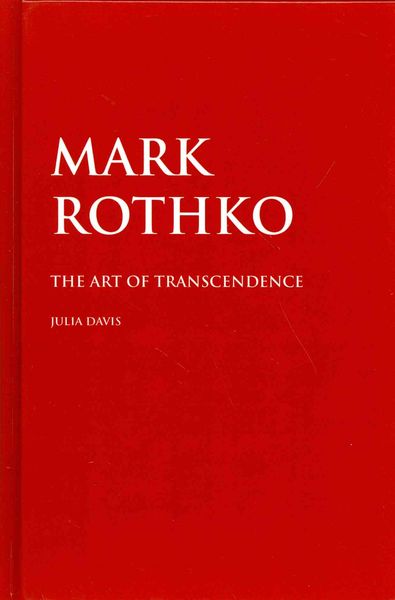
Mark Rothko The Art of Transcendence
-
- Hardcover ausgewählt
- Taschenbuch
-
Sprache:Englisch
36,99 €
inkl. gesetzl. MwSt.,
Lieferung nach Hause
Beschreibung
Produktdetails
Einband
Gebundene Ausgabe
Erscheinungsdatum
01.03.2011
Verlag
Crescent Moon PublishingSeitenzahl
140
Maße (L/B/H)
24/16,1/1,2 cm
Gewicht
382 g
Auflage
3
Sprache
Englisch
ISBN
978-1-86171-315-5
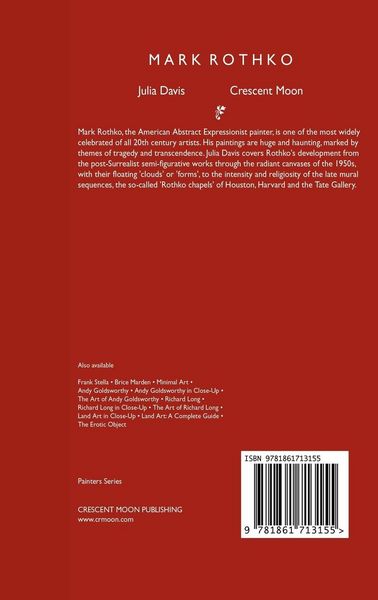
MARK ROTHKO Mark Rothko (1903-1970, born Marcus Rothkowitz in Dvinsk, Russia) is one of the great 20th century American artists. A huge amount of material that has grown up around Rothko. Like Vincent van Gogh, Pablo Picasso, Claude Monet and Leonardo da Vinci, Mark Rothko has been lionized by hundreds of art critics. Rothko remains a greatly admired painter. His works will not, it seems, reach the same mass audiences as Monet or van Gogh, perhaps because Rothko is an abstract artist, and very few abstract artists achieve the mega stature of figurative painters such as van Gogh or Monet. Abstract art of the Mark Rothko kind - the colourfield skeins of Morris Louis, or the black stripes of polychrome shaped canvases of Frank Stella, or the bold, black, calligraphic brushstrokes of Franz Kline - has yet to become as widely accepted as Gustav Klimt's nudes or Sandro Botticelli's Madonnas. In the art world itself, though, Mark Rothko is a highly celebrated painter. He appears in the 20th century Olympian pantheon alongside Jackson Pollock, Piet Mondrian, Paul Klee, Robert Rauschenberg and Jasper Johns. Mark Rothko's art has been seen by critics as 'transcendent' (Ashton, Robertson), 'a sort of spiritual Stonehenge' (Brookner), 'lavish self-indulgence' (Kozloff), 'Dionysian' (Hobbs), 'sensuous and and spiritual' (Waldman), 'enormous, beautiful, opaque surfaces' (Selz), 'enigmatic, gripping presence' (Goldwater), 'incandescent color' (Greenberg), 'haunting' (Sylvester), 'visionary simplicity' (Sandler) and 'tinted hallucinatory cloth' (de Kooning). For poet John Ashbery, Rothko 'seems to eliminate criticism'. The archetypal response to Mark Rothko's art is that it is a (1) 'heroic', (2) 'transcendent', (3) 'spiritual' and (4) 'tragic' art. These are four of the most commonly deployed adjectives in Rothko art criticism (others include 'Buddhist', 'Faustian' and 'death-conscious'). Rothko's painting is seen as (1) 'heroic' because it attempts achieve something great in a world of Existential suffering. Out the slime and the pain and the horror of modern life rise Rothko's 'heroic' canvases. His canvases become a gesture of affirmation in amongst the global angst (as with Rothko's contemporaries, such as Pollock and Newman). Includes new illustrations.
Noch keine Bewertungen vorhanden
Verfassen Sie die erste Bewertung zu diesem Artikel
Helfen Sie anderen Kundinnen und Kunden durch Ihre Meinung.
Kurze Frage zu unserer Seite
Vielen Dank für dein Feedback
Wir nutzen dein Feedback, um unsere Produktseiten zu verbessern. Bitte habe Verständnis, dass wir dir keine Rückmeldung geben können. Falls du Kontakt mit uns aufnehmen möchtest, kannst du dich aber gerne an unseren Kund*innenservice wenden.
zum Kundenservice