KI-Beratung Beta

Gutscheinbedingungen

**Gültig vom 23.11. bis 30.11.2026 | Gültig für nicht preisgebundene fremdsprachige Bücher | Einzelne Artikel können ausgeschlossen sein | Online auf www.bücher.de einlösbar | Click & Collect nur mit Online-Zahlung (Paypal/Kreditkarte) vorab | Nicht kombinierbar mit anderen Gutscheinen oder Preisaktionen | Nur einmal pro Einkauf einlösbar | Gutschein wird auf max. 500€ Bestellwert angerechnet | Keine Barauszahlung | Nicht gültig für Versandkosten und Services

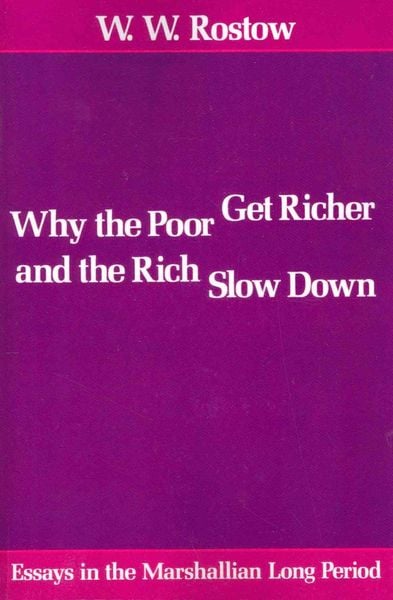
Produktbild: Why the Poor Get Richer and the Rich Slow Down

Why the Poor Get Richer and the Rich Slow Down Essays in the Marshallian Long Period

42,99 €

inkl. gesetzl. MwSt., Versandkostenfrei


Beschreibung

Bearing on fundamental issues of economic theory, history, and public policy, this volume elaborates and goes beyond themes enunciated in W. W. Rostow's previous works. The eight essays presented here are unified by the author's insistence that neo-Keynesian and neoclassical theory are an inadequate...

Beschreibung

Bearing on fundamental issues of economic theory, history, and public policy, this volume elaborates and goes beyond themes enunciated in W. W. Rostow's previous works. The eight essays presented here are unified by the author's insistence that neo-Keynesian and neoclassical theory are an inadequate basis for economic analysis and policy prescription. Changes in technology and in the supply of energy, food, and raw materials, he contends, must be taken into account. The scale and character of the investments required to respond to these changes link his analysis back to conventional income analysis. Rostow outlines in several contexts the framework for a general, disaggregated theory of production and prices that meets this criterion.

The theoretical and historical essays include a review and unification of various long-cycle theories; a formal mathematical model of the Kondratieff cycle; a review of theories relating technology and the price system, including Rostow's own formulation of the appropriate linkage; a lengthy analysis of the pre-1914 relation between money and prices, including a detailed critique of modern monetarist interpretations; and an analysis of the proposition that economic growth assumes an S-shaped path of acceleration and deceleration.

The policy essays include an examination of the links between energy-related investment, full employment, and patterns of regional development in the United States; the discussion of an appropriate framework and procedure for North-South international economic negotiations; and the text of a 1965 talk on inflation that touches on the relations among economics, economists, and the performance of societies as a whole.

Produktdetails

Einband

Taschenbuch

Erscheinungsdatum

01.06.1980

Verlag University of Texas Press
Seitenzahl

396

Produktdetails

Einband

Taschenbuch

Erscheinungsdatum

01.06.1980

Verlag University of Texas Press
Seitenzahl

396

Maße (L/B/H)

22,9/15,2/2,3 cm

Gewicht

641 g

Sprache

Englisch

ISBN

978-0-292-72963-6

Herstelleradresse

Libri GmbH
Europaallee 1
36244 Bad Hersfeld
DE

Email: Libri GmbH

Noch keine Bewertungen vorhanden

Verfassen Sie die erste Bewertung zu diesem Artikel

Helfen Sie anderen Kundinnen und Kunden durch Ihre Meinung.

Kundinnen und Kunden meinen

Bewertungen (0)

  • Produktbild: Why the Poor Get Richer and the Rich Slow Down
    • Preface
    • 1. The Long Cycle: An Integrated View
    • 2. A Simple Model of the Kondratieff Cycle with Four Variations
    • 3. Energy, Full Employment, and Regional Development: The American Case
    • Appendix: A Comparison of Investment Estimates for the National Energy Plan and Energy Information Administration Projections to 1985
    • 4. Technology and the Price System
    • 5. Money and Prices
    • 6. Growth Rates at Different Levels of Income and Stage of Growth : Reflections on Why the Poor Get Richer and the Rich Slow Down
    • Appendix 1. Real GNP per Capita
    • Appendix 2. Gross Investment as Percentage of GNP
    • 7. How to Break the Impasse in North-South Multilateral Economic Negotiations
    • 8. The Chapter That Keynes Never Wrote
    • Notes
    • Author Index
    • Subject Index