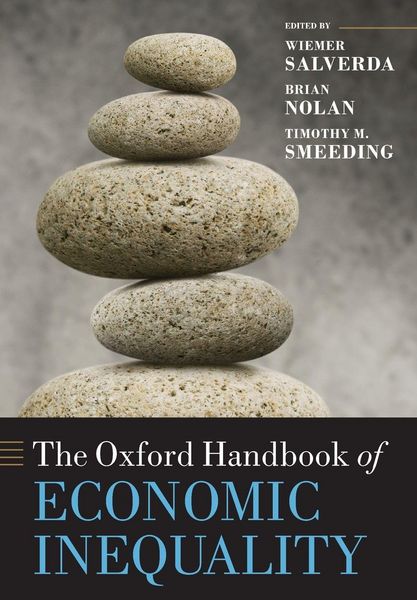
Produktbild: The Oxford Handbook of Economic Inequality

The Oxford Handbook of Economic Inequality

Aus der Reihe Oxford Handbooks

84,99 €

inkl. gesetzl. MwSt., Versandkostenfrei

Lieferung nach Hause

Beschreibung

Produktdetails

Einband

Taschenbuch

Erscheinungsdatum

08.07.2013

Herausgeber

Salverda Wiemer + weitere

Verlag

Oxford University Press

Seitenzahl

768

Maße (L/B/H)

24,4/17/4,1 cm

Gewicht

1210 g

Sprache

Englisch

ISBN

978-0-19-960606-1

Beschreibung

Rezension

This book should be of interest to a vast audience...All chapters are clearly written and accessible, even for non specialists. This Handbook covers almost all the themes that are of importance to those interested in economic inequality, whether from a theoretical, empirical or policymaking perspective, which is a great achievement indeed. Jacques Silber, Journal of Economic Inequality

Produktdetails

Einband

Taschenbuch

Erscheinungsdatum

08.07.2013

Herausgeber

Verlag

Oxford University Press

Seitenzahl

768

Maße (L/B/H)

24,4/17/4,1 cm

Gewicht

1210 g

Sprache

Englisch

ISBN

978-0-19-960606-1

Herstelleradresse

Libri GmbH
Europaallee 1
36244 Bad Hersfeld
DE

Email: gpsr@libri.de

Noch keine Bewertungen vorhanden

Verfassen Sie die erste Bewertung zu diesem Artikel

Helfen Sie anderen Kundinnen und Kunden durch Ihre Meinung.

Kundinnen und Kunden meinen

Bewertungen (0)

  • Produktbild: The Oxford Handbook of Economic Inequality
    • Part 1 Inequality: Overview, Concepts and Measurement

    • 1: Wiemer Salverda, Brian Nolan and Timothy M. Smeeding: Introduction: The scope and worries of economic inequality

    • 2: John E. Roemer: Concepts and theories of inequality

    • 3: Stephen Jenkins and Philippe van Kerm: The measurement of economic inequality

    • Part 2 The Extent of Inequality

    • 4: Andrea Brandolini and Timothy M. Smeeding: Income inequality

    • 5: Andrew Glyn: Functional and personal distribution

    • 6: James B. Davies: Wealth and economic inequality

    • 7: Andrew Leigh: High incomes and inequality

    • Part 3 Earnings inequality

    • 8: Francine D. Blau and Lawrence M. Kahn: Inequality and earnings distribution

    • 9: Julia Lane: Inequality and the labour market: employers

    • 10: Jelle Visser and Daniele Checchi: Inequality and the labour market: unions

    • 11: Claudio Lucifora and Wiemer Salverda: Low pay

    • 12: Mary B. Gregory: Gender and economic inequality

    • Part 4 Dimensions of inequality

    • 13: Brian Nolan and Ive Marx: Inequality, poverty and exclusion

    • 14: Nancy Folbre: Inequality, consumption and time use

    • 15: Bernard van Praag and Ada Ferrer-i-Carbonell: Inequality and happiness

    • 16: Andrew Leigh, Christopher Jencks and Timothy M. Smeeding: Health and economic inequalities

    • 17: Stephen Machin: Inequality and education

    • Part 5 The Dynamics of Inequality

    • 18: Gary Burtless: Demographic transformation and economic inequality

    • 19: Klaus F. Zimmermann and Martin Kahanec: International migration, ethnicity and economic inequality

    • 20: Anders Bjorklund and Markus Jäntti: Intergenerational economic inequality

    • 21: Richard V. Burkhauser and Kenneth A. Couch: Intragenerational inequality and intertemporal mobility

    • Part 6 Global perspectives on inequality

    • 22: Sarah Voitchovsky: Inequality, growth and sectoral change

    • 23: Richard B. Freeman: Trade, skills and globalization

    • 24: Francisco H.G. Ferreira and Martin Ravallion: Poverty and Inequality: The Global Context

    • Part 7 Can inequalities be changed?

    • 25: Gøsta Esping-Andersen and John Myles: Economic inequality and the welfare state

    • 26: Nolan McCarty and Jonas Pontusson: Inequality and policy making

    • 27: John E. Roemer: Prospects for achieving equality in market economies