Gutscheinbedingungen

**Gültig vom 20.07.2026 bis 22.07.2026 | Gültig für nicht preisgebundene fremdsprachige Bücher | Einzelne Artikel können ausgeschlossen sein | Nicht kombinierbar mit anderen Gutscheinen oder Preisaktionen | Nur einmal pro Einkauf einlösbar | Gutschein wird auf max. 500€ Bestellwert angerechnet | Keine Barauszahlung | Nicht gültig für Versandkosten und Services

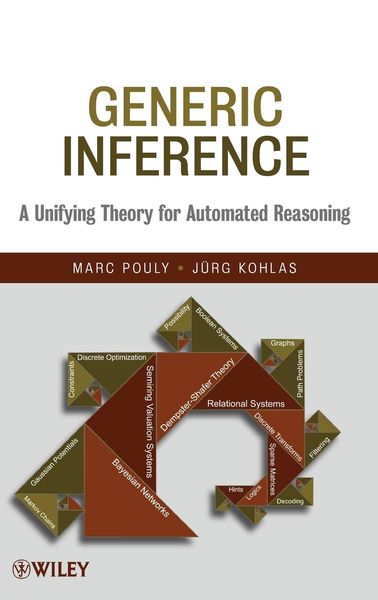
Produktbild: Generic Inference

Generic Inference A Unifying Theory for Automated Reasoning

159,99 €

inkl. gesetzl. MwSt., Versandkostenfrei

Lieferung nach Hause

Beschreibung

Produktdetails

Einband

Gebundene Ausgabe

Erscheinungsdatum

24.05.2011

Verlag

John Wiley & Sons

Seitenzahl

250

Maße (L/B/H)

24/16,1/3,1 cm

Gewicht

891 g

Auflage

1. Auflage

Sprache

Englisch

ISBN

978-0-470-52701-6

Beschreibung

Produktdetails

Einband

Gebundene Ausgabe

Erscheinungsdatum

24.05.2011

Verlag

John Wiley & Sons

Seitenzahl

250

Maße (L/B/H)

24/16,1/3,1 cm

Gewicht

891 g

Auflage

1. Auflage

Sprache

Englisch

ISBN

978-0-470-52701-6

Herstelleradresse

Libri GmbH
Europaallee 1
36244 Bad Hersfeld
DE

Email: GPSR Kontakt

Noch keine Bewertungen vorhanden

Verfassen Sie die erste Bewertung zu diesem Artikel

Helfen Sie anderen Kundinnen und Kunden durch Ihre Meinung.

Kundinnen und Kunden meinen

Bewertungen (0)

Die Leseprobe wird geladen.
  • Produktbild: Generic Inference
  • List of Instances and Applications.
     
    List of Figures and Tables.
     
    Acknowledgments.
     
    Introduction.
     
    Part I Local Computation.
     
    1 Valuation Algebras.
     
    1.1 Operations and Axioms.
     
    1.2 First Examples.
     
    1.3 Conclusion.
     
    2 Inference Problems.
     
    2.1 Graphs, Trees and Hypergraphs.
     
    2.2 Knowledgebases and their Representation.
     
    2.3 The Inference Probloem.
     
    2.4 Conclusion.
     
    3 Computing Single Queries.
     
    3.1 Valuation Algebras with Variable Elimination.
     
    3.2 Fusion and Bucker Elimination.
     
    3.3 Valuation Algebras with Neutral Elements.
     
    3.4 Valuation Algebras with Null Elements.
     
    3.5 Local Computation as Message Passing Scheme.
     
    3.6 Covering Join Trees.
     
    3.7 Join Tree Construction.
     
    3.8 The Collect Algorithm.
     
    3.9 Adjoining an Identity Element.
     
    3.10 The Generalized Collect Algorithm.
     
    3.11 An Application: The Fast Fourier Transform.
     
    3.12 Conclusion.
     
    4 Computing Multiple Queries.
     
    4.1 The Shenoy Shafer.
     
    4.2 Valuation Algebras with Inverse Elements.
     
    4.3 The Lauritzen Spiegelhalter Architecture.
     
    4.4 The HUGIN Architecture.
     
    4.5 The Idempotent Architecture.
     
    4.6 Answering Uncovered Queries.
     
    4.7 Scaling and Normalization.
     
    4.8 Local Computation with Scaling.
     
    4.9 Conclusion.
     
    Part II Generic Constructions.
     
    5 Semiring Valuation Algebras.
     
    5.1 Semirings.
     
    5.2 Semirings and Order.
     
    5.3 Semiring Valuation Algebras.
     
    5.4 Examples of Semiring Valuation Algebras.
     
    5.5 Properties of Semiring Valuation Algebras.
     
    5.6 Some Computational Aspects.
     
    5.7 Set Based Semiring Valuation Algebras.
     
    5.8 Properties of Set Based Semiring Valuation Algebras.
     
    5.9 Conclusion.
     
    6 Valuation Algebras for Path Problems.
     
    6.1 Some Path Problem Examples.
     
    6.2 The Algebraic Path Problem.
     
    6.3 Quasi Regular Semirings.
     
    6.4 Quasi Regular Valuation Algebras.
     
    6.5 Properties of Quasi Regular Valuation Algebras.
     
    6.6 Kleene Algebras.
     
    6.7 Kleene Valuation Algebras.
     
    6.8 Properties of Kleene Valuation Algebras.
     
    6.9 Further Path Problems.
     
    6.10 Conclusion.
     
    7 Language and Information.
     
    7.1 Propositional Logic.
     
    7.2 Linear Equations.
     
    7.3 Information in Context.
     
    7.4 Conclusion.
     
    Part III Applications.
     
    8 Dynamic Programming.
     
    8.1 Solutions and Solution Extensions.
     
    8.2 Computing Solutions.
     
    8.3 Optimization and Constraint Problems.
     
    8.4 Computing Solutions of Optimization Problems.
     
    8.5 Conclusion.
     
    9 Sparse Matrix Techniques.
     
    9.1 Systems of Linear Equations.
     
    9.2 Symmetric, Positive Definite Matrices.
     
    9.3 Semiring Fixpoint Equation Systems.
     
    9.4 Conclusion.
     
    10 Gaussian Information.
     
    10.1 Gaussian Systems and Potentials.
     
    10.2 Generalized Gaussian Potentials.
     
    10.3 Gaussian Information and Gaussian Potentials.
     
    10.4 Valuation Algebra of Gaussian Potentials.
     
    10.5 An Application: Gaussian Dynamic Systems.
     
    10.6 An Application: Gaussian Bayesian Networks.
     
    10.7 Conclusion.
     
    Appendix.
     
    References.
     
    Index.