KI-Beratung Beta

Gutscheinbedingungen

**Gültig vom 23.11. bis 30.11.2026 | Gültig für nicht preisgebundene fremdsprachige Bücher | Einzelne Artikel können ausgeschlossen sein | Online auf www.bücher.de einlösbar | Click & Collect nur mit Online-Zahlung (Paypal/Kreditkarte) vorab | Nicht kombinierbar mit anderen Gutscheinen oder Preisaktionen | Nur einmal pro Einkauf einlösbar | Gutschein wird auf max. 500€ Bestellwert angerechnet | Keine Barauszahlung | Nicht gültig für Versandkosten und Services

Produktbild: MCM Handbook

MCM Handbook

206,99 €

inkl. gesetzl. MwSt., Versandkostenfrei


Beschreibung

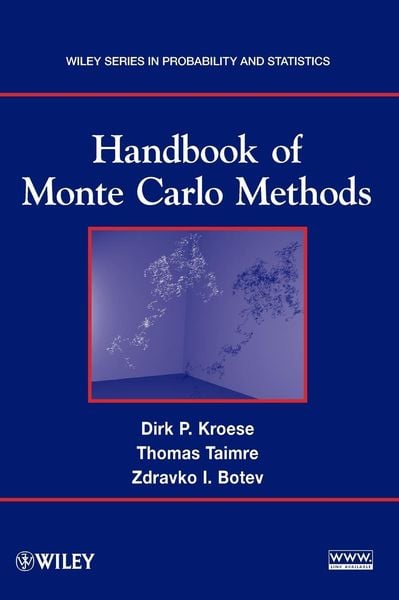
A comprehensive overview of Monte Carlo simulation that explores the latest topics, techniques, and real-world applications   More and more of today's numerical problems found in engineering and finance are solved through Monte Carlo methods. The heightened popularity of these methods and their continuing...

Beschreibung

A comprehensive overview of Monte Carlo simulation that explores the latest topics, techniques, and real-world applications
 
More and more of today's numerical problems found in engineering and finance are solved through Monte Carlo methods. The heightened popularity of these methods and their continuing development makes it important for researchers to have a comprehensive understanding of the Monte Carlo approach. Handbook of Monte Carlo Methods provides the theory, algorithms, and applications that helps provide a thorough understanding of the emerging dynamics of this rapidly-growing field.
 
The authors begin with a discussion of fundamentals such as how to generate random numbers on a computer. Subsequent chapters discuss key Monte Carlo topics and methods, including:
* Random variable and stochastic process generation
* Markov chain Monte Carlo, featuring key algorithms such as the Metropolis-Hastings method, the Gibbs sampler, and hit-and-run
* Discrete-event simulation
* Techniques for the statistical analysis of simulation data including the delta method, steady-state estimation, and kernel density estimation
* Variance reduction, including importance sampling, latin hypercube sampling, and conditional Monte Carlo
* Estimation of derivatives and sensitivity analysis
* Advanced topics including cross-entropy, rare events, kernel density estimation, quasi Monte Carlo, particle systems, and randomized optimization
 
The presented theoretical concepts are illustrated with worked examples that use MATLAB(r), a related Web site houses the MATLAB(r) code, allowing readers to work hands-on with the material and also features the author's own lecture notes on Monte Carlo methods. Detailed appendices provide background material on probability theory, stochastic processes, and mathematical statistics as well as the key optimization concepts and techniques that are relevant to Monte Carlo simulation.
 
Handbook of Monte Carlo Methods is an excellent reference for applied statisticians and practitioners working in the fields of engineering and finance who use or would like to learn how to use Monte Carlo in their research. It is also a suitable supplement for courses on Monte Carlo methods and computational statistics at the upper-undergraduate and graduate levels.

Rezension

"Statisticians Kroese, Thomas Taimre (both U. of Queensland), and Zdravko I. Botev (U. of Montreal) offer researchers and graduate and advanced graduate students a compendium of Monte Carlo methods, which are statistical methods that involve random experiments on a computer. There are a great many such methods being used for so many kinds of problems in so many fields that such an overall view is hard to find. Combining theory, algorithms, and applications, they consider such topics as uniform random number generation, probability distributions, discrete event simulation, variance reduction, estimating derivatives, and applications to network reliability." (Annotation ©2011 Book News Inc. Portland, OR)
Produktdetails

Einband

Gebundene Ausgabe

Erscheinungsdatum

15.03.2011

Abbildungen

Tables: 0 B&W, 0 Color; Graphs: 75 B&W, 0 Color

Verlag John Wiley & Sons Inc

Produktdetails

Einband

Gebundene Ausgabe

Erscheinungsdatum

15.03.2011

Abbildungen

Tables: 0 B&W, 0 Color; Graphs: 75 B&W, 0 Color

Verlag John Wiley & Sons Inc
Seitenzahl

772

Maße (L/B/H)

26/18,3/4,6 cm

Gewicht

1626 g

Auflage

1. Auflage

Sprache

Englisch

ISBN

978-0-470-17793-8

Herstelleradresse

Libri GmbH
Europaallee 1
36244 Bad Hersfeld
DE

Email: gpsr@libri.de

Noch keine Bewertungen vorhanden

Verfassen Sie die erste Bewertung zu diesem Artikel

Helfen Sie anderen Kundinnen und Kunden durch Ihre Meinung.

Kundinnen und Kunden meinen

Bewertungen (0)

Die Leseprobe wird geladen.
  • Produktbild: MCM Handbook
  • Preface.
     
    Acknowledgments.
     
    1 Uniform Random Number Generation.
     
    1.1 Random Numbers.
     
    1.2 Generators Based on Linear Recurrences.
     
    1.3 Combined Generators.
     
    1.4 Other Gnerators.
     
    1.5 Tests for Random Number Generators.
     
    References.
     
    2 Quasirandom Number Generation.
     
    2.1 Multidimensional Integration.
     
    2.2 Van der Corput and Digital Sequences.
     
    2.3 Halton Sequences.
     
    2.4 Faure Sequences.
     
    2.5 Sobol' Sequences.
     
    2.6 Lattice Methods.
     
    2.7 Randomization and Scrambling.
     
    References.
     
    3 Random Variable Generation.
     
    3.1 Generic Algorithms Based on Common Transformations.
     
    3.2 Copulas.
     
    3.3 Generation Methods for Various Random Objects.
     
    References.
     
    4 Probability Distributions.
     
    4.1 Discrete Distributions.
     
    4.2 Continuous Distributions.
     
    4.3 Multivariate Distributions.
     
    References.
     
    5 Random Process Generation.
     
    5.1 Gaussian Processes.
     
    5.2 Markov Chains.
     
    5.3 Markov Jump Processes.
     
    5.4 Poisson Processes.
     
    5.5 Wiener Process and Brownian Motion.
     
    5.6 Stochastic Differential Equations and Diffusion Processes.
     
    5.7 Brownian Bridge.
     
    5.8 Geometric Brownian Motion.
     
    5.9 Ornstein-Uhlenbeck Process.
     
    5.10 Reflected Brownian Motion.
     
    5.11 Fractional Brownian Motion.
     
    5.12 Random Fields.
     
    5.13 Lévy Processes.
     
    5.14 Time Series.
     
    References.
     
    6 Markov Chain Monte Carlo.
     
    6.1 Metropolis-Hastings Algorithm.
     
    6.2 Gibbs Sampler.
     
    6.3 Specialized Samplers.
     
    6.4 Implementation Issues.
     
    6.5 Perfect Sampling.
     
    References.
     
    7 Discrete Event Simulation.
     
    7.1 Simulation Models.
     
    7.2 Discrete Event Systems.
     
    7.3 Event-Oriented Approach.
     
    7.4 More Examples of Discrete Event Simulation.
     
    References.
     
    8 Statistical Analysis of Simulation Data.
     
    8.1 Simulation Data.
     
    8.2 Estimation of Performance Measures for Independent Data.
     
    8.3 Estimation of Steady-State Performance Measures.
     
    8.4 Emprical Cdf.
     
    8.5 Kernal Density Estimation.
     
    8.6 Resampling and the Bootstrap Method.
     
    8.7 Goodness of Fit.
     
    References.
     
    9 Variance Reduction.
     
    9.1 Variance Reduction Example.
     
    9.2 Antithetic Random Variables.
     
    9.3 Control Variables.
     
    9.4 Conditional Monte Carlo.
     
    9.5 Stratified Sampling.
     
    9.6 Latin Hypercube Sampling.
     
    9.7 Importance Scaling.
     
    9.8 Quasi Monte Carlo
     
    References.
     
    10 Rare-Event Simulation.
     
    10.1 Efficiency of Estimators.
     
    10.2 Importance Sampling Methods for Light Tails.
     
    10.3 Conditioning Methods for Heavy Tails.
     
    10.4 State-Dependent Importance Sampling.
     
    10.5 Cross-Entropy Method for Rare-Event Simulation.
     
    10.6 Splitting Method.
     
    References.
     
    11 Estimation of Derivatives.
     
    11.1 Gradient Estimation.
     
    11.2 Finite Difference Method.
     
    11.3 Infinitesimal Perturbation Analysis.
     
    11.4 Score Function Method.
     
    11.5 Weak Deriatives.
     
    11.6 Sensitivity Analysis for Regenerative Processes.
     
    References.
     
    12 Randomized Optimization.
     
    12.1 Stochastic Approximation.
     
    12.2 Stochastic Counterpart Method.
     
    12.3 Simulated Annealing.
     
    12.4 Evoluti