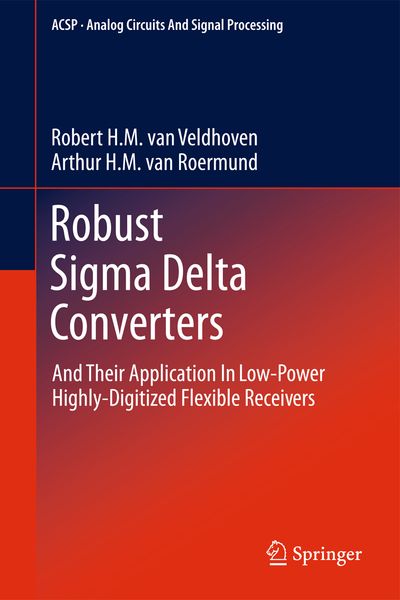
Robust Sigma Delta Converters And Their Application in Low-Power Highly-Digitized Flexible Receivers
-
- Hardcover ausgewählt
- Taschenbuch
- eBook
-
Sprache:Englisch
148,99 €
UVP
171,19 €
inkl. gesetzl. MwSt.,
Beschreibung
Produktdetails
Einband
Gebundene Ausgabe
Erscheinungsdatum
09.02.2011
Abbildungen
XXIV, 296 p.
Verlag
Springer NetherlandSeitenzahl
296
Maße (L/B/H)
24,4/16,7/3 cm
Gewicht
615 g
Auflage
2011 edition
Sprache
Englisch
ISBN
978-94-007-0643-9
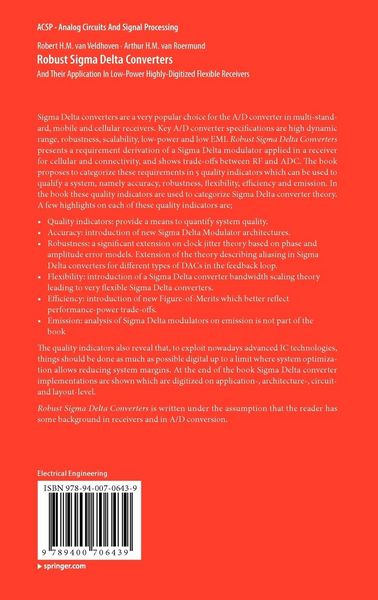
Sigma Delta converters are a very popular choice for the A/D converter in multi-standard, mobile and cellular receivers. Key A/D converter specifications are high dynamic range, robustness, scalability, low-power and low EMI.
Robust Sigma Delta Converters
presents a requirement derivation of a Sigma Delta modulator applied in a receiver for cellular and connectivity, and shows trade-offs between RF and ADC. The book proposes to categorize these requirements in 5 quality indicators which can be used to qualify a system, namely accuracy, robustness, flexibility, efficiency and emission. In the book these quality indicators are used to categorize Sigma Delta converter theory. A few highlights on each of these quality indicators are;
- Quality indicators: provide a means to quantify system quality.
- Accuracy: introduction of new Sigma Delta Modulator architectures.
- Robustness: a significant extension on clock jitter theory based on phase and error amplitude error models. Extension of the theory describing aliasing in Sigma Delta converters for different types of DACs in the feedback loop.
- Flexibility: introduction of a Sigma Delta converter bandwidth scaling theory leading to very flexible Sigma Delta converters.
- Efficiency: introduction of new Figure-of-Merits which better reflect performance-power trade-offs.
- Emission: analysis of Sigma Delta modulators on emission is not part of the book
The quality indicators also reveal that, to exploit nowadays advanced IC technologies, things should be done as much as possible digital up to a limit where system optimization allows reducing system margins. At the end of the book Sigma Delta converter implementations are shown which are digitized on application-, architecture-, circuit- and layout-level.
Robust Sigma Delta Converters
is written under the assumption that the reader has some background in receivers and in A/D conversion.
Noch keine Bewertungen vorhanden
Verfassen Sie die erste Bewertung zu diesem Artikel
Helfen Sie anderen Kundinnen und Kunden durch Ihre Meinung.
Kurze Frage zu unserer Seite
Vielen Dank für dein Feedback
Wir nutzen dein Feedback, um unsere Produktseiten zu verbessern. Bitte habe Verständnis, dass wir dir keine Rückmeldung geben können. Falls du Kontakt mit uns aufnehmen möchtest, kannst du dich aber gerne an unseren Kund*innenservice wenden.
zum Kundenservice