KI-Beratung Beta

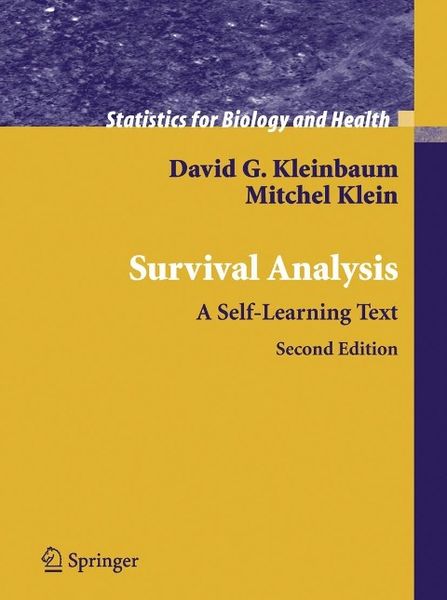
Produktbild: SURVIVAL ANALYSIS REV/E 2/E
- 29%

SURVIVAL ANALYSIS REV/E 2/E

29% sparen

72,99 € UVP 103,99 €

inkl. gesetzl. MwSt., Versandkostenfrei


Beschreibung

This greatly expanded second edition of Survival Analysis- A Self-learning Text provides a highly readable description of state-of-the-art methods of analysis of survival/event-history data. This text is suitable for researchers and statisticians working in the medical and other life sciences as well...

Beschreibung

This greatly expanded second edition of Survival Analysis- A Self-learning Text provides a highly readable description of state-of-the-art methods of analysis of survival/event-history data. This text is suitable for researchers and statisticians working in the medical and other life sciences as well as statisticians in academia who teach introductory and second-level courses on survival analysis. The second edition continues to use the unique "lecture-book" format of the first (1996) edition with the addition of three new chapters on advanced topics:
Chapter 7: Parametric Models
Chapter 8: Recurrent events
Chapter 9: Competing Risks.
Also, the Computer Appendix has been revised to provide step-by-step instructions for using the computer packages STATA (Version 7.0), SAS (Version 8.2), and SPSS (version 11.5) to carry out the procedures presented in the main text.
The original six chapters have been modified slightly
to expand and clarify aspects of survival analysis in response to suggestions by students, colleagues and reviewers, and
to add theoretical background, particularly regarding the formulation of the (partial) likelihood functions for proportional hazards, stratified, and extended Cox regression models
David Kleinbaum is Professor of Epidemiology at the Rollins School of Public Health at Emory University, Atlanta, Georgia. Dr. Kleinbaum is internationally known for innovative textbooks and teaching on epidemiological methods, multiple linear regression, logistic regression, and survival analysis. He has provided extensive worldwide short-course training in over 150 short courses on statistical and epidemiological methods. He is also the author of ActivEpi (2002), an interactive computer-based instructional text on fundamentals of epidemiology, which has been used in a variety of educational environments including distance learning.
Mitchel Klein is Research Assistant Professor with a joint appointment in the Department of Environmental and Occupational Health (EOH) and the Department of Epidemiology, also at the Rollins School of Public Health at Emory University. Dr. Klein is also co-author with Dr. Kleinbaum of the second edition of Logistic Regression- A Self-Learning Text (2002). He has regularly taught epidemiologic methods courses at Emory to graduate students in public health and in clinical medicine. He is responsible for the epidemiologic methods training of physicians enrolled in Emory s Master of Science in Clinical Research Program, and has collaborated with Dr. Kleinbaum both nationally and internationally in teaching several short courses on various topics in epidemiologic methods.

Produktdetails

Einband

Taschenbuch

Abbildungen

107 SW-Abb.

Verlag Springer
Seitenzahl

590

Produktdetails

Einband

Taschenbuch

Abbildungen

107 SW-Abb.

Verlag Springer
Seitenzahl

590

Maße (B/H)

17,8/23,5 cm

Auflage

2nd ed.

Sprache

Englisch

ISBN

978-1-4419-2018-8

Herstelleradresse

Springer Heidelberg
Tiergartenstr. 17
69121 Heidelberg
DE
buchhandel-buch@springer.com

Noch keine Bewertungen vorhanden

Verfassen Sie die erste Bewertung zu diesem Artikel

Helfen Sie anderen Kundinnen und Kunden durch Ihre Meinung.

Kundinnen und Kunden meinen

Bewertungen (0)

  • Produktbild: SURVIVAL ANALYSIS REV/E 2/E
  • Introduction to Survival Analysis.- Kaplan-Meier Survival Curves and the Log-Rank Test.- The Cox Proportional Hazards Model and Its Characteristics.- Evaluating the Proportional Hazards Assumption.- The Stratified Cox Procedure.- Extension of the Cox Proportional Hazards Model for Time-Dependent Variables.- Parametric Survival Models.- Recurrent Events Survival Analysis.- Competing Risks Survival Analysis.