KI-Beratung Beta

Gutscheinbedingungen

**Gültig vom 05.10.2026 bis 07.10.2026 | Gültig für nicht preisgebundene fremdsprachige Bücher | Einzelne Artikel können ausgeschlossen sein | Online auf www.bücher.de einlösbar | Click & Collect nur mit Online-Zahlung (Paypal/Kreditkarte) vorab | Nicht kombinierbar mit anderen Gutscheinen oder Preisaktionen | Nur einmal pro Einkauf einlösbar | Gutschein wird auf max. 500€ Bestellwert angerechnet | Keine Barauszahlung | Nicht gültig für Versandkosten und Services

  • Produktbild: Workflows for e-Science
  • Produktbild: Workflows for e-Science
- 12%

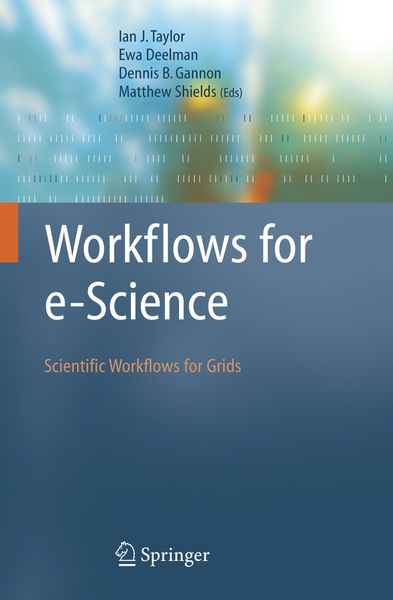
Workflows for e-Science Scientific Workflows for Grids

12% sparen

93,99 € UVP 106,99 €

inkl. gesetzl. MwSt., Versandkostenfrei


Beschreibung

Produktdetails

Einband

Taschenbuch

Erscheinungsdatum

27.03.2014

Abbildungen

XXII, 526 p.

Herausgeber

Ian J. Taylor + weitere

Verlag

Springer London

Seitenzahl

526

Maße (L/B/H)

24,4/17/3 cm

Gewicht

934 g

Auflage

2007

Sprache

Englisch

ISBN

978-1-84996-619-1

Beschreibung

Portrait

Dr. Ian Taylor has been a Lecturer at Cardiff University's School of Computer Science since 2002. He concurrently holds an adjunct Assistant Professorship at the Center for Computation & Technology at Louisiana State University and regularly offers consultations in the USA. Through this he has been active in many major projects including GridLab, CoreGrid and GridOneD. His research interests include distributed techniques and workflow for Grid and P2P computing, which take in applications ranging from astrophysics and healthcare to distributed audio.

Ian has previously written a professional book for Springer on P2P, Web Services and Grids, and has published over 50 scientific papers. He has also co-edited a special edition for Journal of Grid Computing on Scientific Workflow.

Dr. Matthew Shields has been a research associate at Cardiff University, jointly in the Schools of Computer Science,

Physics and Astronomy, since 2001. He gained his Ph.D. in Computer Science from Cardiff University in the area of

problem solving environments. Dr Shields is one of two lead developers for the Triana project and has been responsible

for helping broaden its adoption within new application domains including biodiversity. His interests include problem

solving environments, workflow, component and service based computing, Grid and high-performance computing.

Ewa Deelman is an Research Assistant Professor at the USC Computer Science Department and a Research Team Leader at the Center for Grid Technologies at the USC Information Sciences Institute. Dr. Deelman's research interests include the design and exploration of collaborative scientific environments based on Grid technologies, with particular emphasis on workflow management as well as the management of large amounts of data and metadata. At ISI, Dr. Deelmanis leading the Pegasus project, which designs and implements workflow mapping techniques for large-scale workflows running in distributed environments. Pegasus is being used day-to-day by scientists in a variety of disciplines including astronomy, gravitational-wave physics, earthquake science and many others. Prior to joining ISI in 2000, she was a Senior Software Developer at UCLA conducting research in the area of performance prediction of large-scale applications on high performance machines.

Dr. Deelman received her PhD from Rensselaer Polytechnic Institute in Computer Science in 1997 in the area of parallel discrete event simulation. Dr. Deelman is an Associate Editor responsible for Grid Computing for the Scientific Programming Journal and a chair of the GGF Workflow Management Research Group.

Gannon is a professor of Computer Science in the School of Informatics at Indiana University. He is also Science Director for the Indiana Pervasive Technology Labs. He received his Ph.D. in Computer Science from the University of Illinois in 1980 and his Ph.D. in Mathematics from the University of California in 1974. From 1980 to 1985, he was on the faculty at Purdue University. From 1997-2004 he was Chairman of the Indiana Computer Science Department. His research interests include software tools for high performance parallel and distributed systems and problem solving environments for scientific computation.
Produktdetails

Einband

Taschenbuch

Erscheinungsdatum

27.03.2014

Abbildungen

XXII, 526 p.

Herausgeber

Verlag

Springer London

Seitenzahl

526

Maße (L/B/H)

24,4/17/3 cm

Gewicht

934 g

Auflage

2007

Sprache

Englisch

ISBN

978-1-84996-619-1

Herstelleradresse

Springer-Verlag KG
Sachsenplatz 4-6
1201 Wien
AT

Email: ProductSafety@springernature.com

Noch keine Bewertungen vorhanden

Verfassen Sie die erste Bewertung zu diesem Artikel

Helfen Sie anderen Kundinnen und Kunden durch Ihre Meinung.

Kundinnen und Kunden meinen

Bewertungen (0)

  • Produktbild: Workflows for e-Science
  • Produktbild: Workflows for e-Science
  • Scientific versus Business Workflows.- Scientific versus Business Workflows.- Application and User Perspective.- Generating Complex Astronomy Workflows.- A Case Study on the Use of Workflow Technologies for Scientific Analysis: Gravitational Wave Data Analysis.- Workflows in Pulsar Astronomy.- Workflow and Biodiversity e-Science.- Ecological Niche Modeling Using the Kepler Workflow System.- Case Studies on the Use of Workflow Technologies for Scientific Analysis: The Biomedical Informatics Research Network and the Telescience Project.- Dynamic, Adaptive Workflows for Mesoscale Meteorology.- SCEC CyberShake Workflows—Automating Probabilistic Seismic Hazard Analysis Calculations.- Workflow Representation and Common Structure.- Control- Versus Data-Driven Workflows.- Component Architectures and Services: From Application Construction to Scientific Workflows.- Petri Nets.- Adapting BPEL to Scientific Workflows.- Protocol-Based Integration Using SSDL and ?-Calculus.- Workflow Composition: Semantic Representations for Flexible Automation.- Virtual Data Language: A Typed Workflow Notation for Diversely Structured Scientific Data.- Frameworks and Tools: Workflow Generation, Refinement, and Execution.- Workflow-Level Parametric Study Support by MOTEUR and the P-GRADE Portal.- Taverna/myGrid: Aligning a Workflow System with the Life Sciences Community.- The Triana Workflow Environment: Architecture and Applications.- Java CoG Kit Workflow.- Workflow Management in Condor.- Pegasus: Mapping Large-Scale Workflows to Distributed Resources.- ICENI.- Expressing Workflow in the Cactus Framework.- Sedna: A BPEL-Based Environment for Visual Scientific Workflow Modeling.- ASKALON: A Development and Grid Computing Environment for Scientific Workflows.- Future Requirements.- Looking intothe Future of Workflows: The Challenges Ahead.