
KI-Beratung Beta

  • Produktbild: Distortion Analysis of Analog Integrated Circuits
  • Produktbild: Distortion Analysis of Analog Integrated Circuits
Band 451 - 12%

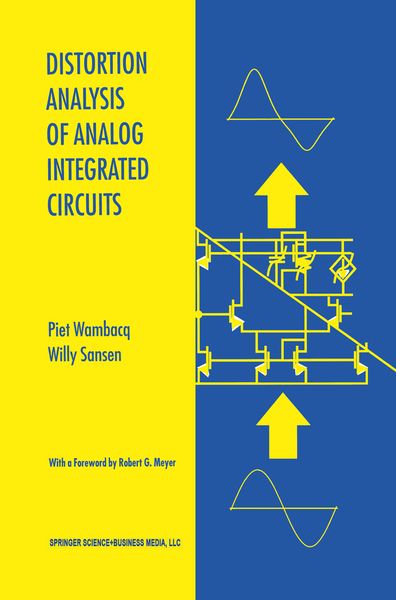
Distortion Analysis of Analog Integrated Circuits

12% sparen

328,99 € UVP 374,49 €

inkl. gesetzl. MwSt., Versandkostenfrei


Beschreibung

The analysis and prediction of nonlinear behavior in electronic circuits has long been a topic of concern for analog circuit designers. The recent explosion of interest in portable electronics such as cellular telephones, cordless telephones and other applications has served to reinforce the importance...

Beschreibung

The analysis and prediction of nonlinear behavior in electronic circuits has long been a topic of concern for analog circuit designers. The recent explosion of interest in portable electronics such as cellular telephones, cordless telephones and other applications has served to reinforce the importance of these issues. The need now often arises to predict and optimize the distortion performance of diverse electronic circuit configurations operating in the gigahertz frequency range, where nonlinear reactive effects often dominate. However, there have historically been few sources available from which design engineers could obtain information on analysis tech niques suitable for tackling these important problems. I am sure that the analog circuit design community will thus welcome this work by Dr. Wambacq and Professor Sansen as a major contribution to the analog circuit design literature in the area of distortion analysis of electronic circuits. I am personally looking forward to having a copy readily available for reference when designing integrated circuits for communication systems.

Produktdetails

Einband

Taschenbuch

Erscheinungsdatum

05.01.2011

Abbildungen

XXIV, 501 p.

Verlag Springer Us

Produktdetails

Einband

Taschenbuch

Erscheinungsdatum

05.01.2011

Abbildungen

XXIV, 501 p.

Verlag Springer Us
Seitenzahl

501

Maße (L/B/H)

23,5/15,5/2,9 cm

Gewicht

797 g

Auflage

Softcover reprint of the original 1st edition 1998

Sprache

Englisch

ISBN

978-1-4419-5044-4

Herstelleradresse

Springer-Verlag KG
Sachsenplatz 4-6
1201 Wien
AT

Email: ProductSafety@springernature.com

Noch keine Bewertungen vorhanden

Verfassen Sie die erste Bewertung zu diesem Artikel

Helfen Sie anderen Kundinnen und Kunden durch Ihre Meinung.

Kundinnen und Kunden meinen

Bewertungen (0)

  • Produktbild: Distortion Analysis of Analog Integrated Circuits
  • Produktbild: Distortion Analysis of Analog Integrated Circuits
  • 1 Introduction.- 2 Basic terminology.- 3 Description of nonlinearities in analog integrated circuits.- 4 Volterra series and their applications to analog integrated circuit design.- 5 Calculation of harmonics and intermodulation products.- 6 Silicon bipolar transistor models for distortion analysis.- 7 MOS transistor models for distortion analysis.- 8 Weakly nonlinear behavior of basic analog building blocks.- 9 Measurements of basic nonlinearities of transistors.- Appendices.- A Useful trigonometric relationships.- B Basics of Volterra series.- B.1 Introduction.- B.2 Volterra series representation of a system.- B.3 Second-order Volterra systems.- B.3.1 The second-order operator.- B.3.2 The second-order Volterra operator.- B.3.3 Second-order kernel symmetrization.- B.4 The second-order kernel transform.- B.4.1 The two-dimensional Fourier and Laplace transform.- B.4.2 Sinusoidal response of a second-order Volterra system.- B.4.3 Response of a second-order system to a sum of two sinusoids.- B.5 Higher-order Volterra systems.- B.5.4 The p-dimensional Laplace and Fourier transforms.- C Derivation of the method for the direct computation of nonlinear responses.- C.1 Setup of basic equations.- C.2 First-order responses.- C.3 Second-order responses.- C.4 Higher-order responses.- D Nonlinearity coefficients for the description of the Early effect.- E Relation between source-referred and bulk-referred nonlinearity coefficients of a MOS transistor.- F Derivatives of the drain current with an implicit saturation voltage.- F.2 First-order derivatives.- F.3 Higher-order derivatives.- G Derivation of the MOS drain current in the presence of velocity saturation.- G.1 Derivation of the drain current with the simple velocity-field models.- G.2 Derivation of the drain current with the more accurate velocity-field model.- G.2.1 The rigorous approach.- G.2.2 Approximate approach.