
Gutscheinbedingungen

**Gültig vom 24.08.2026 bis 26.08.2026 | Gültig für nicht preisgebundene fremdsprachige Bücher | Einzelne Artikel können ausgeschlossen sein | Online auf www.bücher.de einlösbar | Click & Collect nur mit Online-Zahlung (Paypal/Kreditkarte) vorab | Nicht kombinierbar mit anderen Gutscheinen oder Preisaktionen | Nur einmal pro Einkauf einlösbar | Gutschein wird auf max. 500€ Bestellwert angerechnet | Keine Barauszahlung | Nicht gültig für Versandkosten und Services

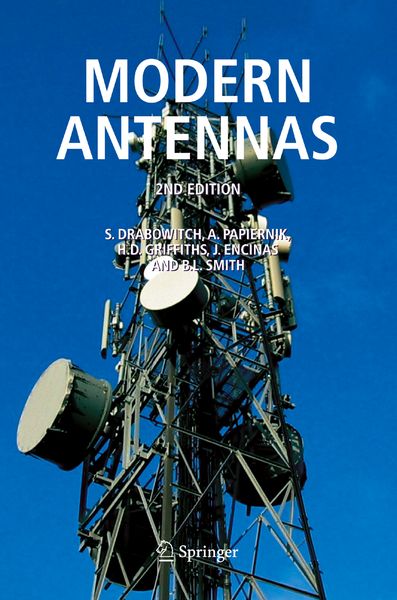
  • Produktbild: Modern Antennas
  • Produktbild: Modern Antennas
Band 12

Modern Antennas

97,99 €

inkl. gesetzl. MwSt., Versandkostenfrei


Beschreibung

Produktdetails

Einband

Taschenbuch

Erscheinungsdatum

29.10.2010

Abbildungen

XX, 690 p.

Verlag

Springer Us

Seitenzahl

690

Maße (L/B/H)

23,5/15,5/3,8 cm

Gewicht

1060 g

Auflage

Second Edition 2005

Sprache

Englisch

ISBN

978-1-4419-5271-4

Beschreibung

Produktdetails

Einband

Taschenbuch

Erscheinungsdatum

29.10.2010

Abbildungen

XX, 690 p.

Verlag

Springer Us

Seitenzahl

690

Maße (L/B/H)

23,5/15,5/3,8 cm

Gewicht

1060 g

Auflage

Second Edition 2005

Sprache

Englisch

ISBN

978-1-4419-5271-4

Herstelleradresse

Springer-Verlag KG
Sachsenplatz 4-6
1201 Wien
AT

Email: ProductSafety@springernature.com

Noch keine Bewertungen vorhanden

Verfassen Sie die erste Bewertung zu diesem Artikel

Helfen Sie anderen Kundinnen und Kunden durch Ihre Meinung.

Kundinnen und Kunden meinen

Bewertungen (0)

  • Produktbild: Modern Antennas
  • Produktbild: Modern Antennas
  • List of contributors. Foreword. Acknowledgements. Electromagnetism and antennas – a historical perspective. 1 Fundamentals of electromagnetism. 1.1 Maxwell’s equations. 1.2 Power and energy. 1.3 Plane waves in linear media. Further reading. Exercises. 2 Radiation. 2.1 Plane wave spectrum. 2.2 Kirchhoff’s formulation. Further reading. Exercises. 3 Antennas in transmission. 3.1 Far field radiation. 3.2 Field radiated from an antenna. 3.3 Directivity, gain, radiation pattern. Further reading. Exercises. 4 Receiving antennas. 4.1 Antenna reciprocity theorem. 4.2 Antenna effective receiving area. 4.3 Energy transmission between two antennas. 4.4 Antenna behaviour in the presence of noise.  Further reading. Exercises. 5 Antennas of simple geometry. 5.1 Aperture antennas. 5.2 Wire antennas. Further reading. Exercises. 6 Printed antennas. 6.1 Introduction. 6.2 Different types of printed radiating elements. 6.3 Field analysis methods. 6.4 Input impedance, bandwidth and radiation pattern. 6.5 Low profile, wideband or multiband antennas for mobile communications and short-range applications. Further reading. Exercises. 7 Large antennas and microwave antennas. 7.1 Introduction. 7.2 Structures and applications. 7.3 Fundamental propagation laws. 7.4 Antennas as radiating apertures. Appendix 7A Deduction of the Huygens-Fresnel principle from the Kirchhoff integral. Further reading. Exercises. 8 Primary feeds. 8.1 General properties. 8.2 Horns. 8.3 Hybrid modes and corrugated horns. 9 Axially symmetric systems. 9.1 Introduction. 9.2 Symmetry properties - propagation of polarization, radiation patterns. 9.3 Principal surface. 9.4 Transfer function. 9.5 System gain.9.6 Radiation patterns. 9.7 Aberrations in axially-symmetric systems. 9.8 Axially symmetric systems considered in reception: diffraction pattern. 9.9 System considered in reception: transfer of the energy contained in the diffraction pattern to theprimary aperture. 9.10 Radiation in the Fresnel zone of a Gaussian illumination - application to the transport of energy by radiation (Goubeau’s waves). Further reading. Exercises. 10 Focused systems. 10.1 Introduction. 10.2 The Cassegrain antenna. 10.3 Tracking systems. 10.4 Non axially-symmetric systems. Further reading. Exercises. 11 Arrays. 11.1 Introduction. 11.2 General structure of a phased array (examples). 11.3 Linear array theory. 11.4 Variation of gain as a function of direction. 11.5 Effects of phase quantization. 11.6 Frequency-scanned arrays. 11.7 Analogue beamforming matrices. 11.8 Further topics. Appendix 11A Comparison of linear and circular arrays. Further reading. Exercises. 12 Fundamentals of polarimetry. 12.1 Introduction. 12.2 Fully polarized waves. 12.3 Partially polarized waves. 12.4 Polarimetric representation of radar targets. 12.5 Partially polarized waves: The Mueller Matrix. 12.6 Polarizers and polarization separators for telecommunications antennas and polarimetric radars. 13 Antennas and signal theory. 13.1 Introduction. 13.2 Equivalence of an aperture and a spatial frequency filter. 13.3 Synthesis of an aperture to radiate a given radiation pattern. 13.4 Superdirective antennas.13.5 The antenna as a filter of angular signals. Further reading. Exercises. 14 Signal processing antennas. 14.1 Introduction. 14.2 Synthetic antennas in radar and sonar. 14.3 Imaging of coherent sources. 14.4 Imaging of incoherent sources. 14.5 High resolution imagery and the maximum entropy method. 14.6 Other methods of spectral estimation. 14.7 Spatial filtering. Appendix 14A Entropy and probability.  Further reading. Exercises. 15 Antenna measurements. 15.1 Introduction. 15.2 Gain measurements. 15.3 Radiation pattern measurements. 15.4 Time-domain gating. 15.5 Antenna noise temperature and G/T. 15.6 Impedance and bandwidth. Further reading. Exercises. Index.