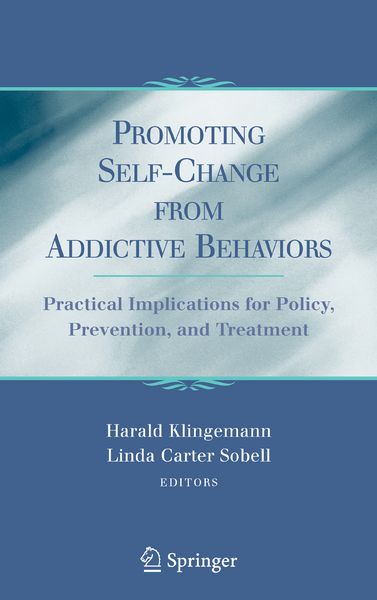
Promoting Self-Change From Addictive Behaviors Practical Implications for Policy, Prevention, and Treatment
-
- Hardcover
- Taschenbuch ausgewählt
-
Sprache:Englisch
49,99 €
inkl. gesetzl. MwSt.,
Lieferung nach Hause
Beschreibung
Produktdetails
Einband
Taschenbuch
Erscheinungsdatum
04.11.2010
Herausgeber
Harald Klingemann + weitereVerlag
Springer UsSeitenzahl
260
Maße (L/B/H)
23,5/15,5/1,6 cm
Gewicht
435 g
Auflage
Softcover reprint of hardcover 1st ed. 2007
Sprache
Englisch
ISBN
978-1-4419-4390-3
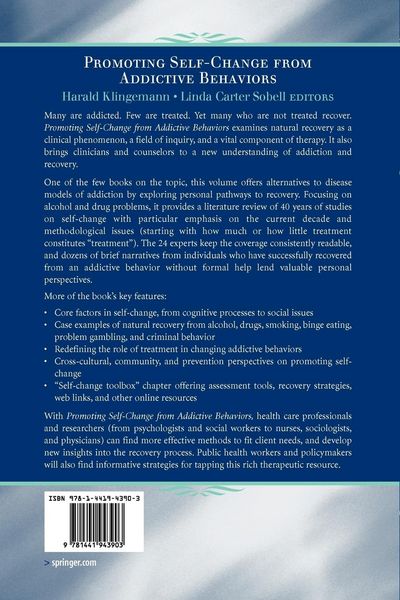
Many are addicted. Few are treated. Yet many who are not treated recover. Promoting Self-Change from Addictive Behaviors examines natural recovery as a clinical phenomenon, a field of inquiry, and a vital component of therapy. It also brings clinicians and counselors to a new understanding of addiction and recovery.
One of the few books on the topic, this updated edition offers alternatives to disease models of addiction by exploring personal pathways to recovery. Focusing on alcohol and drug problems, it provides a literature review of 40 years of studies on self-change with particular emphasis on the current decade and methodological issues (starting with how much or how little treatment constitutes “treatment”). The 24 experts keep the coverage consistently readable, and dozens of brief narratives from individuals who have successfully recovered from an addictive behavior without formal help lend valuable personal perspectives.
More of the book’s key features: Core factors in self-change, from cognitive processes to social issues; Case examples of natural recovery from smoking, binge eating, problem gambling, and criminal behavior; Redefining the role of treatment in changing addictive behaviors; Cross-cultural, community, and prevention perspectives on promoting self-change; “Self-change toolbox” chapter offering assessment tools, recovery strategies, web links, and other online resources.
With Promoting Self-Change from Addictive Behaviors, health care professionals and researchers (from psychologists and social workers to nurses, sociologists, and physicians) can find more effective methods to fit client needs, and develop new insights into the recovery process. Public health workers and policymakers will also find informative strategies for tapping this rich therapeutic resource.
Noch keine Bewertungen vorhanden
Verfassen Sie die erste Bewertung zu diesem Artikel
Helfen Sie anderen Kundinnen und Kunden durch Ihre Meinung.
Kurze Frage zu unserer Seite
Vielen Dank für dein Feedback
Wir nutzen dein Feedback, um unsere Produktseiten zu verbessern. Bitte habe Verständnis, dass wir dir keine Rückmeldung geben können. Falls du Kontakt mit uns aufnehmen möchtest, kannst du dich aber gerne an unseren Kund*innenservice wenden.
zum Kundenservice