KI-Beratung Beta

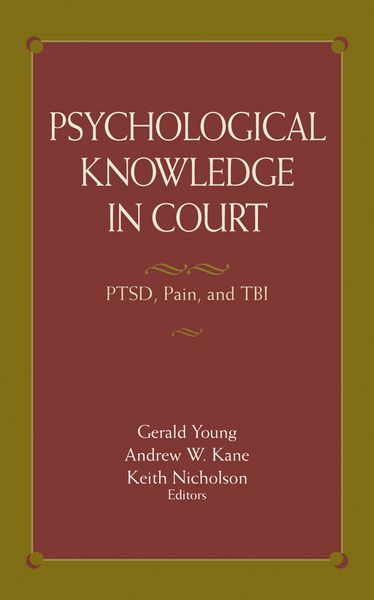
  • Produktbild: Psychological Knowledge in Court
  • Produktbild: Psychological Knowledge in Court

Psychological Knowledge in Court PTSD, Pain, and TBI

84,99 €

inkl. gesetzl. MwSt., Versandkostenfrei


Beschreibung

Produktdetails

Einband

Taschenbuch

Erscheinungsdatum

29.10.2010

Abbildungen

XVI, 412 p.

Herausgeber

Gerald Young + weitere

Verlag

Springer Us

Seitenzahl

412

Maße (L/B/H)

23,5/15,5/2,4 cm

Gewicht

645 g

Sprache

Englisch

ISBN

978-1-4419-3812-1

Beschreibung

Rezension

In
Psychological Knowledge in Court: PTSD, Pain, and TBI
, Gerald Young, Andrew W. Kane, and Keith Nicholson provide forensic psychologists, both new and experienced, with 20 well-selected chapters that should be read by anyone likely to testify in a courtroom. The selections cover much more than the title suggests. The editors provide an insightful and practical discussion of what is required when providing expert testimony. . . I do recommend
Psychological Knowledge in Court
, and I encourage any psychologist likely to be testifying as an expert witness to buy it and read it.

- John L. Caccavale, PsycCRITIQUES, Volume 51 (26), Article 11

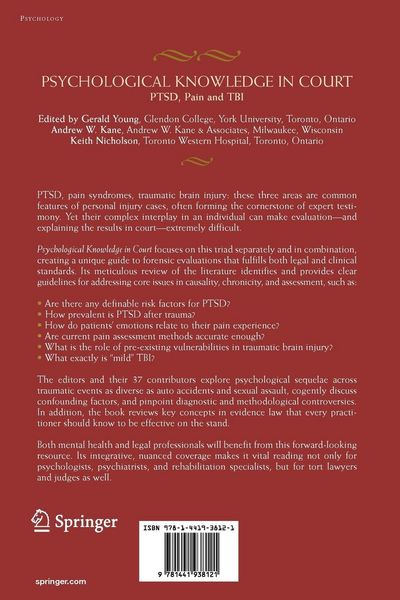
PTSD, pain syndromes, traumatic brain injury: these three areas are common features of personal injury cases, often forming the cornerstone of expert testimony. Yet their complex interplay in an individual can make evaluation-and explaining the results in court-extremely difficult.
Psychological Knowledge in Court
focuses on this triad separately and in combination, creating a unique guide to forensic evaluations that fulfills both legal and clinical standards. Its meticulous review of the literature identifies and provides clear guidelines for addressing core issues in causality, chronicity, and assessment.

- R.K.

Produktdetails

Einband

Taschenbuch

Erscheinungsdatum

29.10.2010

Abbildungen

XVI, 412 p.

Herausgeber

Verlag

Springer Us

Seitenzahl

412

Maße (L/B/H)

23,5/15,5/2,4 cm

Gewicht

645 g

Sprache

Englisch

ISBN

978-1-4419-3812-1

Herstelleradresse

Springer-Verlag GmbH
Tiergartenstr. 17
69121 Heidelberg
DE

Email: ProductSafety@springernature.com

Noch keine Bewertungen vorhanden

Verfassen Sie die erste Bewertung zu diesem Artikel

Helfen Sie anderen Kundinnen und Kunden durch Ihre Meinung.

Kundinnen und Kunden meinen

Bewertungen (0)

  • Produktbild: Psychological Knowledge in Court
  • Produktbild: Psychological Knowledge in Court
  • to Psychological Knowledge in Court: PTSD, Pain, and TBI.- Psychology, Causality, and Court.- PTSD/Distress.- Understanding PTSD: Implications for Court.- Posttraumatic Disorders Following Injury: Assessment and Other Methodological Considerations.- Predicting Who Will Develop Posttraumatic Stress Disorder.- Assessment of Psychological Distress and Disability After Sexual Assault in Adults.- Chronic Pain.- Pain in the 21st Century: The Neuromatrix and Beyond.- Influence of Personality Characteristics of Pain Patients: Implications for Causality in Pain.- Effect of Cognition on Pain Experience and Pain Behavior: Diathesis-Stress and the Causal Conundrum.- Chronic Pain and Affect as a Nonlinear Dynamical System.- Objective and Subjective Measurement of Pain: Current Approaches for Forensic Applications.- PTSD and Pain.- Posttraumatic Stress Disorder and Whiplash After Motor Vehicle Accidents.- PTSD and Chronic Pain: Cognitive-Behavioral Perspectives and Practical Implications.- Comorbid Chronic Pain and Posttraumatic Stress Disorder Across the Lifespan: A Review of Theoretical Models.- Traumatic Brain Injury.- Mild Traumatic Brain Injury: Definitions.- Mild Traumatic Brain Injury: Neuropsychological Causality Modelling.- Mild Traumatic Brain Injury: Causality Considerations from a Neuroimaging and Neuropathology Perspective.- Confounding Effects of Pain, Psychoemotional Problems or Psychiatric Disorder, Premorbid Ability Structure, and Motivational or Other Factors on Neuropsychological Test Performance.- Neuropsychological Assessment of Moderate to Severe Traumatic Brain Injury.- Conclusions.- Conclusions on Psychological Knowledge in Court: PTSD, Pain, and TBI.