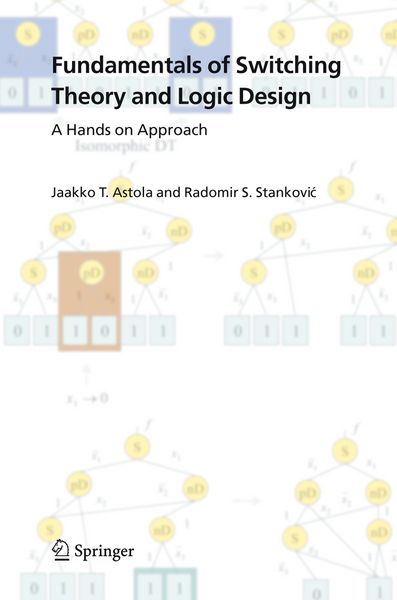
Fundamentals of Switching Theory and Logic Design A Hands on Approach
-
- Hardcover
- Taschenbuch ausgewählt
-
Sprache:Englisch
49,99 €
inkl. gesetzl. MwSt.,
Beschreibung
Produktdetails
Einband
Taschenbuch
Erscheinungsdatum
19.11.2010
Abbildungen
XIV, 342 p.
Verlag
Springer UsSeitenzahl
342
Maße (L/B/H)
24/16/2 cm
Gewicht
569 g
Auflage
Softcover reprint of hardcover 1st edition 2006
Sprache
Englisch
ISBN
978-1-4419-3945-6
Switching theory and logic design provide mathematical foundations and tools for digital system design that is an essential part in the research and development in almost all areas of modern technology. The vast complexity of modern digital systems implies that they can only be handled by computer aided design tools that are built on sophisticated mathematical models.
Fundamentals of Switching Theory and Logic Design
is aimed at providing an accessible introduction to these mathematical techniques that underlie the design tools and that are necessary for understanding their capabilities and limitations.
As is typical to many disciplines a high level of abstraction enables a unified treatment of many methodologies and techniques as well as provides a deep understanding of the subject in general. The drawback is that without a hands-on touch on the details it is difficult to develop an intuitive understanding of the techniques. We try to combine these views by providing hands-on examples on the techniques while binding these to the more general theory that is developed in parallel. For instance, the use of vector spaces and group theory unifies the spectral (Fourier-like) interpretation of polynomial, and graphic (decision diagrams) representations of logic functions, as well as provides new methods for optimization of logic functions.
Consequently,
Fundamentals of Switching Theory and Logic Design
discusses the fundamentals of switching theory and logic design from a slightly alternative point of view and also presents links between switching theory and related areas of signal processing and system theory. It also covers the core topics recommended in IEEE/ACM curricula for teaching and study in this area. Further, it contains several elective sections discussing topics for further research work in this area
Noch keine Bewertungen vorhanden
Verfassen Sie die erste Bewertung zu diesem Artikel
Helfen Sie anderen Kundinnen und Kunden durch Ihre Meinung.
Kurze Frage zu unserer Seite
Vielen Dank für dein Feedback
Wir nutzen dein Feedback, um unsere Produktseiten zu verbessern. Bitte habe Verständnis, dass wir dir keine Rückmeldung geben können. Falls du Kontakt mit uns aufnehmen möchtest, kannst du dich aber gerne an unseren Kund*innenservice wenden.
zum Kundenservice