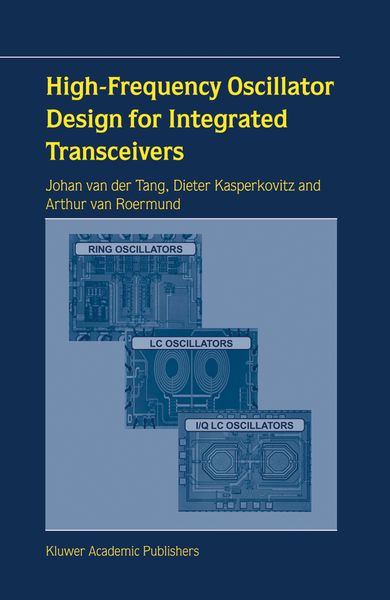
High-Frequency Oscillator Design for Integrated Transceivers
-
- Hardcover
- Taschenbuch ausgewählt
- eBook
-
Sprache:Englisch
139,99 €
UVP
160,49 €
inkl. gesetzl. MwSt.,
Beschreibung
Produktdetails
Einband
Taschenbuch
Erscheinungsdatum
23.11.2010
Abbildungen
343 p.
Verlag
Springer UsSeitenzahl
343
Maße (L/B/H)
24/16/1,9 cm
Gewicht
551 g
Auflage
Softcover reprint of hardcover 1st ed. 2003
Sprache
Englisch
ISBN
978-1-4419-5387-2
High-Frequency Oscillator Design for Integrated Transceivers
covers the analysis and design of all high-frequency oscillators required to realize integrated transceivers for wireless and wired applications. This includes the design of oscillator types as single-phase LC oscillators, I/Q LC oscillators, multi-phase LC oscillators, and ring oscillators in various IC technologies such as bipolar, BiCMOS, CMOS, and SOI (silicon on insulator). Starting from an in depth review of basic oscillator theory, the authors discuss key oscillator specifications, numerous oscillator circuit topologies, and introduce the concepts of design figures of merit (FOMs) and benchmark FOMs, which assist the oscillator designer during the overall design cycle. Taking advantage of behavioral modeling, the elementary properties of LC oscillators and ring oscillators are analyzed first. A detailed analysis of oscillator properties at circuit level follows taking parasitic elements and other practical aspects of integrated oscillator design into account. Special attention is given to advantages and limitations of linear time invariant (LTI) phase noise modeling, leading to the concept of optimum coupling in I/Q LC oscillators and a simulation method for fast and efficient phase noise optimization in oscillators. In addition, all modern linear time variant (LTV) phase noise theories are covered. As not only phase noise is of high importance to the designer, but optimization of other oscillator properties as well, additional subjects such as various tuning methods of LC oscillators are analyzed, too. Design examples of integrated LC and ring oscillators in the frequency range of 100 MHz up to 11 GHz are thoroughly discussed throughout the book.
The clear and structured discussion of basic oscillator properties make
High-Frequency Oscillator Design for Integrated Transceivers
an excellent starting point for the inexperienced oscillator designer. The detailed analysis of many oscillator types and circuit topologies, the discussion of numerous practical design issues together with fast optimization methods, and more than 200 carefully selected literature references on oscillator literature, LC oscillator and ring oscillator designs make this book a very valuable resource for the experienced IC designer as well.
Noch keine Bewertungen vorhanden
Verfassen Sie die erste Bewertung zu diesem Artikel
Helfen Sie anderen Kundinnen und Kunden durch Ihre Meinung.
Kurze Frage zu unserer Seite
Vielen Dank für dein Feedback
Wir nutzen dein Feedback, um unsere Produktseiten zu verbessern. Bitte habe Verständnis, dass wir dir keine Rückmeldung geben können. Falls du Kontakt mit uns aufnehmen möchtest, kannst du dich aber gerne an unseren Kund*innenservice wenden.
zum Kundenservice