• Produktbild: Video Content Analysis Using Multimodal Information
  • Produktbild: Video Content Analysis Using Multimodal Information

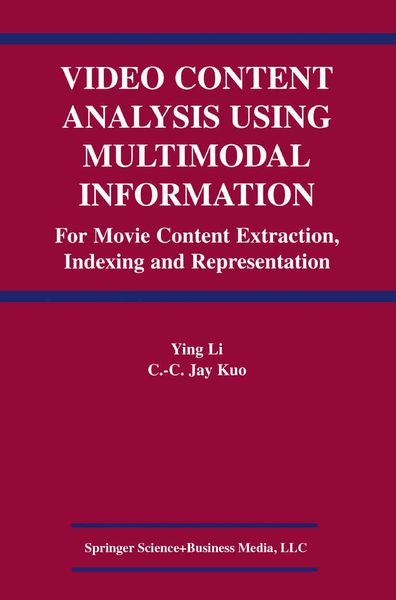
Video Content Analysis Using Multimodal Information For Movie Content Extraction, Indexing and Representation

92,99 €

inkl. gesetzl. MwSt., Versandkostenfrei

Lieferung nach Hause

Beschreibung

Produktdetails

Einband

Taschenbuch

Erscheinungsdatum

07.12.2010

Verlag

Springer Us

Seitenzahl

194

Maße (L/B/H)

23,5/15,5/1,3 cm

Gewicht

700 g

Auflage

Softcover reprint of hardcover 1st ed. 2003

Sprache

Englisch

ISBN

978-1-4419-5365-0

Beschreibung

Produktdetails

Einband

Taschenbuch

Erscheinungsdatum

07.12.2010

Verlag

Springer Us

Seitenzahl

194

Maße (L/B/H)

23,5/15,5/1,3 cm

Gewicht

700 g

Auflage

Softcover reprint of hardcover 1st ed. 2003

Sprache

Englisch

ISBN

978-1-4419-5365-0

Herstelleradresse

Springer-Verlag KG
Sachsenplatz 4-6
1201 Wien
AT

Email: GPSR Kontakt

Noch keine Bewertungen vorhanden

Verfassen Sie die erste Bewertung zu diesem Artikel

Helfen Sie anderen Kundinnen und Kunden durch Ihre Meinung.

Kundinnen und Kunden meinen

Bewertungen (0)

  • Produktbild: Video Content Analysis Using Multimodal Information
  • Produktbild: Video Content Analysis Using Multimodal Information
  • Dedication. List of Figures. List of Tables. Preface. Acknowledgments. 1: Introduction. 1. Audiovisual Content Analysis. 1.1. Audio Content Analysis. 1.2. Visual Content Analysis. 1.3. Audiovisual Content Analysis. 2. Video Indexing, Browsing and Abstraction. 3. MPEG-7 Standard. 4. Roadmap of The Book. 4.1. Video Segmentation. 4.2. Movie Content Analysis. 4.3. Movie Content Abstraction. 2: Background And Previous Work. 1. Visual Content Analysis. 1.1. Video Shot Detection. 1.2. Video Scene and Event Detection. 2. Audio Content Analysis. 2.1. Audio Segmentation and Classification. 2.2. Audio Analysis for Video Indexing. 3. Speaker Identification. 4. Video Abstraction. 4.1. Video Skimming. 4.2. Video Summarization. 5. Video Indexing and Retrieval. 3: Video Content Pre-Processing. 1. Shot Detection in Raw Data Domain. 1.1. YUV Color Space. 1.2. Metrics for Frame Differencing. 1.3. Camera Break Detection. 1.4. Gradual Transition Detection. 1.5. Camera Motion Detection. 1.6. Illumination Change Detection. 1.7. A Review of the Proposed System. 2. Shot Detection in Compressed Domain. 2.1. DC-image and DC-sequence. 3. Audio Feature Analysis. 4. Commercial Break Detection. 4.1. Features of A Commercial Break. 4.2. Feature Extraction. 4.3. The Proposed Detection Scheme. 5. Experimental Results. 5.1. Shot Detection Results. 5.2. Commercial Break Detection Results. 4: Content-Based Movie Scene And Event Extraction. 1. Movie Scene Extraction. 1.1. Sink-based Scene Construction. 1.2. Audiovisual-based Scene Refinement. 1.3. User Interaction. 2. Movie Event Extraction. 2.1. Sink Clustering and Categorization. 2.2. Event Extraction and Classification. 2.3. Integrating Speech and Face Information. 3. Experimental Results. 3.1. Scene Extraction Results. 3.2. Event Extraction Results. 5: Speaker Identification For Movies. 1. Supervised Speaker Identification for Movie Dialogs. 1.1. Feature Selection and Extraction. 1.2. Gaussian Mixture Model. 1.3. Likelihood Calculation and Score Normalization. 1.4. Speech Segment Isolation. 2. Adaptive Speaker Identification. 2.1. Face Detection, Recognition and Mouth Tracking. 2.2. Speech Segmentation and Clustering. 2.3. Initial Speaker Modeling. 2.4. Likelihood-based Speaker Identification. 2.5. Audiovisual Integration for Speaker Identification. 2.6. Unsupervised Speaker Model Adaptation. 3. Experimental Results. 3.1. Supervised Speaker Identification Results. 3.2. Adaptive Speaker Identification Results. 3.3. An Example of Movie Content Annotation. 6: Scene-Based Movie Summarization. 1. An Overview of the Proposed System. 2. Hierarchical Keyframe Extraction. 2.1. Scene Importance Computation. 2.2. Sink Importance Computation. 2.3. Sh