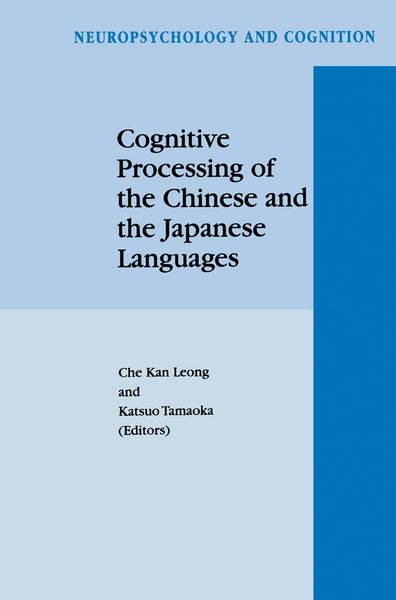
Cognitive Processing of the Chinese and the Japanese Languages
-
- Hardcover
- Taschenbuch ausgewählt
- eBook
-
Sprache:Englisch
138,99 €
UVP
160,49 €
inkl. gesetzl. MwSt.,
Beschreibung
Produktdetails
Einband
Taschenbuch
Erscheinungsdatum
15.12.2010
Abbildungen
VI, 322 p.
Herausgeber
C.K. Leong + weitereVerlag
Springer NetherlandSeitenzahl
322
Maße (L/B/H)
23,5/15,5/1,8 cm
Gewicht
499 g
Auflage
Softcover reprint of hardcover 1st edition 1998
Sprache
Englisch
ISBN
978-90-481-5140-0
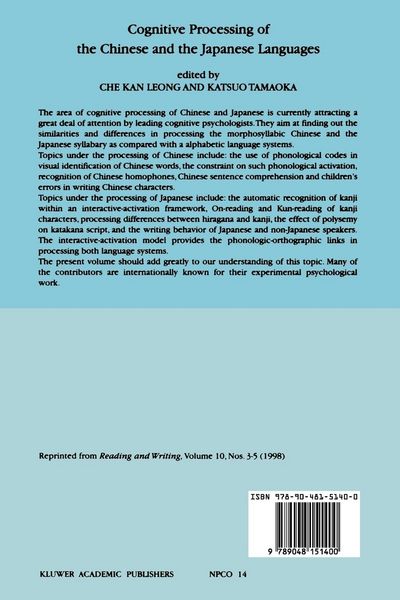
Topics under the processing of Chinese include: the use of phonological codes in visual identification of Chinese words, the constraint on such phonological activation, recognition of Chinese homophones, Chinese sentence comprehension and children's errors in writing Chinese characters.
Topics under the processing of Japanese include: the automatic recognition of kanji within an interactive-activation framework, On-reading and Kun-reading of kanji characters, processing differences between hiragana and kanji, the effect of polysemy on katakana script, and the writing behavior of Japanese and non-Japanese speakers.
The interactive-activation model provides the phonologic-orthographic links in processing both language systems.
The present volume should add greatly to our understanding of this topic. Many of the contributors are internationally known for their experimental psychological work.
Noch keine Bewertungen vorhanden
Verfassen Sie die erste Bewertung zu diesem Artikel
Helfen Sie anderen Kundinnen und Kunden durch Ihre Meinung.
Kurze Frage zu unserer Seite
Vielen Dank für dein Feedback
Wir nutzen dein Feedback, um unsere Produktseiten zu verbessern. Bitte habe Verständnis, dass wir dir keine Rückmeldung geben können. Falls du Kontakt mit uns aufnehmen möchtest, kannst du dich aber gerne an unseren Kund*innenservice wenden.
zum Kundenservice