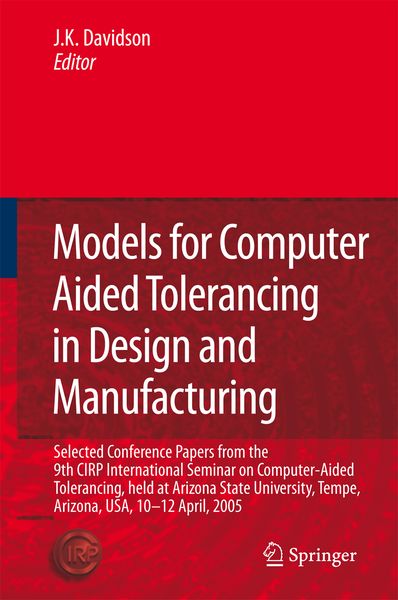
Models for Computer Aided Tolerancing in Design and Manufacturing Selected Conference Papers from the 9th CIRP International Seminar on Computer-Aided Tolerancing, held at Arizona State University, Tempe, Arizona, USA, 10-12 April, 2005
-
- Hardcover
- Taschenbuch ausgewählt
- eBook
-
Sprache:Englisch
139,99 €
UVP
160,49 €
inkl. gesetzl. MwSt.,
Beschreibung
Produktdetails
Einband
Taschenbuch
Erscheinungsdatum
19.10.2010
Abbildungen
XIII, 354 p.
Herausgeber
Joseph K. DavidsonVerlag
Springer NetherlandSeitenzahl
354
Maße (L/B/H)
23,5/15,5/2 cm
Gewicht
557 g
Auflage
1. Auflage
Sprache
Englisch
ISBN
978-90-481-7367-9
Computer Aided Tolerancing (CAT) is an important topic in any field of design and production where parts move relative to one another and/or are assembled together. Geometric variations from specified dimensions and form always occur when parts are manufactured. Improvements in production systems can cause the amounts of the variations to become smaller, but their presence does not disappear. To shorten the time from concept to market of a product, it has been increasingly important to take clearances and the tolerancing of manufacturing variations into consideration right from the beginning, at the stage of design. Hence, geometric models are defined that represent both the complete array of geometric variations possible during manufacture and also the influence of geometry on the function of individual parts and on assemblies of them.
The contents of this book originate from a collection of selected papers presented at the 9th CIRP International Seminar on CAT that was held from April 10-12, 2005 at Arizona State University, USA. The CIRP (Collège International pour la Recherche en Production or International Institution for Production Engineering Research) plans this seminar every two years, and the book is one in a series of Proceedings on CAT. The book is organized into seven parts: Models for Tolerance Representation and Specification, Tolerance Analysis, Tolerance Synthesis, Computational Metrology and Verification, Tolerances in Manufacturing, Applications to Machinery, and Incorporating Elasticity in Tolerance Models.
Noch keine Bewertungen vorhanden
Verfassen Sie die erste Bewertung zu diesem Artikel
Helfen Sie anderen Kundinnen und Kunden durch Ihre Meinung.
Kurze Frage zu unserer Seite
Vielen Dank für dein Feedback
Wir nutzen dein Feedback, um unsere Produktseiten zu verbessern. Bitte habe Verständnis, dass wir dir keine Rückmeldung geben können. Falls du Kontakt mit uns aufnehmen möchtest, kannst du dich aber gerne an unseren Kund*innenservice wenden.
zum Kundenservice