Beschreibung
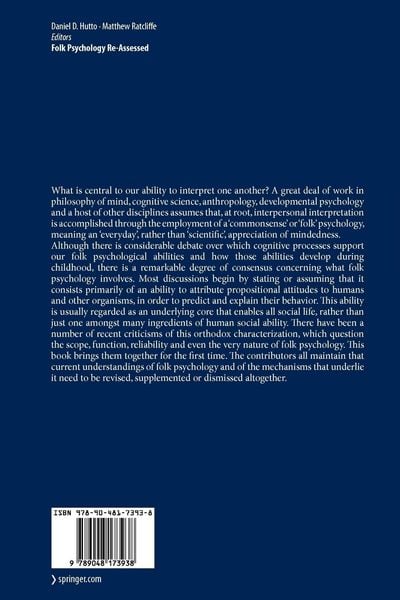
1.1. FOLK PSYCHOLOGY, THEORY OF MIND AND SIMULATION The tasks we face in our day to day social lives are quite heterogeneous but many of them make a common demand upon us. They require us to understand and interact with other people and, in most social encounters, we exhibit a special sensitivity to our fellow human beings that is quite different from the way we respond to inanimate objects and most other species of organism. Social life is dependent, to a considerable degree, on our ability to understand what is distinctive about human behaviour and to successfully apply that understanding in all manner of situations. What is central to our ability to interpret one another? A great deal of work in philosophy of mind, cognitive science, anthropology, developmental psychology and a host of other disciplines assumes that, at root, interpersonal interpretation is accomplished through the employment of a ‘commonsense’ or ‘folk’ psychology, meaning an ‘everyday’, rather than ‘scientific’, appreciation of mindedness. Although there is considerable debate over which cognitive processes support our folk psychological abilities and how those abilities develop during childhood, there is a remarkable degree of consensus concerning what folk psychology consists of. Almost all discussions of the topic begin by stating or presupposing that it is the ability to attribute intentional states, principally beliefs and desires, to other people and perhaps also to oneself, in order to predict and explain behaviour.
Rezension
From the reviews:
"Traditionally folk psychology is understood as our ability to predict and explain the behavior of other people by attributing intentional states (beliefs, desires, etc.) to them. Debates about the status of folk psychology have been going on for decades. … Folk Psychology Re-Assessed contributes some interesting angles to the mainstream folk-psychology debate. … the volume will appeal to work in philosophy of mind, neuroscience and experimental psychology … . I think the volume is probably most useful … in advanced undergraduate or graduate courses." (Christina Behme, Metapsychology Online Reviews, Vol. 12 (11), 2008)
Portrait
Matthew Ratcliffe is Reader in Philosophy at Durham University in England. Most of his recent work addresses issues in phenomenology, philosophy of psychology and philosophy of psychiatry. He is author of
Rethinking Commonsense Psychology: A Critique of Folk Psychology, Theory of Mind and Simulation
(Palgrave, 2007) and Feelings of Being: Phenomenology, Psychiatry and the Sense of Reality (Oxford University Press, 2008).