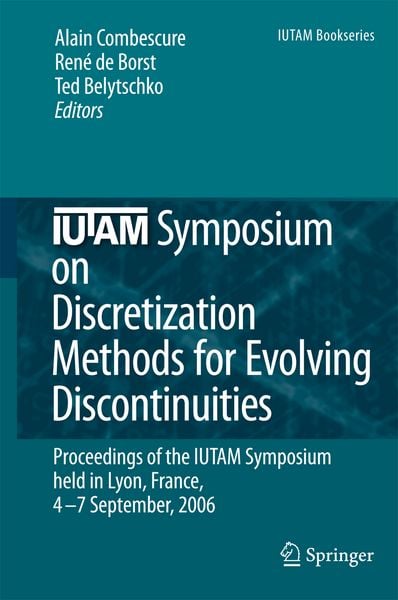
IUTAM Symposium on Discretization Methods for Evolving Discontinuities Proceedings of the IUTAM Symposium held Lyon, France, 4 – 7 September, 2006
-
- Hardcover
- Taschenbuch ausgewählt
- eBook
-
Sprache:Englisch
92,99 €
UVP
106,99 €
inkl. gesetzl. MwSt.,
Beschreibung
Produktdetails
Einband
Taschenbuch
Erscheinungsdatum
29.01.2011
Abbildungen
IX, 436 p.
Herausgeber
Alain Combescure + weitereVerlag
Springer NetherlandSeitenzahl
436
Maße (L/B/H)
24/16/2,5 cm
Gewicht
711 g
Auflage
1. Auflage
Sprache
Englisch
ISBN
978-90-481-7659-5
Meshless Finite Element Methods.- Meshless discretisation of nonlocal damage theories.- Three-dimensional non-linear fracture mechanics by enriched meshfree methods without asymptotic enrichment.- Accounting for weak discontinuities and moving boundaries in the context of the Natural Element Method and model reduction techniques.- Discontinuous Galerkin Methods.- Modeling Evolving Discontinuities with Spacetime Discontinuous Galerkin Methods.- Analysis of a finite element formulation for modelling phase separation.- Finite Element Methods with Embedded Discontinuities.- Recent Developments in the Formulation of Finite Elements with Embedded Strong Discontinuities.- Evolving Material Discontinuities: Numerical Modeling by the Continuum Strong Discontinuity Approach (CSDA).- A 3D Cohesive Investigation on Branching for Brittle Materials.- Partition-of-Unity Based Finite Element Methods.- On Applications of XFEM to Dynamic Fracture and Dislocations.- Some improvements of Xfem for cracked domains.- 2D X-FEM Simulation of Dynamic Brittle Crack Propagation.- A numerical framework to model 3-D fracture in bone tissue with application to failure of the proximal femur.- Application of X-FEM to 3D Real Cracks and Elastic-Plastic Fatigue Crack Growth.- Accurate Simulation of Frictionless and Frictional Cohesive Crack Growth in Quasi-Brittle Materials Using XFEM.- On the Application of Hansbo's Method for Interface Problems.- An optimal explicit time stepping scheme for cracks modeled with X-FEM.- Variational Extended Finite Element Model for Cohesive Cracks: Influence of Integration and Interface Law.- An Evaluation of the Accuracy of Discontinuous Finite Elements in Explicit Dynamic Calculations.- A discrete model for the propagation of discontinuities in a fluid-saturatedmedium.- Single Domain Quadrature Techniques for Discontinuous and Non-Linear Enrichments in Local Partion of Unity FEM.- Other Discretization Methods.- Numerical determination of crack stress and deformation fields in gradient elastic solids.- The variational formulation of brittle fracture: numerical implementation and extensions.- Measurement and Identification Techniques for Evolving Discontinuities.- Conservation under Incompatibility for Fluid-Solid-Interaction Problems: the NPCL Method.
Noch keine Bewertungen vorhanden
Verfassen Sie die erste Bewertung zu diesem Artikel
Helfen Sie anderen Kundinnen und Kunden durch Ihre Meinung.
Kurze Frage zu unserer Seite
Vielen Dank für dein Feedback
Wir nutzen dein Feedback, um unsere Produktseiten zu verbessern. Bitte habe Verständnis, dass wir dir keine Rückmeldung geben können. Falls du Kontakt mit uns aufnehmen möchtest, kannst du dich aber gerne an unseren Kund*innenservice wenden.
zum Kundenservice