
KI-Beratung Beta

  • Produktbild: Collective Decision-Making:
  • Produktbild: Collective Decision-Making:
Band 50 - 13%

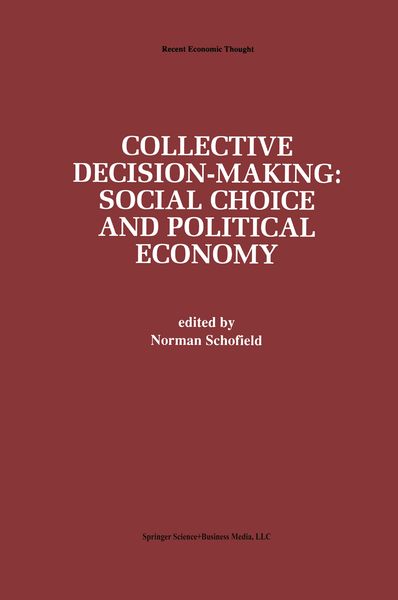
Collective Decision-Making: Social Choice and Political Economy

Aus der Reihe Recent Economic Thought
13% sparen

185,99 € UVP 213,99 €

inkl. gesetzl. MwSt., Versandkostenfrei


Beschreibung

In the last decade the techniques of social choice theory, game theory and positive political theory have been combined in interesting ways so as to pro vide a common framework for analyzing the behavior of a developed political economy. Social choice theory itself grew out of the innovative attempts...

Beschreibung

In the last decade the techniques of social choice theory, game theory and positive political theory have been combined in interesting ways so as to pro vide a common framework for analyzing the behavior of a developed political economy. Social choice theory itself grew out of the innovative attempts by Ken neth Arrow (1951) and Duncan Black (1948, 1958) to extend the range of economic theory in order to deal with collective decision-making over public goods. Later work, by William Baumol (1952), and James Buchanan and Gordon Tullock (1962), focussed on providing an "economic" interpretation of democratic institutions. In the same period Anthony Downs (1957) sought to model representative democracy and elections while William Riker (1962) made use of work in cooperative game theory (by John von Neumann and Oscar Morgenstern, 1944) to study coalition behavior. In my view, these "rational choice" analyses of collective decision-making have their antecedents in the arguments of Adam Smith (1759, 1776), James Madison (1787) and the Marquis de Condorcet (1785) about the "design" of political institutions. In the introductory chapter to this volume I briefly describe how some of the current normative and positive aspects of social choice date back to these earlier writers.

Rezension

`
The editor has selected carefully an excellent array of articles and organized them most effectively in a logical and coherent presentation of critical issues with social choice and political economy within the context of collective decision making. This is an excellent edited volume for readers familiar with the general theories, theorems, and voting methods presented, and for those interested in updating their understanding of the more recent literature on these topics.
'
Review of Radical Political Economics, December 1998

Produktdetails

Einband

Taschenbuch

Erscheinungsdatum

07.12.2010

Abbildungen

XXI, 422 p.

Herausgeber Norman Schofield

Produktdetails

Einband

Taschenbuch

Erscheinungsdatum

07.12.2010

Abbildungen

XXI, 422 p.

Herausgeber Norman Schofield
Verlag Springer Netherland
Seitenzahl

422

Maße (L/B/H)

23,5/15,5/2,4 cm

Gewicht

668 g

Auflage

Softcover reprint of hardcover 1st edition 1996

Sprache

Englisch

ISBN

978-90-481-5800-3

Herstelleradresse

Springer-Verlag KG
Sachsenplatz 4-6
1201 Wien
AT

Email: ProductSafety@springernature.com

Noch keine Bewertungen vorhanden

Verfassen Sie die erste Bewertung zu diesem Artikel

Helfen Sie anderen Kundinnen und Kunden durch Ihre Meinung.

Kundinnen und Kunden meinen

Bewertungen (0)

  • Produktbild: Collective Decision-Making:
  • Produktbild: Collective Decision-Making:
  • 1 Introduction: Research Programs in Preference and Belief Aggregation.- I. Social Choice.- 2 An Introduction to Arrovian Social Welfare Functions on Economic and Political Domains.- 3 Social Ranking of Allocations with and without Coalition Formation.- 4 Non Binary Social Choice: A Brief Introduction.- 5 Election Relations and a Partial Ordering for Positional Voting.- II. Elections and Committees.- 6 Electing Legislatures.- 7 Preference-Based Stability: Experiments on Cooperative Solutions to Majority Rule Games.- 8 The Heart of a Polity.- 9 Refinements of the Heart.- III. Coalition Governments.- 10 Bargaining in the Liberal Democratic Party of Japan.- 11 An Analysis of the Euskarian Parliament.- 12 Extending a Dynamic Model of Protocoalition Formation.- 13 The Sequential Dynamics of Cabinet Formation, Stochastic Error, and a Test of Competing Models.- 14 Subgame-Perfect Portfolio Allocations in Parliamentary Government Formation.- 15 The Costs of Coalition: The Italian Anomaly.- IV. Political Economy.- 16 Models of Interest Groups: Four Different Approaches.- 17 Partisan Electoral Cycles and Monetary Policy Games.- 18 Hypothesis Testing and Collective Decision-Making.- 19 Political Discourse, Factions, and the General Will: Correlated Voting and Condorcet’s Jury Theorem.- Name Index.