
KI-Beratung Beta

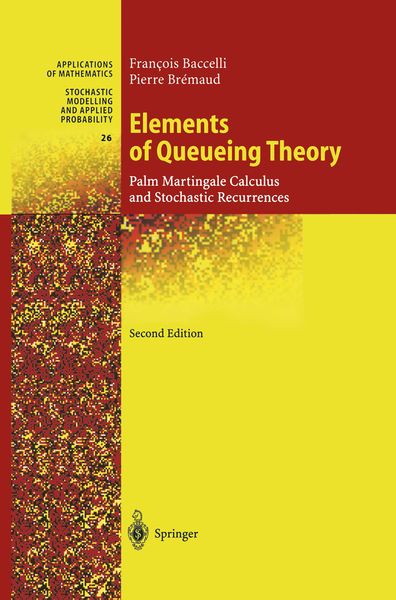
  • Produktbild: Elements of Queueing Theory
  • Produktbild: Elements of Queueing Theory
Band 26 - 10%

Elements of Queueing Theory Palm Martingale Calculus and Stochastic Recurrences

10% sparen

95,99 € UVP 106,99 €

inkl. gesetzl. MwSt., Versandkostenfrei


Beschreibung

Queueing theory is a fascinating subject in Applied Probability for two con tradictory reasons: it sometimes requires the most sophisticated tools of stochastic processes, and it often leads to simple and explicit answers. More over its interest has been steadily growing since the pioneering work of...

Beschreibung

Queueing theory is a fascinating subject in Applied Probability for two con tradictory reasons: it sometimes requires the most sophisticated tools of stochastic processes, and it often leads to simple and explicit answers. More over its interest has been steadily growing since the pioneering work of Erlang in 1917 on the blocking of telephone calls, to the more recent applications on the design of broadband communication networks and on the performance evaluation of computer architectures. All this led to a huge literature, articles and books, at various levels of mathematical rigor. Concerning the mathematical approach, most of the explicit results have been obtained when specific assumptions (Markov, re newal) are made. The aim of the present book is in no way to give a systematic account of the formulas of queueing theory and their applications, but rather to give a general framework in which these results are best understood and most easily derived. What knowledge of this vast literature is needed to read the book? As the title of the book suggests, we believe that it can be read without prior knowledge of queueing theory at all, although the unifying nature of the proposed framework will of course be more meaningful to readers who already studied the classical Markovian approach.

Rezension

From the reviews:


No doubt this textbook will further convince the queueing modeller of the essential importance of point processes and martingale technology.


Paul Embrechts.
Short Book Reviews
, December 2003


"This book is intended for graduate students and researchers in queuing theory and applied probability. … Overall this is a well-written text that provides an interesting alternative to more classical approaches. … The results on stability and other qualitative properties of queues provided by this framework are very general and show the power of this modern approach." (Charles Knessl, SIAM Reviews, Vol. 47 (4), 2005)


"The mathematical treatment in the book is careful and thorough enough that it can be understood by anyone with a reasonable preparation in measure-theoretic probability. … A particularly useful feature … is the addition of exercises and problems … . The strength of this book is the careful and rigorous treatment of the framework and of the mathematical tools that unify and derive classical results and formulae for a number of queuing networks. It can definitely be used as a text at an advanced level." (S. Ramakrishnan, Sankhya, Vol. 66 (2), 2004)


"No doubt this textbook will further convince the queuing modeller of the essential importance of point process and martingale technology. Besides providing an elegant and broad theoretical foundation, the general results obtained allow for straightforward explicit calculations … . The theory presented is non-trivial … those who master it will be in the possession of a powerful tool with considerable potential for applied work. … I take pleasure in recommending this text very highly." (P.A.L. Embrechts, Short Book Reviews, Vol. 23 (3), 2003)


"I am convinced that this second edition will be welcomed in the same way by those who need a source for (comparable) easy access to point process methodology. It is well written, a clearpresentation of the topics … . I find its first edition useful as a reference and a source for new material. And in my view the second edition is clearly an enhanced revision of it. … the book will be welcomed by everyone interested in the field." (Hans Daduna, Statistical Papers, Vol. 44 (3), 2003)

Produktdetails

Einband

Taschenbuch

Erscheinungsdatum

08.12.2010

Abbildungen

XIV, 334 p.

Verlag Springer Berlin

Produktdetails

Einband

Taschenbuch

Erscheinungsdatum

08.12.2010

Abbildungen

XIV, 334 p.

Verlag Springer Berlin
Seitenzahl

334

Maße (L/B/H)

23,4/15,6/2 cm

Gewicht

535 g

Auflage

Second Edition 2003

Sprache

Englisch

ISBN

978-3-642-08537-6

Herstelleradresse

Springer-Verlag KG
Sachsenplatz 4-6
1201 Wien
AT

Email: ProductSafety@springernature.com

Noch keine Bewertungen vorhanden

Verfassen Sie die erste Bewertung zu diesem Artikel

Helfen Sie anderen Kundinnen und Kunden durch Ihre Meinung.

Kundinnen und Kunden meinen

Bewertungen (0)

  • Produktbild: Elements of Queueing Theory
  • Produktbild: Elements of Queueing Theory
  • The Palm Calculus of Point Processes.- Stationarity and Coupling.- Formulas.- Stochastic Ordering of Queues.